
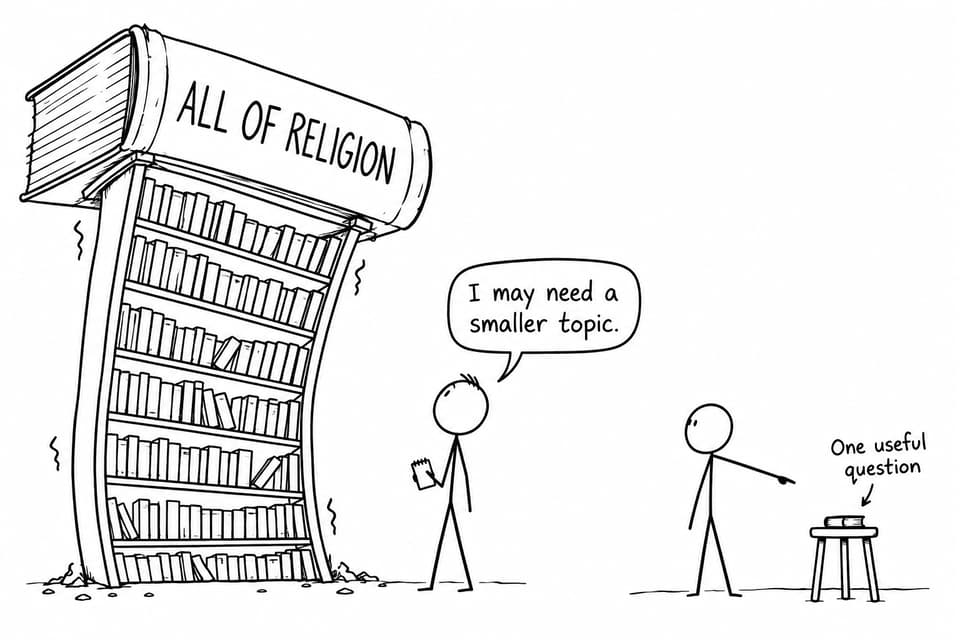
Choosing an issue for a World Religions investigative study is difficult for a simple reason: the most interesting religious dilemmas are usually enormous. Climate justice, gender, technology, migration, medical ethics, and identity can each fill a library. Your IB IA cannot.
A strong contemporary religious issues IA therefore examines how a particular group or individual experiences one carefully defined issue. It connects belief with lived religion, uses manageable evidence, and leaves room for critical reflection. The best question is not the most dramatic one. It is the one you can investigate responsibly within 1,500-1,800 words.
This guide offers viable ideas and a step-by-step plan tied to the five criteria: A (8 marks), B (3), C (6), D (10), and E (3). You can also consult RevisionDojo's complete IB World Religions IA criteria guide as you plan.
A quick topic checklist
Before committing to an issue, ask:
- Does the question concern religious experience, practice, or belief?
- Is it connected to a contemporary issue or dilemma?
- Have I identified a specific community, location, or group of adherents?
- Can I collect meaningful evidence ethically and safely?
- Does the question invite interpretation rather than a yes-or-no answer?
- Can I complete the investigation within 1,500-1,800 words?
- Will I be able to evaluate conflicting evidence and limitations?
If several answers are uncertain, narrow the topic before beginning fieldwork. RevisionDojo's guide to choosing an investigative focus can help test whether a question is genuinely workable.
Contemporary religious issues IA ideas
Treat these as starting points, not questions to copy unchanged. Each must be adapted to the community you can access and the evidence actually available.
| Contemporary issue | Possible focused question |
|---|---|
| Digital technology | How do adult members of one named Jewish community interpret smartphone use during Shabbat? |
| Climate responsibility | How does a named Buddhist group connect environmental action with teachings about interdependence? |
| Food insecurity | How do volunteers at one gurdwara understand seva through their participation in langar? |
| Medical ethics | How do members of one named religious community interpret their tradition when considering organ donation? |
| Migration and identity | How do first-generation and second-generation Hindu adherents in one community understand the adaptation of a named festival? |
| Modest dress | How do adult Muslim women in one local community explain the relationship between modest dress, faith, and online culture? |
| Gender and leadership | How do members of one congregation interpret religious authority in debates about women's leadership? |
| LGBTQ+ inclusion | How does one congregation negotiate tensions between inherited teachings and the inclusion of LGBTQ+ adherents? |
| Artificial intelligence | How do leaders and adult adherents in one community evaluate the use of AI for religious learning? |
| Interfaith families | How do adults in interfaith households negotiate one named ritual or celebration? |
Some subjects are more sensitive than others. A topic involving sexuality, discrimination, family conflict, illness, or personal identity may produce strong analysis, but only if participants can speak voluntarily without being exposed to harm. Academic ambition never overrides participant welfare.
Step-by-step guidance for the five IA criteria
The marks are unevenly distributed. Criterion D alone is worth one-third of the available 30 marks, while Criterion B is worth 3. Your writing plan should reflect that balance.
Criterion A: Rationale and preliminary research, 8 marks
Begin by explaining why this particular investigation matters. Personal interest may motivate you, but it is not enough as an academic rationale. Establish the religious issue, introduce the community, and show what preliminary research revealed.
Use a purposeful range of evidence. This might include academic scholarship, relevant sacred or authoritative material, official community statements, and reputable contextual sources. Explain how those sources shaped or complicated your question rather than presenting a list of reading.
A practical process is:
- Read broadly enough to identify a genuine tension or interpretive question.
- Define the central religious concept, such as seva, authority, modesty, stewardship, or interdependence.
- Identify the group or individuals whose lived experience you will investigate.
- Convert the topic into one focused question.
- Justify why your selected sources are relevant and sufficiently varied.
For example, a weak rationale says that climate change is important. A stronger one explains that scholarship presents Buddhist environmental engagement in different ways, then asks how one local sangha connects a specific teaching with its environmental activity.
Allow roughly 250-300 words for this section. For closer support, use RevisionDojo's guidance on meeting Criteria A-D.
Criterion B: Plan for study, 3 marks
Your plan should be concise, focused, and clearly matched to the research question. State what evidence you intend to gather, from whom, where relevant, and why the method is suitable.
A plan might combine two semi-structured interviews with observation of a public community activity and analysis of community materials. Explain the order of these steps and the purpose of each. Do not claim that one or two interviewees represent an entire global tradition.
Aim for approximately 100-150 words. Precision matters more than length. A realistic World Religions IA timeline can help you schedule permissions, research, fieldwork, analysis, and drafting.
Criterion C: Summary of significant findings, 6 marks
This section reports what the investigation meaningfully revealed. Organize findings by theme, not as a diary of everything you did.
Suppose two participants describe modest dress differently. One emphasizes obedience, while another emphasizes identity and personal agency. Your findings should identify that difference, support it with appropriately attributed evidence, and connect it to the preliminary research. You should not flatten both accounts into one supposedly universal religious position.
Select only evidence that helps answer the question. Distinguish participant testimony, observation, textual teaching, and your own interpretation. Approximately 300-350 words can provide enough space for two or three developed findings without consuming the reflection section.
Criterion D: Critical reflection and evaluation, 10 marks
This is the intellectual center of the IB IA. Description tells the reader what participants said. Critical reflection asks what the evidence means, why accounts differed, what assumptions changed, and how the methods affected the knowledge produced.
Work through four layers:
- Interpret the evidence. Explain how findings illuminate religious belief, practice, or experience.
- Examine complexity. Address contradictions between scholarship, authoritative teachings, community positions, and individual testimony.
- Evaluate the investigation. Consider access, sample size, question wording, researcher assumptions, and the limits of observation.
- Reach a qualified conclusion. Answer the question without claiming more than your evidence supports, then identify realistic further research.
Imagine that interviewees describe a community food project as seva, but volunteers also mention friendship and social belonging. A sophisticated reflection would not force these motives into opposition. It might consider how religious duty and ordinary human relationships reinforce one another in lived practice.
Likewise, if participants gave similar answers, do not automatically call the findings representative. They may share an age group, social network, or leadership role. Similarity itself requires interpretation.
Reserve approximately 650-750 words for Criterion D. RevisionDojo's critical reflection and evaluation guide helps distinguish genuine analysis from a concluding summary.
Criterion E: References and format, 3 marks
Presentation is small in marks but easy to protect. Use the required headings, remain within 1,500-1,800 words, cite sources consistently, and provide a complete bibliography. Do not hide essential analysis in appendices or assume that a bibliography compensates for missing in-text attribution.
The exact distribution of words is not prescribed by the mark scheme, so treat the suggested allocations here as planning guidance. Confirm submission conventions and what counts toward the limit with your teacher. RevisionDojo's five-heading format and word-count guide provides a final structural check.
Ethics for interviews, observations, and fieldwork
Fieldwork gives the investigation immediacy, but access to a community is a privilege rather than raw material to collect.
Explain the project honestly and obtain informed consent before interviewing or recording anyone. Participants should know how their words will be used and that they may decline a question or withdraw. Seek additional guidance from your school before involving minors or vulnerable participants. Protect identities when identification could create discomfort, conflict, or risk.
Ask permission before entering restricted spaces, photographing rituals, or quoting private communication. Store notes and recordings securely. Avoid intrusive questions, deceptive methods, and pressure to disclose traumatic experiences. Finally, write with humility: one participant offers a situated perspective, not the voice of an entire religion.
Turning an idea into a strong final study
A useful drafting target is around 1,600-1,700 words. That leaves room to refine your argument without drifting beyond 1,800. Draft Criterion D early enough to discover whether your findings actually support reflection; do not leave it as an afterthought.
RevisionDojo brings the process together. Explore annotated work in the World Religions Coursework Library, then use the World Religions IA rubric grader for criterion-based review. Study Notes, Flashcards, AI Chat, and Tutors can strengthen subject understanding, while the Questionbank, Predicted Papers, Mock Exams, and Grading tools support the wider course.
The central lesson is restraint. A large dilemma can feel impressive, but a small, well-observed question usually reveals more. Focus the issue, respect the people behind the evidence, and let careful reflection carry the study.