


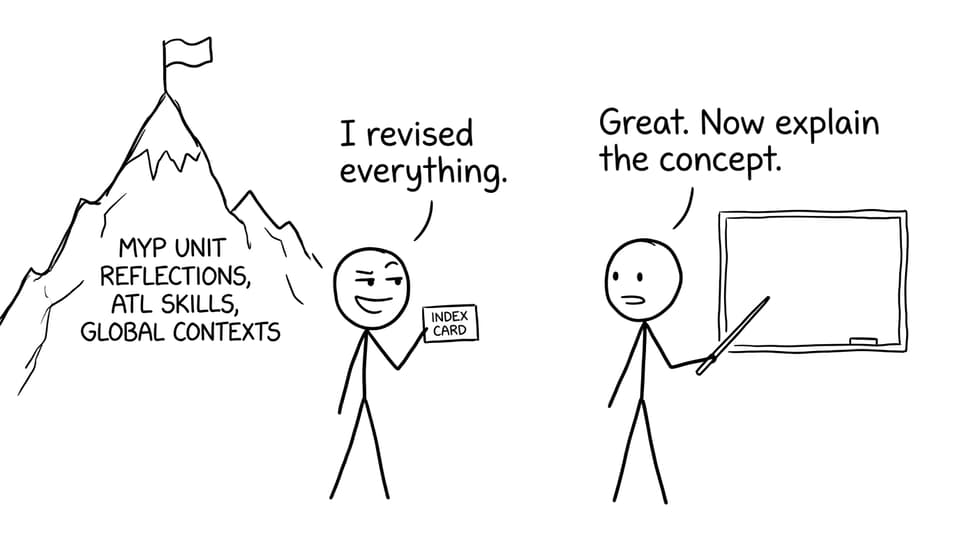
When you revise for exams, you can feel the difference between knowing something and understanding it.
Knowing is what happens when you can repeat a definition. Understanding is what happens when a question changes the context and you can still solve it.
That gap is where the MYP lives.
National curriculums can be excellent at building coverage and clear benchmarks. The MYP is designed to build transfer: taking ideas, skills, and feedback and carrying them into unfamiliar situations. If you're an IB student preparing for exams (or about to move into the DP), comparing the MYP to national curriculums isn't just an education debate. It's a practical way to figure out how you should study.
Quick comparison checklist (save this before you revise)
Use this as your fast lens when you think about MYP vs national curriculums:
-
Are you being trained for coverage (finish the syllabus) or transfer (apply ideas in new contexts)?
-
Do grades mainly reward final answers, or the quality of thinking and communication?
-
Are skills like reflection, organization, and collaboration taught explicitly?
-
Are assessments norm-referenced (compared to other students) or criterion-referenced (compared to descriptors)?
-
Do units connect to global issues and real-world problems, or stay mostly inside the subject?
If you want the full framework view, start at the Middle Years Program (MYP) hub and then drill into your subject pages.
The real difference: what the curriculum believes learning is
A national curriculum usually starts with a question like: What content should a student at this age know? That tends to create a clear sequence, standardized outcomes, and familiar grading.
The MYP starts with a different question: What kind of thinker should a student become? It still teaches subject knowledge, but it keeps pointing your attention to concepts, inquiry, and reflection.
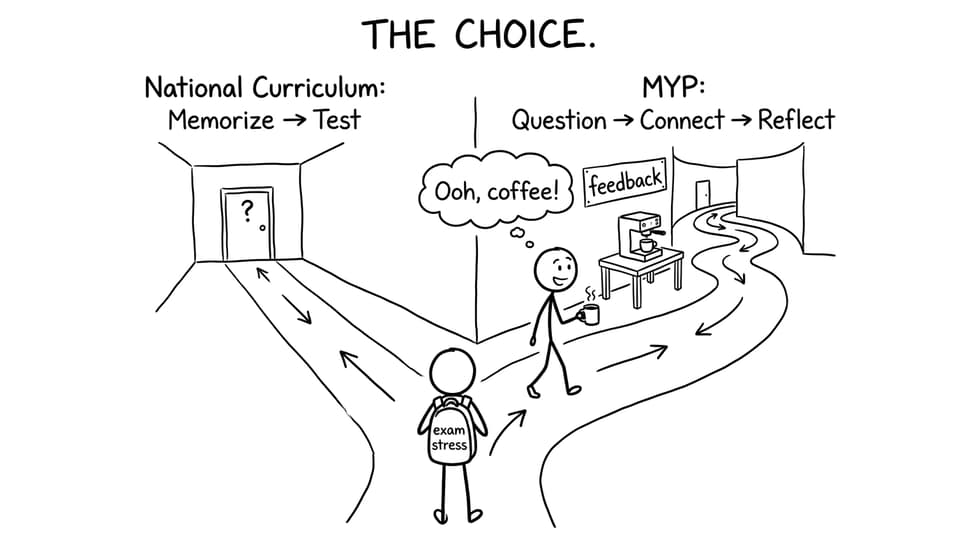
That philosophical difference matters in exam season. In a national system, students often revise by re-reading and repeating. In the MYP, the highest marks tend to show up when your revision includes practice, feedback, and re-drafting your thinking.
A good entry point for how that plays out day-to-day is the MYP Revision Guide: Study Tips for Success.
MYP vs national curriculums in the classroom
Structure: framework vs prescription
The MYP is a framework. Schools build units using key concepts and global contexts, then map the content to local requirements. That flexibility is why the MYP can fit into so many countries.
Many national curriculums are more prescriptive: content lists, progression standards, and fixed assessment expectations. That structure can be comforting, especially when you're used to knowing exactly what will be tested.
For you as a student, here's the exam takeaway:
-
In the MYP, you should revise by concept and skill, not just by chapter.
-
In a national curriculum, you can sometimes get away with revising by topic list alone.
If you're studying MYP subjects on RevisionDojo, you can see that concept-and-skill organization in the subject hubs, like MYP Biology Resources or MYP Standard Mathematics Resources.
Approach to learning: inquiry and ATL vs linear mastery
National curriculums often teach skills implicitly: you learn organization by being marked down when your work is messy.
The MYP makes learning skills explicit through Approaches to Learning (ATL): research, communication, self-management, collaboration, and thinking skills. This matters more than it seems, because exams punish disorganized thinking even when your knowledge is solid.
To train that, you need more than notes. You need loops: attempt, get feedback, fix, repeat. RevisionDojo is built around that loop with Study Notes, Flashcards, AI Chat, and the Questionbank.
If you want to see the full practice ecosystem, start with Questionbank and build short daily sets.
The assessment gap: criteria vs percentages
How MYP grading actually works
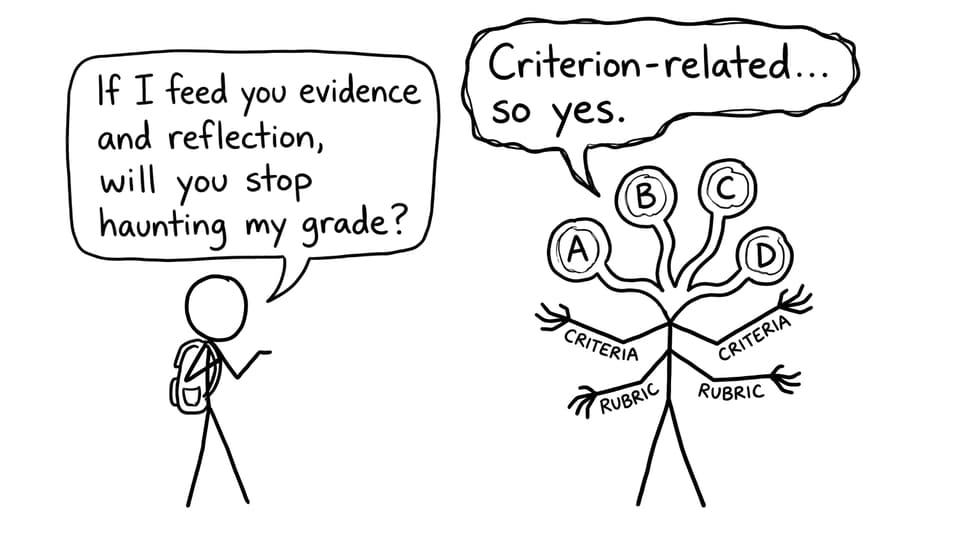
The MYP uses criterion-related assessment. In most subjects, you’re assessed against four criteria (A-D), each typically scored 0-8. Those totals then convert into a 1-7 grade boundary.
National curriculums more often use percentages, letter grades, or rank-based systems. The hidden effect is psychological: students chase points rather than clarity.
In the MYP, the rubric is the map. Once you understand what each criterion rewards, you can aim your revision at it.
Read these alongside your subject tasks:
And if you want a subject-specific example of criteria thinking, this breakdown is especially useful:
Why criteria-based thinking helps with exams
Here’s the quiet advantage of the MYP: criteria language forces you to describe what good performance looks like.
Instead of saying “I need to study harder,” you can say:
-
“I lose marks because I don’t justify my method.”
-
“My evaluation is descriptive, not analytical.”
-
“My organization makes the examiner work.”
That precision is a revision superpower. It turns stress into a plan.
For more task-focused practice across subjects, use Sample MYP Assessment Tasks for Every Subject Group.
Global contexts and interdisciplinary learning (why it feels different)
National curriculums can absolutely include citizenship, ethics, and real-world applications. The MYP just builds that connection into the design of every unit through global contexts.
It can feel annoying when you're tired: “Why do we have to connect this to a real issue?” But that habit trains you for the kind of exam question that changes the surface story while testing the same underlying concept.
The MYP also expects interdisciplinary learning: combining methods and perspectives across subjects. National curriculums often keep subjects in separate lanes, which can make school feel simpler but can limit transfer.
If you’re heading toward DP, think of this as early training for doing more than one thing at once: explain + evaluate, interpret + justify, calculate + communicate.
How to use MYP strengths even if you’re in a national curriculum
You don’t need to be in an MYP school to study like an MYP student. Try this three-step routine:
-
Concept first (10 minutes): use Study Notes to write a one-sentence “big idea” per topic.
-
Application next (25 minutes): do a targeted set in the Questionbank.
-
Reflection last (10 minutes): write one improvement rule (what you will do next time).
If you want a structured schedule, this is the most direct plan:
And if you’re balancing big assessments alongside revision, the MYP Personal Project resources can help you keep your process evidence-based and rubric-aligned:
RevisionDojo supports this whole workflow in one place: Study Notes for clarity, Flashcards for recall, AI Chat for explanations and mini-quizzes, Grading tools for rubric feedback, Mock Exams for timed pressure, Predicted Papers for realistic rehearsal, a Coursework Library for models, and Tutors when you need a human plan.
Conclusion: use MYP thinking to revise smarter
Comparing the MYP to national curriculums isn’t about deciding which is “better.” It’s about noticing what each one trains.
National curriculums often train coverage and consistency. The MYP trains transfer and reflection. If you’re preparing for exams, you want both: solid knowledge and the ability to use it under pressure.
Start from the Middle Years Program (MYP) hub, pick one subject, and run the RevisionDojo loop: Study Notes to get clear, Questionbank to apply, Flashcards to retain, AI Chat when you’re stuck, then timed practice with Mock Exams and Predicted Papers. That’s how MYP students build calm confidence: not by hoping the exam is kind, but by becoming harder to surprise.