

The cellular respiration equation summarizes how cells use glucose and oxygen to produce carbon dioxide, water, and energy transferred to ATP: C₆H₁₂O₆ + 6O₂ → 6CO₂ + 6H₂O + energy. For IB Biology, you should understand the balanced formula, what each substance does, and why the equation represents many enzyme-controlled reactions rather than one event.
The cellular respiration equation in words and symbols
The word equation for aerobic cellular respiration is:
glucose + oxygen → carbon dioxide + water + energy transferred to ATP
The balanced chemical equation is:
C₆H₁₂O₆ + 6O₂ → 6CO₂ + 6H₂O + energy
The coefficients matter. One glucose molecule contains six carbon atoms, so complete oxidation produces six carbon dioxide molecules. Twelve hydrogen atoms become six water molecules. The six oxygen molecules help balance the oxygen atoms across both sides.
A useful exam-ready definition is: cell respiration is a system of reactions that produces ATP using energy released from carbon compounds. This wording is more precise than saying cells simply “make energy.” Energy is transferred and transformed; it is not created.
Start your revision with the C1.2 Cell Respiration study hub, where the equation connects to syllabus-aligned notes, lessons, flashcards, and questions.
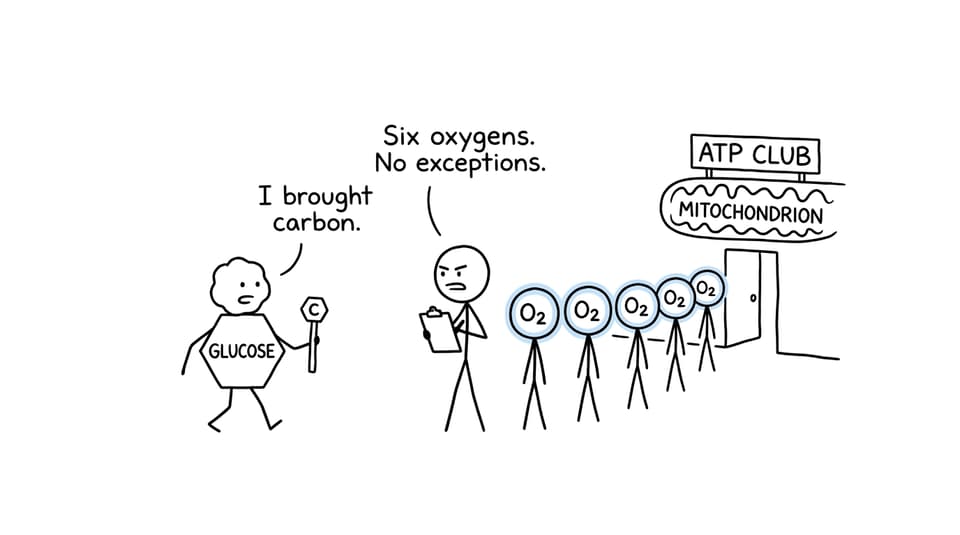
What each part of the equation means
The equation is short because it shows the net change, not every intermediate reaction.
| Substance | Biological meaning |
|---|---|
| Glucose | A carbon compound whose oxidation releases usable chemical energy |
| Oxygen | The terminal electron acceptor in aerobic respiration |
| Carbon dioxide | A product released during decarboxylation reactions |
| Water | Formed when oxygen accepts electrons and protons at the end of the electron transport chain |
| ATP | The molecule that distributes usable energy within cells |
Glucose is often used in the summary because it is an important respiratory substrate. However, cells can also obtain energy from other carbon compounds, including fatty acids. The equation is therefore a model of complete aerobic glucose oxidation, not a claim that glucose is the only possible fuel.
ATP is frequently written beside the products, but it is better understood as an outcome of energy transfer. The energy released through oxidation is used to phosphorylate ADP, forming ATP. For deeper revision, compare the overview with RevisionDojo’s cell respiration study notes.
How one equation hides an entire pathway
A balanced line can create the illusion that glucose meets oxygen in one reaction. In reality, respiration proceeds through controlled stages:
- Glycolysis occurs in the cytosol, converting one glucose into two pyruvate molecules. It produces a net gain of two ATP and reduces NAD.
- The link reaction converts pyruvate into acetyl-CoA, releasing carbon dioxide and reducing NAD.
- The Krebs cycle oxidizes acetyl groups, releasing more carbon dioxide and producing reduced electron carriers.
- Oxidative phosphorylation uses electrons from reduced carriers to establish a proton gradient. Protons then pass through ATP synthase, driving ATP production.
Oxygen appears at the beginning of the overall equation, but it acts at the end of the electron transport chain. It accepts electrons and protons, forming water. Without a final electron acceptor, aerobic oxidative phosphorylation cannot continue normally.
This distinction is especially important at Higher Level. The equation tells you the inputs and outputs; it does not explain chemiosmosis, redox reactions, or substrate-level phosphorylation. Review these relationships through the IB Biology respiration exam guide.
Aerobic and anaerobic equations are not interchangeable
The cellular respiration equation above describes aerobic respiration. Anaerobic pathways do not use oxygen and do not completely oxidize glucose.
In humans, the simplified anaerobic equation is:
glucose → lactate + a small yield of ATP
In yeast, the simplified equation is:
glucose → ethanol + carbon dioxide + a small yield of ATP
Both pathways allow glycolysis to continue by regenerating oxidized NAD, but their ATP yield is much lower than aerobic respiration because glucose is only partially broken down. RevisionDojo’s guide to the differences between aerobic and anaerobic respiration is useful when a question asks you to compare oxygen requirement, location, products, or ATP yield.
How the equation appears in IB Biology exams
Knowing the formula is the starting point. Exam questions may ask you to:
- state or complete the balanced equation;
- identify oxidation and reduction;
- explain the role of oxygen;
- distinguish aerobic from anaerobic respiration;
- calculate reactant use or product formation from a ratio;
- interpret oxygen-consumption or carbon-dioxide-production data;
- connect mitochondrial structure to ATP production.
Worked ratio example
Suppose a question states that 0.25 mol of glucose is completely oxidized and asks for the oxygen required.
From the balanced equation:
1 mol glucose : 6 mol oxygen
Therefore:
0.25 × 6 = 1.50 mol oxygen
The same ratio shows that 0.25 mol of glucose produces 1.50 mol of carbon dioxide under complete aerobic oxidation. Always take the coefficients from the balanced equation before calculating.
After learning the logic, use the C1.2 Cell Respiration Questionbank to practise applying it. The broader IB Biology Questionbank can then test how respiration connects with enzymes, membranes, and photosynthesis.
Common mistakes that lose marks
Saying respiration creates energy
Cells transfer energy from carbon compounds into ATP and release some as heat. Write releases energy or transfers energy, not “creates energy.”
Forgetting the coefficients
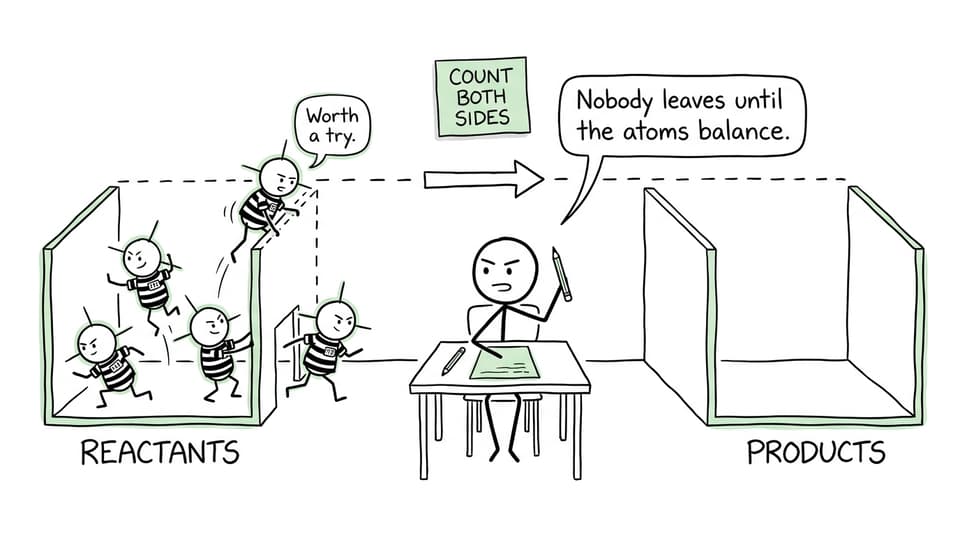
Writing the correct substances without the sixes produces an unbalanced equation. Count carbon, hydrogen, and oxygen atoms on both sides.
Treating breathing and cellular respiration as synonyms
Breathing exchanges gases between an organism and its environment. Cellular respiration consists of biochemical reactions within cells. The processes are connected, but they are not identical.
Saying oxygen is used directly in glycolysis
Glycolysis does not require oxygen directly. In aerobic respiration, oxygen acts as the terminal electron acceptor in the electron transport chain.
Calling respiration the reverse of photosynthesis
Their overall equations appear complementary, but each process has distinct enzymes, stages, organelles, and energy transformations. Use the photosynthesis and cellular respiration comparison to revise the relationship without oversimplifying it.
Quick-reference checklist
Before an exam, make sure you can:
- write C₆H₁₂O₆ + 6O₂ → 6CO₂ + 6H₂O + energy;
- explain that the equation represents complete aerobic glucose oxidation;
- define cell respiration in terms of ATP production and carbon compounds;
- identify oxygen as the terminal electron acceptor;
- distinguish the overall equation from its component pathways;
- compare aerobic respiration with anaerobic pathways;
- use the 1:6:6:6 ratio in calculations;
- avoid claiming that energy is created.
Use C1.2 respiration flashcards for rapid recall, then move quickly into application. RevisionDojo brings Questionbank practice, Study Notes, Flashcards, AI Chat, Grading tools, Predicted Papers, Mock Exams, a Coursework Library, and Tutors into one connected IB workflow.
Turn the equation into understanding
The strongest response does more than reproduce a formula. It explains where carbon goes, why oxygen matters, and how oxidation ultimately supports ATP production. Once those connections are clear, the cellular respiration equation becomes less like a line to memorize and more like a map of cellular energy transfer.
That is the shift RevisionDojo is built to support: learn the idea, test it under exam conditions, examine the feedback, and return to the exact step that needs work.

