
Catalysts feel like the cheat code of IB Chemistry: same reactants, same products, just faster. Then you meet a question where the rate suddenly drops and everyone in the diagram looks innocent. That’s the moment catalyst poisoning matters. Not because it’s complicated, but because it’s realistic, in labs, in cars, and in the big industrial processes the IB loves to mention.
In this guide, you’ll learn catalyst poisoning in plain language, keep the definitions exam-ready for IB Chemistry, and connect it to the kinds of explanations that earn marks.
Catalyst poisoning (IB Chemistry definition you can actually use)
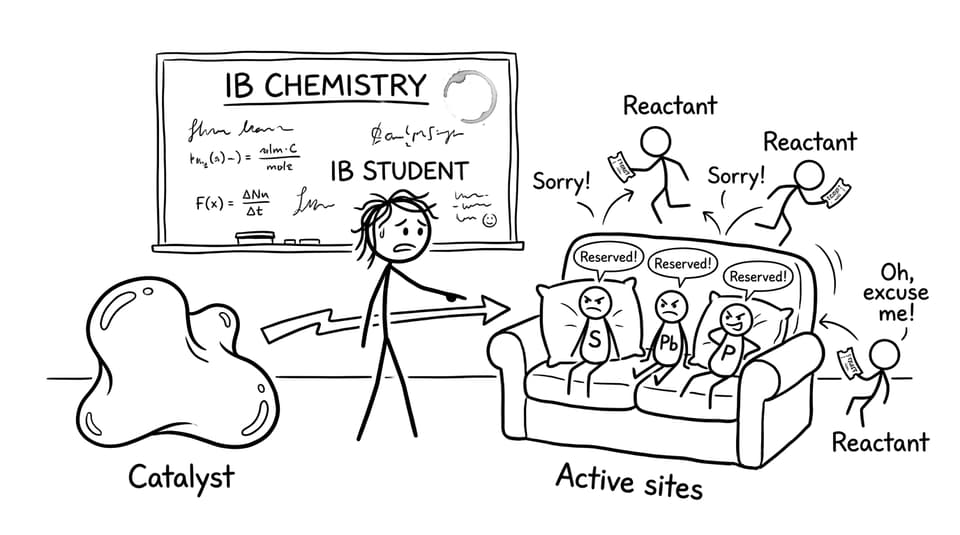
In IB Chemistry, catalyst poisoning is when a catalyst becomes less effective because another substance binds to its surface and blocks the active sites.
That’s the entire idea. Once active sites are blocked:
-
reactant particles can’t adsorb
-
fewer successful surface reactions happen per second
-
the reaction rate decreases
-
yield and efficiency often drop (especially in industry)
If you want a perfect link back to core kinetics language, revise the baseline catalyst story first: What Is the Role of a Catalyst? IB Chemistry Explained.
Why active sites matter so much in IB Chemistry
A heterogeneous catalyst (usually a solid) works because its surface has active sites: specific places where reactants stick, bonds weaken, and reactions become easier.
A clean way to describe heterogeneous catalysis (and set up poisoning) is:
-
adsorption of reactants onto the surface
-
reaction on the surface (often with weakened bonds)
-
desorption of products
When a poison takes up those surface locations, it’s not that the catalyst “stops existing.” It’s that the catalyst can’t do its job.
For a quick refresher on catalyst types and the surface mechanism, see Heterogeneous vs Homogeneous Catalysis Explained.
Reversible vs irreversible catalyst poisoning
In IB Chemistry, you’ll usually classify poisoning as reversible or irreversible. The distinction is all about how strongly the poison sticks.
Reversible catalyst poisoning
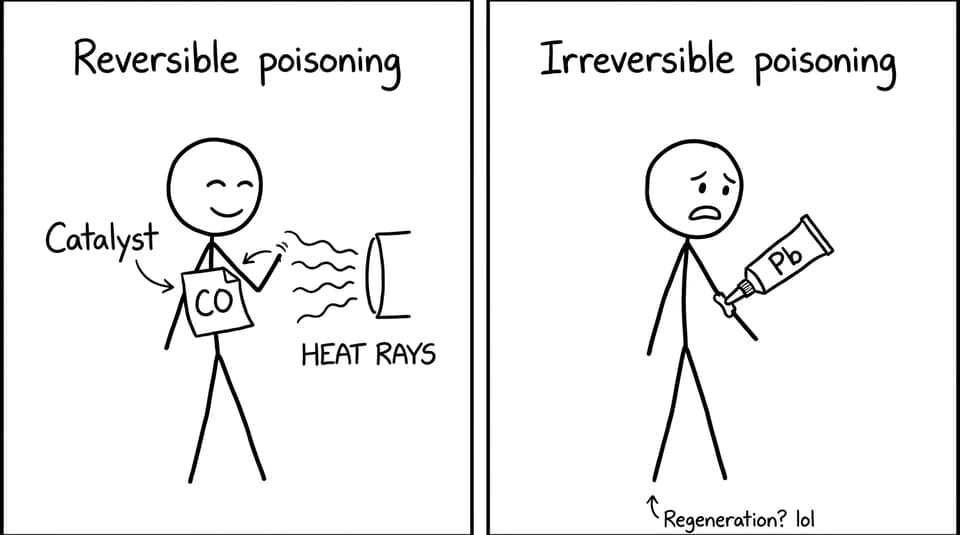
Reversible poisoning happens when the poison binds weakly enough that it can be removed by changing conditions (for example, heating or altering the mixture). The catalyst can often be regenerated.
A common example students meet is carbon monoxide (CO) acting as a poison for some metal catalysts under certain conditions.
Irreversible catalyst poisoning
Irreversible poisoning is when the poison binds strongly and essentially “permanently” blocks the surface. In practice, the catalyst must be replaced or undergo heavy industrial regeneration.
Classic examples include:
-
lead compounds damaging catalytic converter catalysts
-
sulfur compounds poisoning industrial metal catalysts
-
heavy metals binding to enzyme active sites
Common catalyst poisons you should recognize
The specific poison depends on the catalyst and conditions, but in IB Chemistry these are the names worth remembering:
Metal (industrial) catalysts
-
sulfur compounds
-
lead compounds
-
phosphorus compounds
-
chlorine and chlorinated hydrocarbons
-
carbon monoxide (sometimes)
Enzymes (biological catalysts)
-
heavy metal ions (e.g., Hg²⁺, Pb²⁺)
-
cyanide
-
certain inhibitors/drugs
The exam move is to say what they do: they bind to active sites and reduce adsorption of reactants.
Real examples that make IB Chemistry questions feel easier
Industrial contexts show up in IB Chemistry because they force you to talk about efficiency, purification, and economics.
Haber process (ammonia)
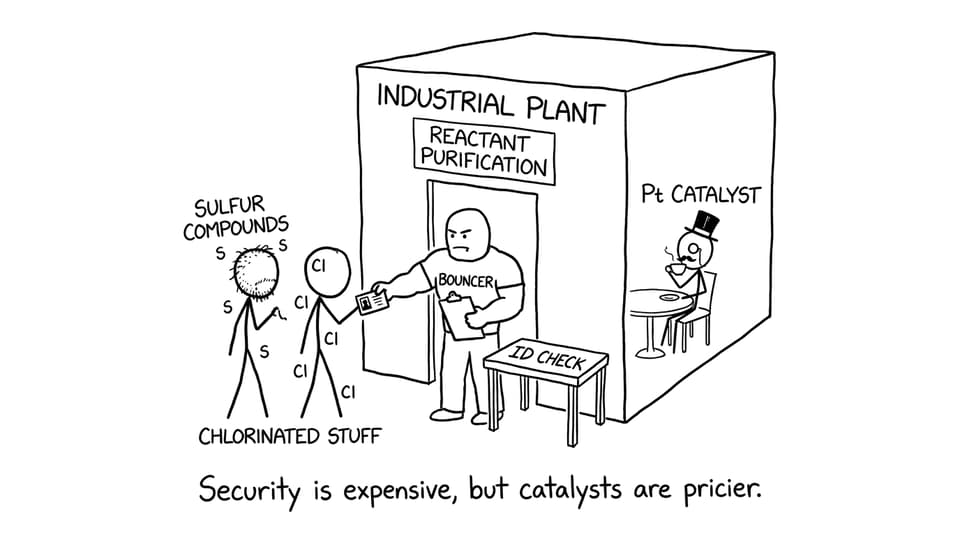
In the Haber process, the iron catalyst can be poisoned by impurities such as sulfur compounds and carbon oxides (CO, CO₂). This is why reactants are purified before entering the reactor. In an exam, that sentence is basically the whole markscheme.
Catalytic converters
Catalytic converters use Pt, Pd, and Rh catalysts to convert harmful exhaust gases into less harmful products. They are poisoned by lead and sulfur compounds, which is one reason unleaded petrol became essential.
Hydrogenation reactions
Nickel catalysts used in hydrogenation can be poisoned by sulfur impurities in oils and fats. It’s a neat reminder that “poisoning” isn’t only about gases.
To keep your catalyst fundamentals tight (because poisoning questions often start with “explain how catalysts work”), revise: Why Do Catalysts Speed Up Reactions Without Being Consumed.
How industry prevents catalyst poisoning (and how you phrase it)
Industry treats catalysts like expensive employees: protect them, or pay the replacement cost.
Key strategies you can list in IB Chemistry answers:
-
Purify reactants to remove sulfur/lead/phosphorus contaminants
-
Use filters and traps to stop poisons reaching the catalyst
-
Control reaction conditions to reduce buildup
-
Run regeneration cycles when poisoning is reversible
Quick exam checklist (IB Chemistry catalyst poisoning)
Use this when you see poisoning in a structured response:
-
Define poisoning: blocked active sites
-
Mention adsorption decreases
-
State rate decreases, catalyst activity drops
-
Classify reversible vs irreversible
-
Give a relevant example (Haber, converter, hydrogenation, enzyme)
-
Add one prevention method (purification or regeneration)
If you want to drill the wording with real prompts, the RevisionDojo Questionbank is ideal for kinetics-style explanations under time pressure.
Using RevisionDojo to master IB Chemistry catalysis faster
Catalyst poisoning is small, but it connects to a lot: kinetics, adsorption, industrial chemistry, and enzyme inhibition. That’s why it’s worth revising in a connected way.
On RevisionDojo, you can tighten this topic quickly using:
-
the Study Notes for clean definitions like R2.2.5 Catalysts Notes
-
Flashcards for rapid recall: Reactivity 2 Flashcards
-
AI Chat to practise “explain” questions with feedback
-
Grading tools to check whether your phrasing hits markscheme language
-
Mock Exams and Predicted Papers to spot how IB Chemistry likes to frame catalysis in unfamiliar contexts
-
the Tutors feature when you want someone to fix your explanation style in one session
If you’re exploring experiment ideas, you can also browse the Coursework Library for catalysis-focused exemplars like Investigating catalyst mass vs oxygen volume.
Conclusion: the simplest way to remember catalyst poisoning
Catalyst poisoning is just this: in IB Chemistry, a poison blocks the catalyst’s active sites, so reactants can’t adsorb and the reaction rate falls. From there, everything else is detail: reversible vs irreversible, real industrial examples, and prevention by purification or regeneration.
If you want this topic to feel automatic under exam time pressure, use RevisionDojo’s Study Notes, Flashcards, and Questionbank to rehearse the exact wording IB Chemistry rewards, then test it with Mock Exams and Predicted Papers until it sticks.