




In IB Chemistry, few ideas feel as satisfying as the moment an energy profile finally makes sense. You look at a reaction and think, “That one has to release loads of energy.” Then you try another that seems similar and it barely warms the surroundings. The difference is not luck. It’s bookkeeping -- the calm, ruthless accounting of bonds and stability.
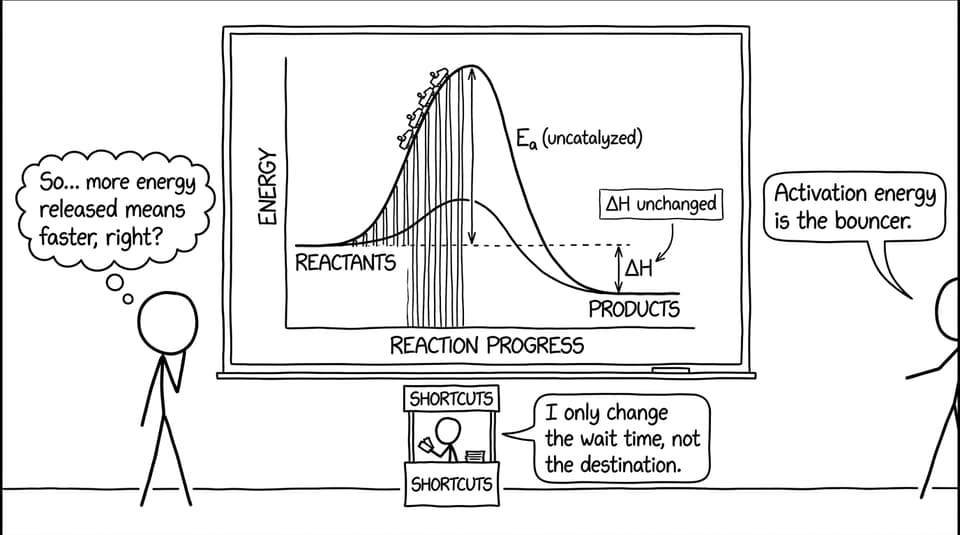
The core reason: energy in vs energy out (IB Chemistry)
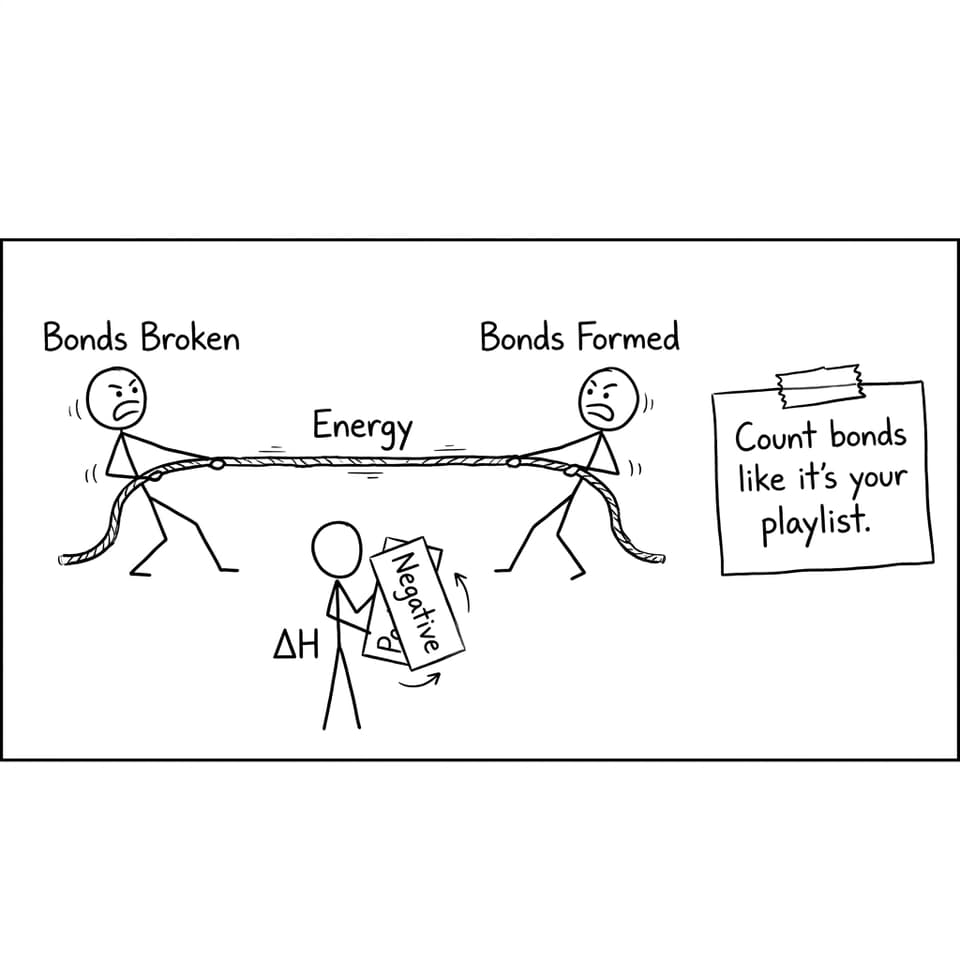
Every reaction has two competing “moves,” and IB Chemistry examiners love when you name them clearly:
-
Breaking bonds in the reactants (always endothermic -- energy in)
-
Forming bonds in the products (always exothermic -- energy out)
The overall enthalpy change, ΔH, depends on which side wins.
If the bonds you form release much more energy than the bonds you break require, the reaction is strongly exothermic (large negative ΔH). If the new bonds are only a bit more stabilizing, you get a small energy release. And if bond-breaking costs more than bond-forming pays back, the reaction becomes endothermic.
For the syllabus wording and worked examples, keep these open while you revise: Energetics and Thermochemistry Notes and Enthalpy Change Explained for IB Chemistry.
A quick exam checklist for reaction energetics
When you see an “energy released” question in IB Chemistry, do this fast scan:
-
Identify what bonds are broken and formed
-
Ask whether products are more stable (lower enthalpy) than reactants
-
Separate ΔH from activation energy (Ea)
-
If data is given, decide: bond enthalpies or Hess’s law route
RevisionDojo’s IB Chemistry: Exothermic Reactions Explained Simply is perfect for that 20-second pre-question reset.
Why combustion releases so much energy in IB Chemistry
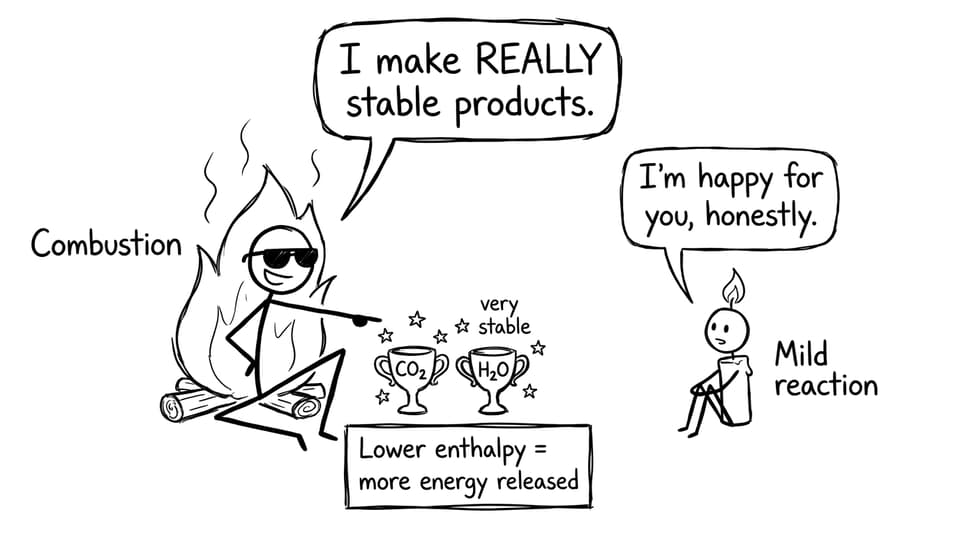
Combustion is the classic high-energy story in IB Chemistry because it tends to form extremely stable products: CO₂ and H₂O.
In many fuels, you start with C--H and C--C bonds, then end with strong C=O and O--H bonds. The “payoff” from forming these bonds is huge, and it outweighs the energy you had to invest to break the original bonds.
If you’re revising this, anchor it with: Enthalpy of Combustion Explained.
Stability is the quiet driver of bigger energy release
A useful way to think about IB Chemistry energetics is: reactions release more energy when products sit at a much lower potential energy level than reactants.
“Lower” usually means more stable: strong bonds, low reactivity, and fewer energetic ways to rearrange. That’s why making CO₂ and H₂O is such a “deep drop” on an energy diagram. In contrast, if your products are only slightly more stable than reactants, the drop is small, so the energy released is small.
Mechanism matters, but not the final energy difference
Reaction pathways can include intermediates and transition states that change the route a reaction takes. But in IB Chemistry, remember the key separation:
-
Activation energy (Ea) controls speed
-
ΔH controls how much energy is released or absorbed overall
A catalyst lowers Ea (new pathway), but it does not change ΔH. If you want an exam-ready explanation of bonds and values, use: Bond Enthalpy Explained for IB Chemistry.
Bring it home: practice it the RevisionDojo way
In IB Chemistry, reactions release different amounts of energy because the balance between bond breaking and bond forming, plus the stability of products, changes from case to case. If you can say that in one clean sentence, you’re already thinking like the markscheme.
To lock it in, combine understanding with repetition: revise the concept in the IB Chemistry Resources hub, then test it using the Energetics and Thermochemistry Questionbank. When you’re ready to simulate real exam pressure, use RevisionDojo’s IB Predicted Papers and get instant feedback with AI Chat and grading tools. Add Flashcards for daily recall, lean on Study Notes when you forget definitions, and use Mock Exams and Tutors when you want the full, confident IB Chemistry finish.