


Catalysts are the quiet heroes of IB Chemistry. They don’t get the glory of color changes or explosive reactions. They just stand there, make everything easier, and somehow still show up in every exam question where you least want extra thinking.
If you’ve ever stared at a kinetics question thinking, “I know catalysts speed things up… but what do they actually do?”, this is your reset. In IB Chemistry, marks come from precision: the right mechanism words, the right diagram logic, and one key reminder about equilibrium.
Quick checklist: what a catalyst does in IB Chemistry
Keep this mini-list in your head for any IB Chemistry short answer:
-
Increases the rate of reaction
-
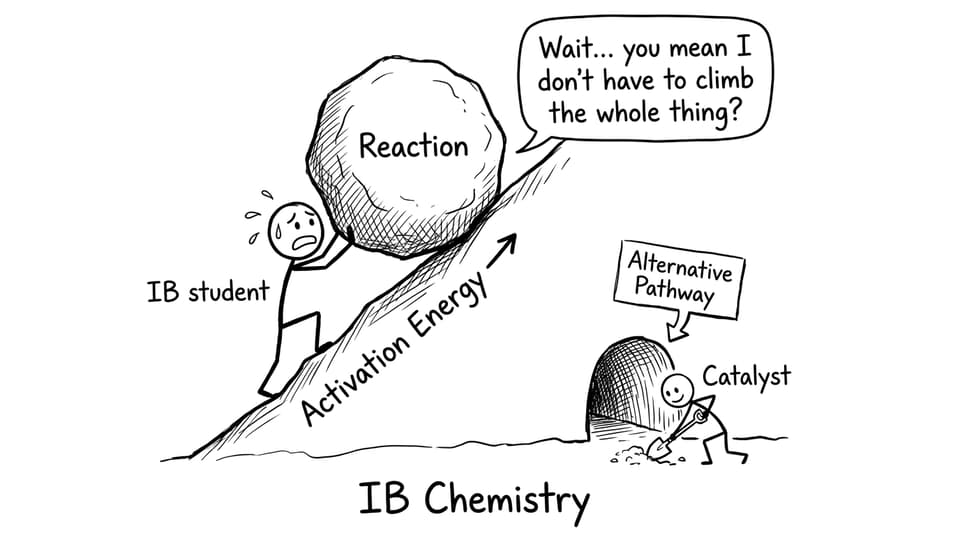
Provides an alternative pathway
-
The pathway has lower activation energy (Ea)
-
Catalyst is regenerated (not used up overall)
-
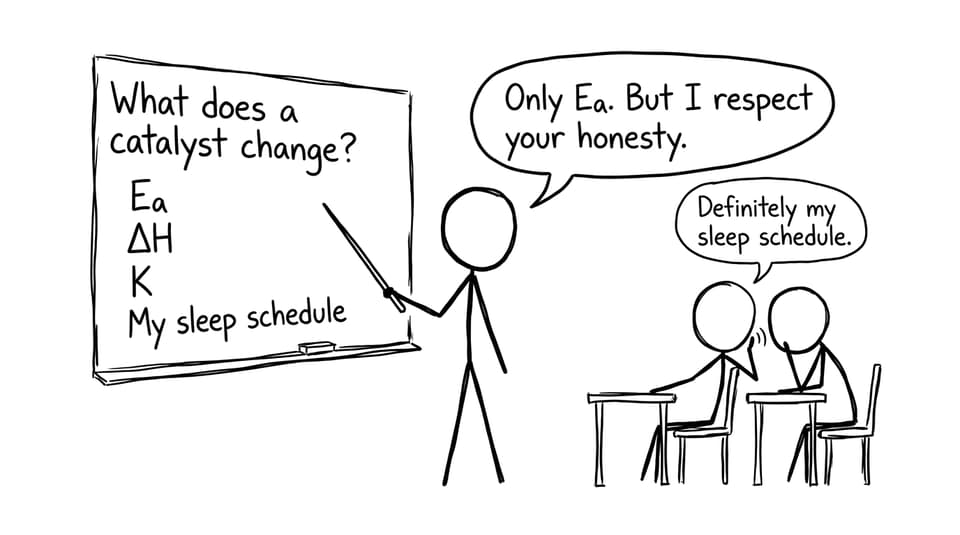
Does not change ΔH
-
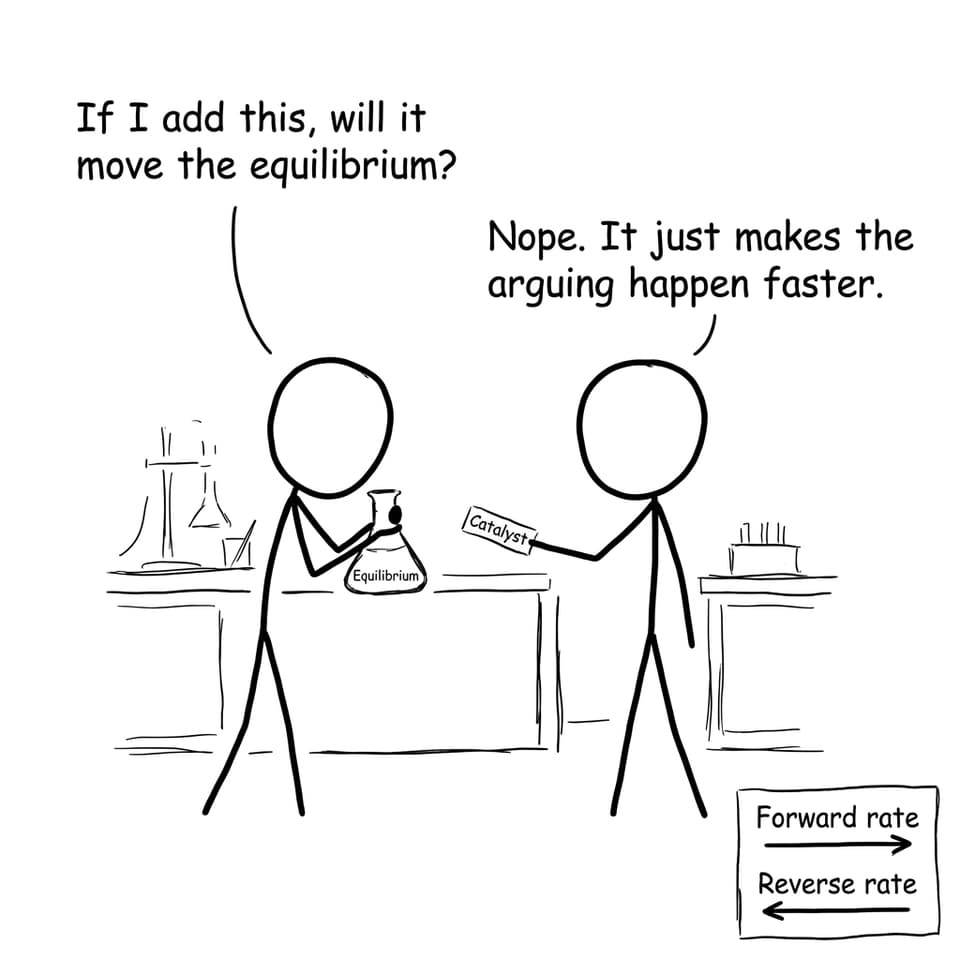
Does not change the equilibrium position (it only reaches it faster)
If you want targeted practice after reading, build momentum with the IB Chemistry Chemical Kinetics HL Questionbank and the broader IB Chemistry Questionbank.
What is the role of a catalyst in IB Chemistry?
The core role of a catalyst in IB Chemistry is to increase reaction rate by lowering activation energy. It achieves this by offering an alternative reaction pathway (a different mechanism) that requires less energy to reach the transition state.
The best exam sentence is simple and always scores:
In IB Chemistry, a catalyst increases the rate of reaction by providing an alternative pathway with lower activation energy.
If you want the “why” behind that one line, revise activation energy itself using What Is Activation Energy? IB Chemistry Explained.
Why lowering activation energy speeds reactions up
In collision theory terms (the language IB Chemistry likes), particles must collide with:
-
enough energy to meet or exceed Ea, and
-
the right orientation
Lower Ea means more particles at the same temperature now count as “energetic enough.” So the fraction of successful collisions rises, and the reaction rate increases.
To tighten your wording even more, see How Catalysts Affect Activation Energy.
Catalysts on energy profile diagrams (what to say)
Energy profile diagrams are a favorite because they test whether you understand what changes and what stays the same.
In IB Chemistry, when a catalyst is added:
-
the peak is lower (lower Ea)
-
the reactant and product energy levels are unchanged
-
therefore ΔH is unchanged
For HL students, connect this to multi-step pathways and transition states with R2.2.7 Energy profiles and transition states Notes.
Catalysts and equilibrium: the exam trap
A catalyst does not change the position of equilibrium in IB Chemistry.
What it does change is time: it helps the system reach equilibrium faster because it increases the rates of the forward and reverse reactions (often by similar factors). Equilibrium constants and final concentrations remain the same.
If equilibrium language feels shaky, pair this topic with Dynamic Equilibrium Explained for IB Chemistry and What Is Le Chatelier's Principle? IB Chemistry Explained.
Types of catalysts you must distinguish
Homogeneous catalysis
In IB Chemistry, homogeneous catalysis means the catalyst is in the same phase as the reactants (often aqueous). These mechanisms often involve intermediate species that later regenerate the catalyst.
Heterogeneous catalysis
Heterogeneous catalysis means the catalyst is in a different phase (commonly a solid surface with gaseous reactants). Adsorption onto the surface and improved orientation are often part of the explanation.
For a deeper compare-and-contrast, use IB Chemistry: Heterogeneous vs Homogeneous Catalysis and the syllabus-aligned R2.2.5 Catalysts Notes.
Final takeaway (and how to practice it fast)
The role of a catalyst in IB Chemistry is straightforward when you keep your language tight: it increases rate by providing an alternative pathway with lower activation energy, is regenerated, and does not change equilibrium position or ΔH.
To lock this in for exams, use RevisionDojo as your home base: drill catalysis and kinetics with the Questionbank, memorize definitions with Flashcards, and clarify wording using Study Notes. Then test yourself under pressure with Mock Exams, Predicted Papers, and the Grading tools that show exactly where marks go missing. If you get stuck, AI Chat and Tutors can walk you through mechanisms and diagrams until the explanation feels automatic.