
Catalysts feel like a cheat code the first time you meet them in IB Chemistry. A reaction that crawls suddenly sprints. Nothing “extra” appears in the products. And the catalyst seems to walk away like it was never there.
That last part is what confuses people: if it’s helping, why doesn’t it get used up?
In IB Chemistry, the best answer is calm and mechanical: a catalyst speeds a reaction by changing the route the reaction takes, not the start or finish. It participates, but it comes back.
The quick IB Chemistry checklist (what examiners want)
If you see “catalyst” in an IB Chemistry question, hit these points:
-
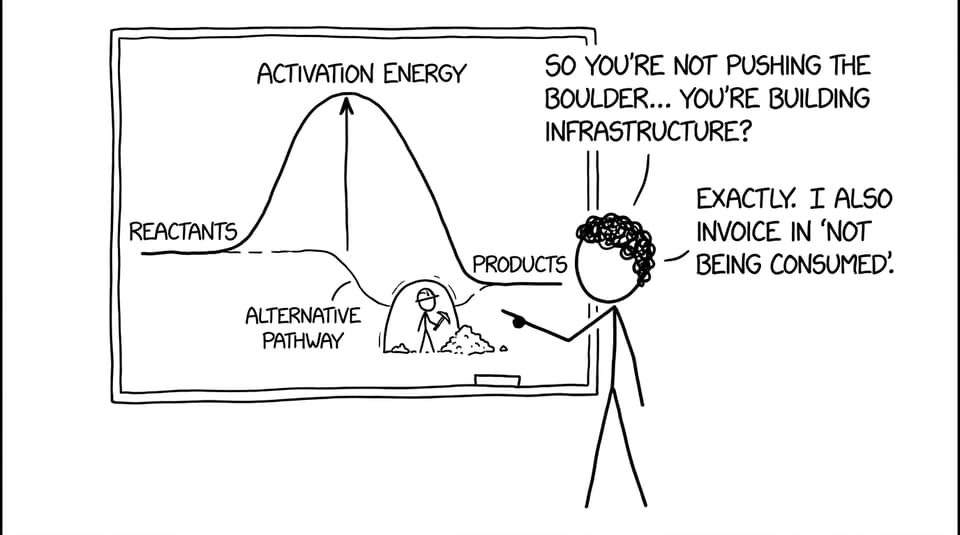
A catalyst provides an alternative reaction pathway
-
The pathway has lower activation energy (Ea)
-
Lower Ea means more successful collisions at the same temperature
-
The catalyst is regenerated (not consumed overall)
-
Catalysts change rate (kinetics), not ΔH or equilibrium position
For clean definitions and diagrams, pair this with What Is a Catalyst and How Does It Work? and What Is Activation Energy? IB Chemistry Explained.
Why catalysts speed up reactions in IB Chemistry
Think of activation energy as a hill that reactant particles have to climb. Most particles simply don’t have enough energy at the moment of collision to get over the peak.
A catalyst doesn’t “give” particles more energy. In IB Chemistry language, it lowers Ea by offering a different mechanism with lower-energy steps (often via intermediates). That changes the fraction of particles that can reach the transition state at a given temperature.
If collision theory is still fuzzy, revise it alongside IB Chemistry: Collision Theory Explained Simply.
Why catalysts aren’t consumed (they get regenerated)
Here’s the key story: catalysts join the reaction temporarily.
In the mechanism, the catalyst forms an intermediate with reactants, helps rearrange bonds in a lower-Ea step, and then gets regenerated in a later step. When you add all elementary steps together, the catalyst cancels out. That’s why it doesn’t appear in the overall equation.
This is also why a catalyst doesn’t change the final equilibrium position. It speeds up both the forward and reverse reactions, so the system reaches equilibrium faster, but the equilibrium composition stays the same. If you want that idea to click, read IB Chemistry: Dynamic Equilibrium, Finally Clear.
Homogeneous vs heterogeneous catalysis (the exam-friendly difference)
In IB Chemistry, you’re often asked to compare catalyst types:
Homogeneous catalysis
Catalyst and reactants are in the same phase (often all aqueous). The catalyst forms temporary bonds and intermediates that lower Ea.
Heterogeneous catalysis
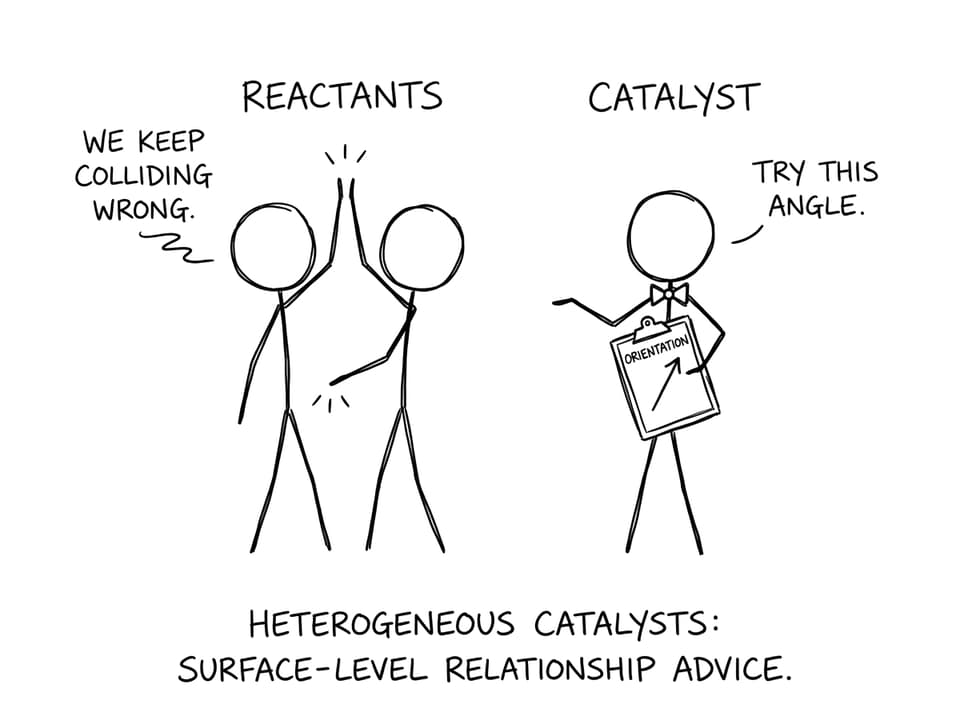
Catalyst is in a different phase, usually a solid surface. Reactants adsorb onto active sites, get held close together, and react with better orientation. This lowers Ea and increases effective collision frequency.
For a step-by-step comparison, use IB Chemistry: Heterogeneous vs Homogeneous Catalysis.
Enzymes: the biological catalyst version
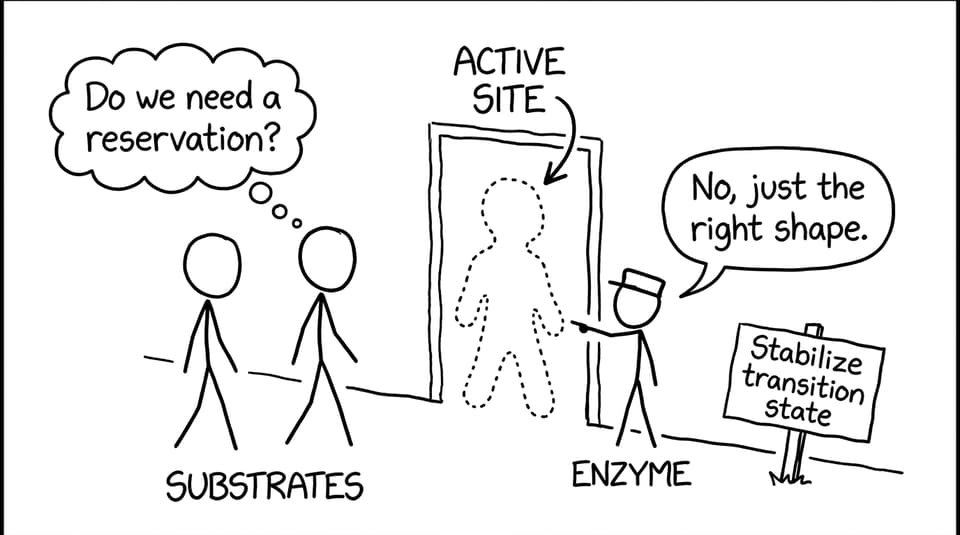
Enzymes are catalysts with an “active site” that binds substrates, positions them correctly, and stabilizes the transition state. In other words, enzymes are IB Chemistry catalysis with a personality: specific shape, specific substrate, same lower-Ea logic.
A final exam move for IB Chemistry
When you’re stressed, your brain tries to overcomplicate catalysts. Don’t.
In IB Chemistry, catalysts speed up reactions because they provide an alternative pathway with lower activation energy, increasing the fraction of successful collisions, and they are not consumed because they are regenerated by the end of the mechanism.
If you want to lock this in with real exam-style practice, build a targeted set in the IB Chemistry Questionbank, then reinforce it with RevisionDojo’s Study Notes, Flashcards, AI Chat, Mock Exams, and predicted exam-style practice so your explanation stays sharp under time pressure.