
A practical CAS reflection template for DP1
A CAS reflection does not need to sound profound. It needs to help you notice what happened, what you did, and what you might do differently next time. A simple CAS reflection template gives you somewhere to start before the details blur into “it was good” or “I learned teamwork.”
For a first-year IB student, the useful habit is repeatable: capture a specific moment, explain your response, and connect it to a learning outcome when the connection is real. Your school or CAS coordinator sets documentation requirements, so check local expectations about recording experiences and evidence.
At a glance:
- Record the experience and your role.
- Choose one specific moment.
- Explain what you thought, felt, or did, and why.
- Identify what you learned or would change.
- Connect a learning outcome only if you can explain it.
[DOWNLOAD BUTTON]
The download provides prompts for describing an experience, exploring a meaningful moment, considering learning, and planning a next step. Use it alongside your school’s CAS guidance.
What a CAS reflection template is for
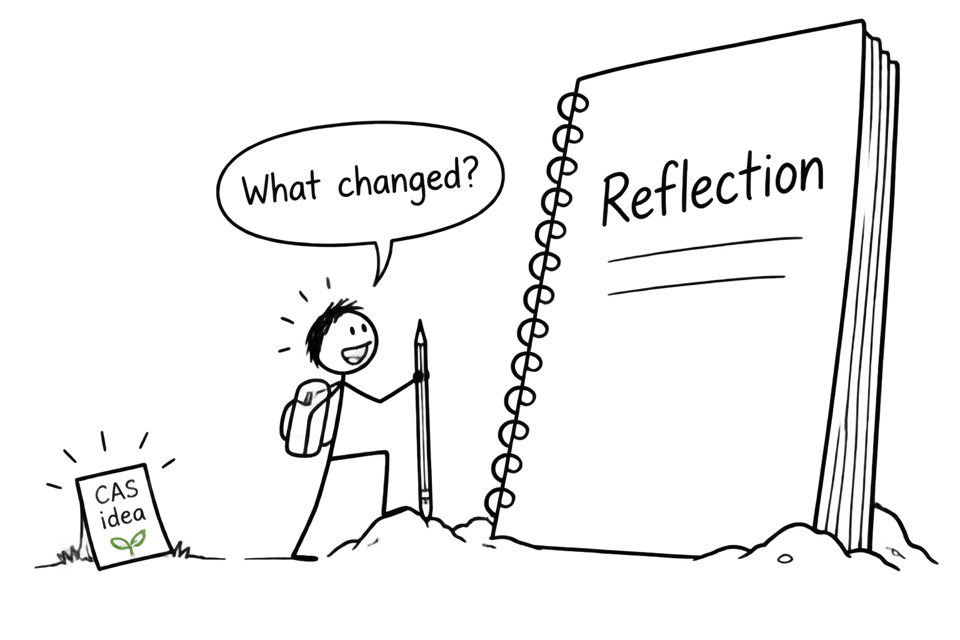
CAS involves experiences in creativity, activity, and service. Reflection helps you make sense of those experiences. It is not a diary of every hour or a list of achievements. It records your thinking: what challenged you, what choices you made, and what you understand now that you did not understand before.
Prompts give your memory somewhere to land. They are scaffolding, not a script. You do not need to answer every prompt every time or force a lesson that the experience did not teach you.
“I improved my communication” is a conclusion. “Two volunteers were giving different instructions, so I paused the activity and agreed on one explanation with them” gives the reader something concrete. From that moment, you can consider what changed and what to try next.
How to fill in the template
Start with the facts
Write the experience name, date or time period, CAS strand, and your role. Include enough context for someone unfamiliar with the activity. For an ongoing experience, identify which session or milestone you are reflecting on.
For example: “Saturday reading club, service, volunteer supporting younger students with a group reading activity.” This is clearer than “helping at school.” Follow your school’s instructions about recording these details.
Choose one moment to examine
Think of a moment that surprised, frustrated, pleased, or unsettled you. Perhaps a plan failed, you asked for help, or someone responded differently than expected.
Describe what happened in a few sentences, including your part in it. Avoid a full timeline unless the sequence matters to your point.
Explore your response
Ask: What were you thinking? What did you do? What influenced that choice? How did another person or the situation affect your response?
Honest reflection can include uncertainty. You might describe feeling awkward asking a teammate to repeat an instruction, then explain why you asked anyway. Naming the difficulty is more useful than pretending everything went smoothly.
Identify learning and a next step
Consider what the experience showed you about a skill, assumption, strength, or area to improve. Then name one practical next step. “Be more confident” is hard to act on. “Next session, I will explain the instructions to one volunteer before participants arrive” is observable and manageable.
If you connect a CAS learning outcome, explain the evidence in your own words. Do not select an outcome because it sounds impressive. Your coordinator can clarify how outcomes should be documented.
Review before saving
Can a new reader tell what happened, what you noticed, and what you learned? Replace general claims with an example. Remove unnecessary personal details about others and follow your school’s privacy guidance.
Length matters less than whether the writing shows real thought. If a prompt leaves you with an unanswered question, record that honestly and revisit it after another session.
A completed example
This hypothetical example shows how the prompts can work together.
Experience: Saturday reading club, service
My role: Helped organize a group reading activity for younger students.
Moment I chose: Two volunteers gave different instructions about when students should take turns reading.
What happened: I continued handing out books while the instructions were unclear. A few students waited, and I worried that I was slowing the group down. I asked the volunteers to pause so we could agree on one instruction before continuing.
What I was thinking and feeling: I did not want to sound critical, so I hesitated. Then I noticed the students looking to us for direction. Keeping quiet felt easier, but it was not helping the group.
What I learned: Clear communication can mean checking that a team shares the same plan, not just speaking confidently to participants. I sometimes wait too long to raise a practical problem because I worry about how it will sound.
What I will try next: Before the next session, I will ask the volunteers to agree on the instructions and who will explain them. Afterward, I will check whether students understood the activity.
Possible learning connection: This may relate to collaboration because I helped the group coordinate its instructions. I would confirm the appropriate outcome with my coordinator and explain the connection using this evidence.
The example does not claim the session transformed the writer. It describes one decision and a next step that can be tested. That makes the reflection useful.
Common mistakes to avoid
Writing only a recap. A recap tells what happened; reflection explains why a moment mattered. Keep the summary short and explore your response.
Using a generic lesson. “I learned teamwork” needs evidence. Which action, disagreement, or decision changed your understanding?
Trying to sound perfect. Reflections are not advertisements for your character. A mistake or uncertainty can clarify your learning when you explain your response.
Forcing a learning outcome. Describe the experience accurately rather than trying to make every outcome fit.
Waiting until details fade. A quick note after an activity preserves material for fuller reflection later.
Make the habit easier to keep
In DP1, CAS can feel like another system to manage alongside classes and deadlines. Keep the process light: write notes soon after an experience, choose one moment, and return when you have time to reflect. A reusable IB template makes starting easier; your details keep each entry personal.
RevisionDojo supports the wider IB workload with Questionbank, Study Notes, Flashcards, and AI Chat. For CAS, keep your school’s guidance central and use this template to turn one experience into a thoughtful record. The aim is not an impressive account of everything you did. It is a clearer understanding of one moment and what you will do next.