

There’s a specific kind of silence that happens after you see a bad number on a test.
Not the noisy kind of panic where you text everyone. The quieter kind, where your brain starts doing math you never wanted to do: If I got a 2 here, does that mean I just lost the whole IB Diploma?
If you’re an IB student preparing for exams, this question isn’t dramatic. It’s practical. Because the IB doesn’t award the diploma based on vibes, effort, or “overall improvement.” It awards it based on rules.
So let’s make those rules feel clear, and then talk about what to do if you’re hovering near that line.
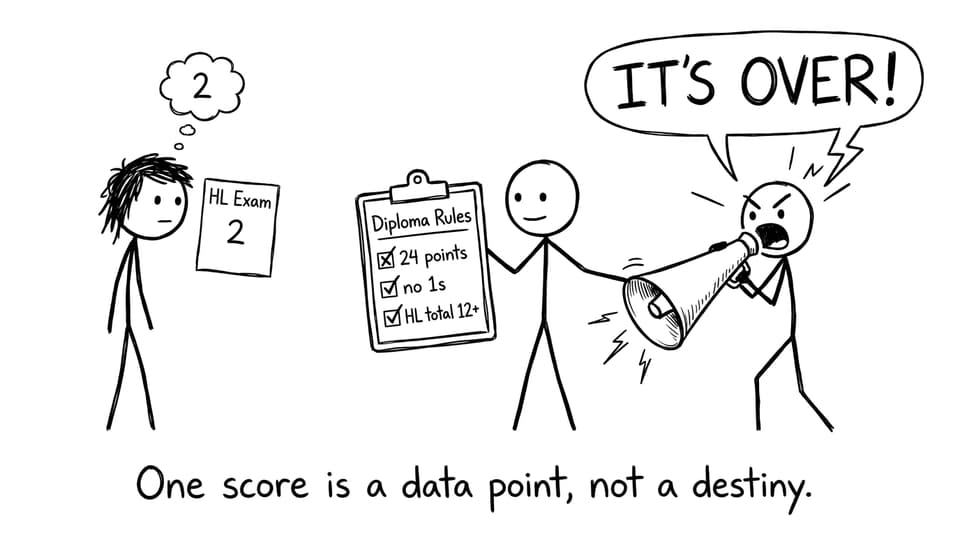
The short answer: does a 2 in IB HL stop the diploma?
Under current IB diploma award conditions, a 2 in an HL subject typically prevents the IB Diploma from being awarded, even if your total points are high.
That sounds harsh, but it’s also useful: clarity gives you a plan.
If you want the exact breakdown in one place, read Can You Get a 2 on an IB HL Test and Still Get Your Diploma? alongside this guide.
IB grading basics (so the rules make sense)
In the IB Diploma Programme, each of your six subjects is graded from 1 to 7.
-
7 = excellent
-
4 = satisfactory
-
2 = poor
-
1 = very poor
Those six subjects add up to a maximum of 42 points. Then TOK and the Extended Essay can add up to 3 bonus points, for a total of 45.
If you want a clean overview of how the whole system fits together, this helps: How Does the IB Diploma Work? A Clear Breakdown.
The IB diploma checklist (print this mentally)
Here’s the simple checklist most students should anchor to when stress spikes.
Minimum totals
- At least 24 points total (out of 45)
The 24-point threshold is the famous baseline, explained here: What Is the 24-Point Rule in the IB Diploma?
Subject requirements (the part that surprises people)
Beyond total points, the IB applies “fail conditions” that override your total.
Common examples include:
-
A 2 in any HL subject (typically a diploma blocker)
-
Too many low grades across the six subjects
-
Missing core requirements
Core requirements
-
Complete CAS
-
Submit the EE
-
Meet required TOK outcomes
And yes, those core points can matter when you’re near the boundary. They don’t magically erase an HL requirement, but they do shift totals and outcomes in borderline situations.
If you’re aiming to make the most of TOK and EE, use guides like IB Extended Essay Guides and Mastering the TOK Essay and Exhibition.
Why IB treats HL differently
HL is where the IB expects depth: more teaching hours, more content, more demanding markscheme expectations.
That’s why the diploma rules treat HL as non-negotiable. The system is basically saying: “You can wobble a little, but you can’t fully collapse at Higher Level.”
This is also why your revision strategy for IB HL needs to include technique, not just knowledge.
“But it was just a test” vs “it’s the final exam”
A crucial distinction:
-
A 2 on a school HL test is a warning light.
-
A 2 as a final IB HL result is where diploma eligibility becomes a real issue.
School tests can be harder, easier, or simply different from IB marking standards. So don’t treat one number as a prophecy.
Treat it as data.
That’s where structured practice helps: you want your next few weeks to produce better data.
On RevisionDojo, that usually means:
-
Use Study Notes to get clear on the topic quickly
-
Drill the same topic in the Questionbank until patterns feel familiar
-
Use Flashcards to keep definitions and processes alive
-
Ask AI Chat to diagnose why you’re losing marks
-
Use Grading tools for criterion-based feedback (especially in essay subjects)
Start here: Questionbank and Flashcards.
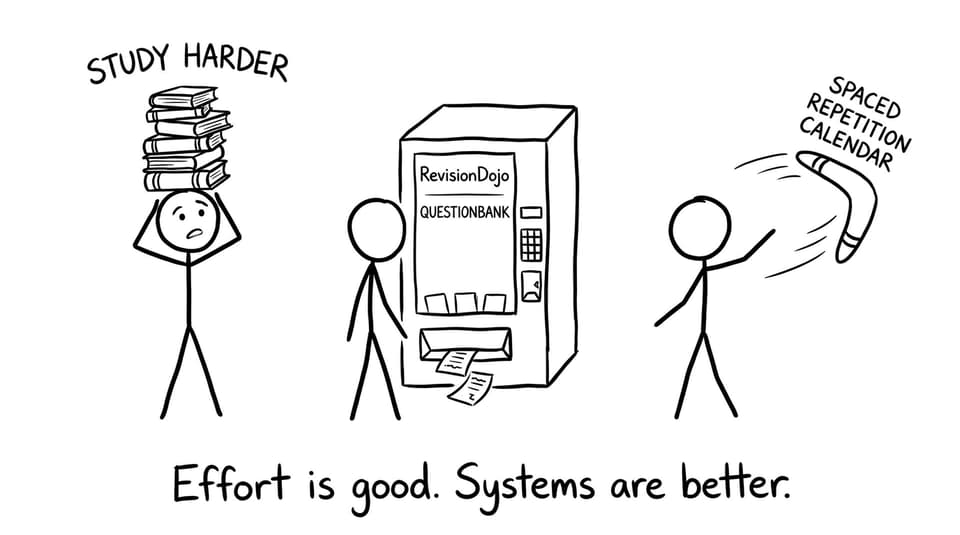
If you’re at risk of a 2 in IB HL: a calm recovery plan
If your mock, unit test, or timed practice suggests you’re drifting toward a 2, you don’t need a motivational speech. You need a loop.
A 7-day loop that works for IB students
Day 1: Diagnose
-
Pick the exact unit/paper skill causing the low score.
-
Write down three recurring errors (content gap, command term confusion, timing).
Days 2-4: Patch + drill
-
Patch with targeted notes (not full-topic rereading).
-
Do 20-40 focused questions in a topic-filtered set.
Days 5-6: Timed practice
-
Sit one timed section.
-
Mark it honestly.
-
Create a 5-line mistake log.
Day 7: Retest the same weakness
-
Repeat a short timed set.
-
Compare the mistake log. Improvement should be visible.
If you want a bigger plan for crunch time, use: IB: The Last 2 Weeks Before Exams (What Matters).
Use predicted papers the right way
Predicted papers help because they turn anxiety into rehearsal. They’re not magic, but they are structured exposure.
-
Practice here: IB Predicted Papers
-
Learn how to use them: IB Predicted vs Specimen Papers: What They Mean
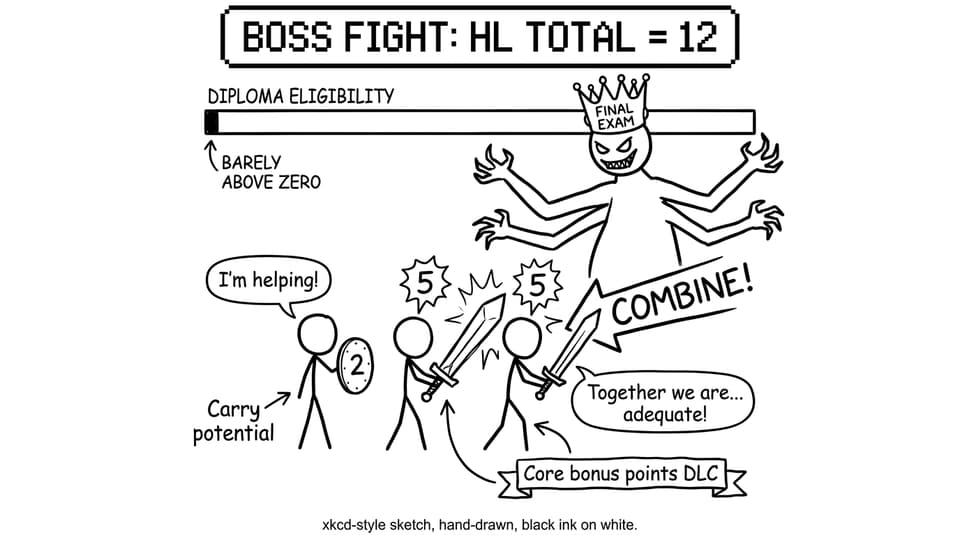
What you can still earn if the diploma isn’t awarded
This matters emotionally and practically: even if the full IB Diploma is not awarded due to an HL requirement, students may still receive course certificates for individual subjects.
That’s not the outcome anyone wants, but it means your work is not “wasted.” It also means you can build a retake plan with a narrower focus.
RevisionDojo’s strength here is that it reduces the size of the task. Instead of “redo HL,” you can do:
-
“Redo Paper 1, Topic X, Question Type Y” using the Questionbank
-
“Rebuild timing” using Mock Exams and Predicted Papers
-
“Fix the writing criteria” using Grading tools and Tutors
For the bigger mindset shift, this is worth reading: IB Predicted Grades Don't Define You (Here's What Does).
Closing: the IB is strict, but it’s not personal
A 2 feels like a label. But in the IB, it’s really a measurement: one snapshot of performance under certain conditions.
The diploma rules are strict, especially at HL. Yet strict systems can be navigated when you understand them. Your job is to turn worry into a plan: diagnose, practice with feedback, rehearse under time, and repeat.
If you want the most direct path from “I’m at risk” to “I’m improving,” build your loop inside RevisionDojo: Study Notes, Flashcards, Questionbank, AI Chat, Grading tools, Predicted Papers, Mock Exams, Coursework Library, and Tutors when you need human-level strategy. That’s how IB students stop guessing and start climbing.