

Every IB student has the same quiet fear at some point: you finally care about your topic… and then you wonder if you’re allowed to sound like a human in your IA.
Maybe you’ve found a pattern in your data that surprises you. Maybe your method didn’t behave the way the textbook promised. Or maybe your research question is personal for a real reason, and you want the examiner to understand that.
So, can you include personal opinions in your IA?
Yes, and often you should, as long as your opinions are relevant, clearly signposted, and anchored to evidence. In a strong IA, your voice doesn’t replace analysis. It guides it.
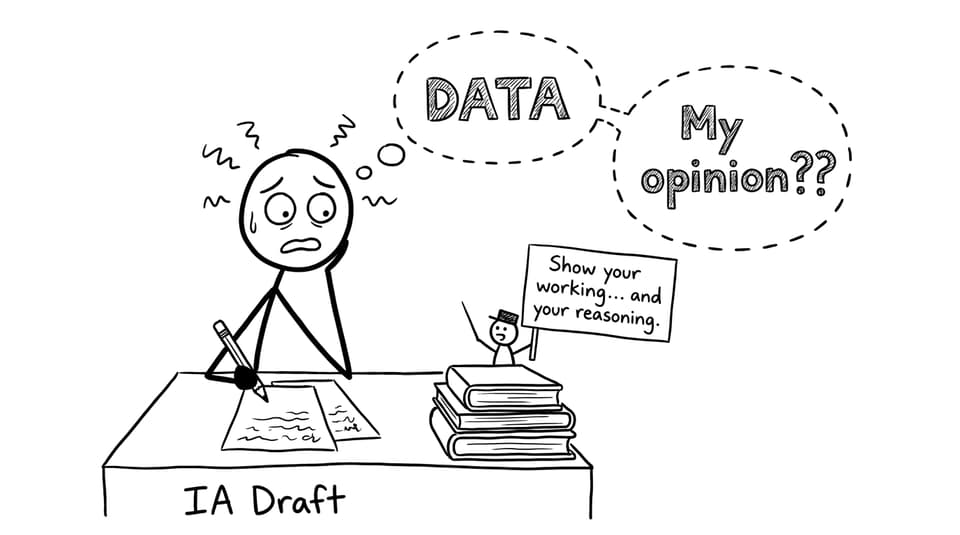
The quick checklist: opinions that score in an IA
Use this mini-filter before you add any personal line to your IA:
-
Is it tied to the research question? If not, cut it.
-
Is it supported by data, sources, or calculations? If not, rebuild it.
-
Is it clearly labelled as interpretation or reflection? If not, rewrite it.
-
Does it acknowledge limits or alternatives? If not, balance it.
-
Does it show decision-making (initiative)? If yes, keep it.
If you want a clearer map of what examiners mean by “engagement,” read Writing the Personal Engagement Section Effectively.
What “personal opinion” actually means in an IA
A personal opinion in an IA is not a hot take. It’s a reasoned judgement.
Think of it as the difference between:
-
“I think this method is bad.”
-
“This method likely reduced reliability because trial 2 and 3 show high variation (SD = …), so I chose to repeat measurements and justify excluding one anomalous point.”
The second one is still personal. But it’s built like an academic claim: observation, reasoning, and consequence.
If you’re unsure how to keep that balance, this guide helps with phrasing and tone: Balancing Personal Voice with Academic Tone in Your IA.
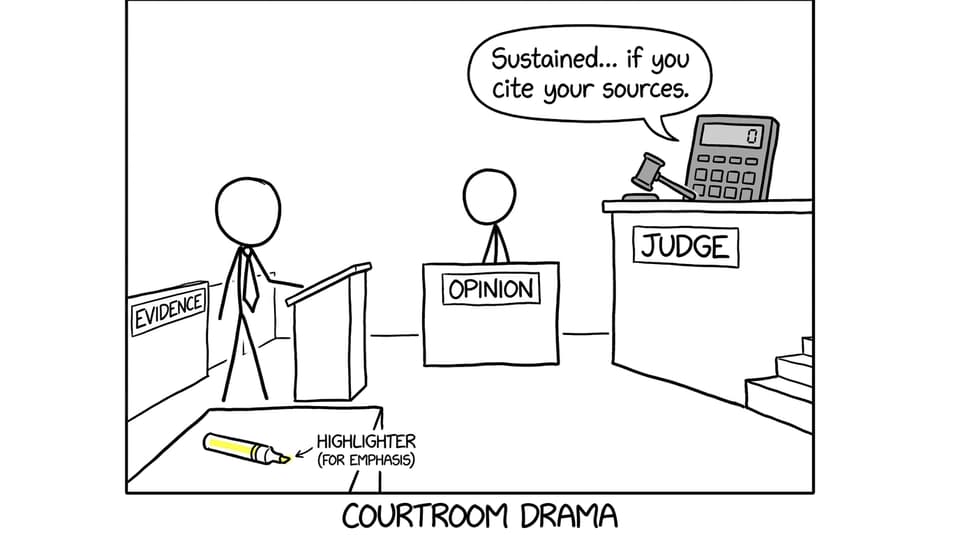
Where personal opinions belong in an IA (and where they don’t)
Your IA has “safe zones” for opinion. Use them.
Strong places to include personal opinions in an IA
-
Introduction and rationale: why this question matters to you (briefly).
-
Method choices: why you selected certain variables, materials, sampling, or models.
-
Analysis: interpretation of patterns, anomalies, trends, and what they imply.
-
Evaluation and reflection: limitations, improvements, and what you learned.
If you’re still shaping the question itself, start here: How to Write a Strong IA Research Question.
Weak places to include personal opinions in an IA
-
Background theory paragraphs that should be objective.
-
Results/data tables (data speaks, you interpret later).
-
Long emotional storytelling that doesn’t affect the investigation.
A useful rule: if your opinion doesn’t change the reader’s understanding of the process or meaning of your results, it probably doesn’t belong in the IA.
How to “prove” your opinion inside an IA
Examiners reward ownership when it’s visible in your reasoning.
Here are three practical sentence frames that keep your IA rigorous:
-
Evidence-first: “The data suggests X because… therefore I infer…”
-
Decision-first: “I chose method A over B because… which improved…”
-
Limitation-first: “A weakness is… which may have caused… so I would…”
If you want to deepen reflection without sounding informal, use: How to Write IA Reflections That Show Real Growth.
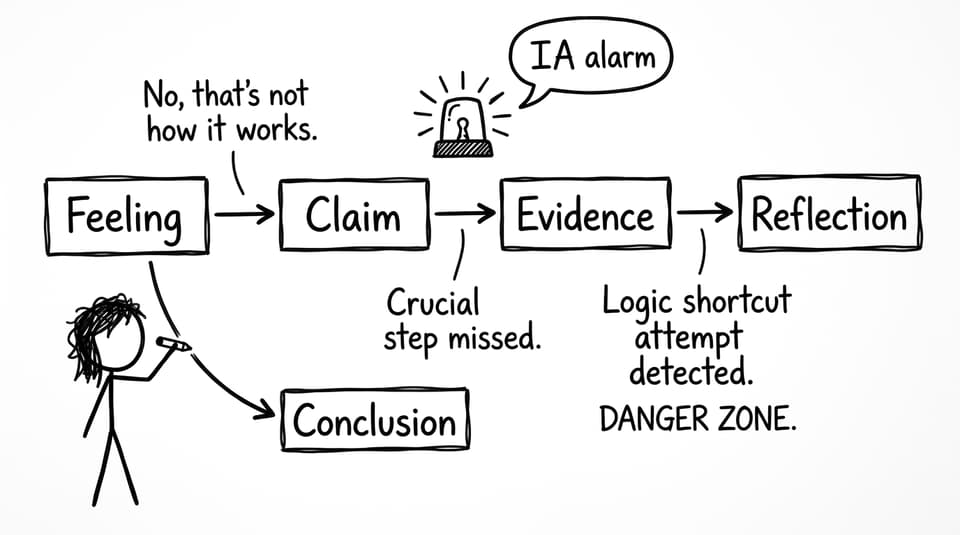
Subject-specific notes: Math and Science IAs
Personal engagement is often easiest in subjects where your decisions shape the work.
Math IA
In a Math IA, your opinion shows up through choices: what you model, what assumptions you make, and how you interpret whether the model fits reality. A sports stats investigation, for example, can be personal because you chose the variables, justified the model, and evaluated its limitations honestly.
If you want help making your work feel distinctive (without adding fluff), read: How to Make Your IB Math IA Memorable to Examiners.
Science IA
In a Science IA, your opinion belongs in your evaluation and analysis: how you interpret anomalies, whether your method truly measured what you think it measured, and what improvements would strengthen validity.
For concrete examples of structure and expectations, browse IB Biology Internal Assessment Guide and compare a real write-up like Sample IB Biology IA: A Step-by-Step Example.
Bringing it home: make your IA sound like you, but built on evidence
The best IA doesn’t hide your voice. It disciplines it.
When your personal opinions are tied to decisions, backed by evidence, and framed as reflection or interpretation, they become a scoring advantage. They show ownership. They show thinking. And they make your work harder to confuse with something generic.
If you want a calmer workflow, RevisionDojo helps you build that evidence-backed confidence: use Study Notes and Flashcards to tighten theory, the Questionbank to keep exam skills alive, AI Chat to refine wording, Grading tools to check criteria alignment, and the Coursework Library for high-quality exemplars. Add Mock Exams and Predicted Papers to protect your exam prep while your IA comes together.
Your IA can include your opinion. Just make sure it earns its place on the page.