

Bond order is one of those IB Chemistry ideas that feels almost too tidy at first: count the lines between atoms, write 1, 2, or 3, and move on. Then you meet ozone, nitrate, benzene, and (HL) molecular orbital diagrams, and suddenly the bond is… one and a half?
That moment is frustrating, but it is also a gift. Because once bond order clicks, a lot of exam questions stop being “memorize this fact” and start being “predict the trend.” In IB Chemistry, bond order becomes a quiet shortcut to bond length, bond strength, stability, and even reactivity.
Bond order in IB Chemistry (the simple definition)
In IB Chemistry, bond order is the number of shared electron pairs between two atoms.
-
Single bond: bond order 1
-
Double bond: bond order 2
-
Triple bond: bond order 3
The exam-friendly summary is:
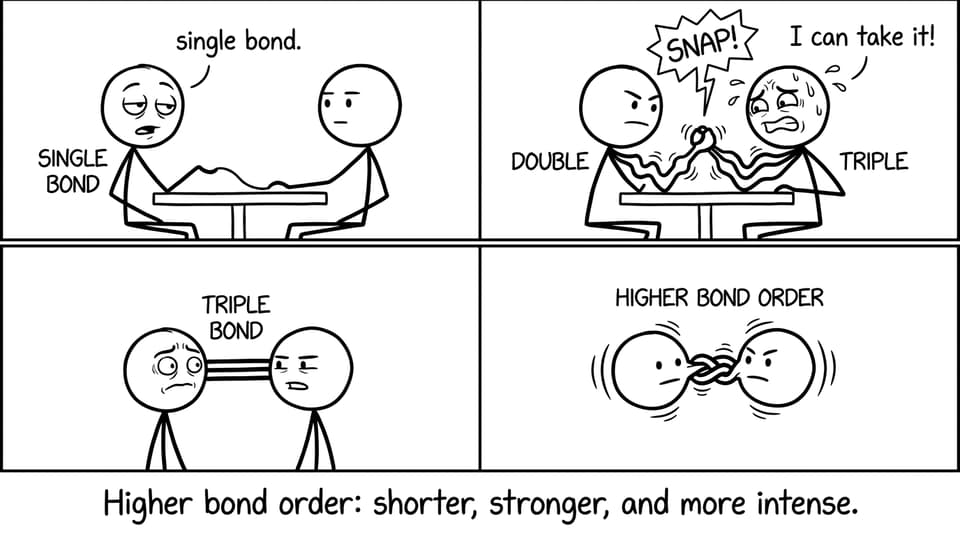
Higher bond order == shorter bond == stronger bond == higher bond energy (usually) == more stable (often).
If you want a clean home base before resonance and HL ideas arrive, start with RevisionDojo’s Structure 2 hub: Structure 2: Models of bonding and structure.
A quick bond order checklist (what to do in questions)
Use this checklist whenever a bond order question appears in IB Chemistry:
-
If the molecule has one clear Lewis structure: count shared pairs (or bond lines).
-
If resonance is present: calculate an average bond order across equivalent bond positions.
-
If it is HL molecular orbital theory: use (bonding electrons - antibonding electrons) / 2.
-
Then link bond order to bond length and bond strength in your explanation.
For more practice in the exact style examiners love, build a targeted set from the Chemical bonding and structure Questionbank.
Bond order for “normal” molecules (no resonance)
For many early IB Chemistry questions, bond order is just careful counting.
Examples:
-
H_2: bond order 1
-
O_2: bond order 2
-
N_2: bond order 3
-
CO_2: each C=O has bond order 2
This is why nitrogen gas is famously unreactive: a bond order of 3 is not just “three lines,” it is a very strong, very short bond that does not want to break.
If single/double/triple bonds feel shaky, tighten that foundation here: Single, double and triple bonds notes.
Bond order with resonance (why you get fractions)
Resonance is where IB Chemistry starts rewarding students who think in averages instead of absolutes.
When a molecule has multiple valid resonance structures, the real structure is a resonance hybrid. That means individual bonds can have partial double-bond character. On paper, we handle that with an average.
A simple way to compute resonance bond order is:
Bond order = (total number of bonding pairs across resonance forms) / (number of equivalent bond positions)
Common exam examples:
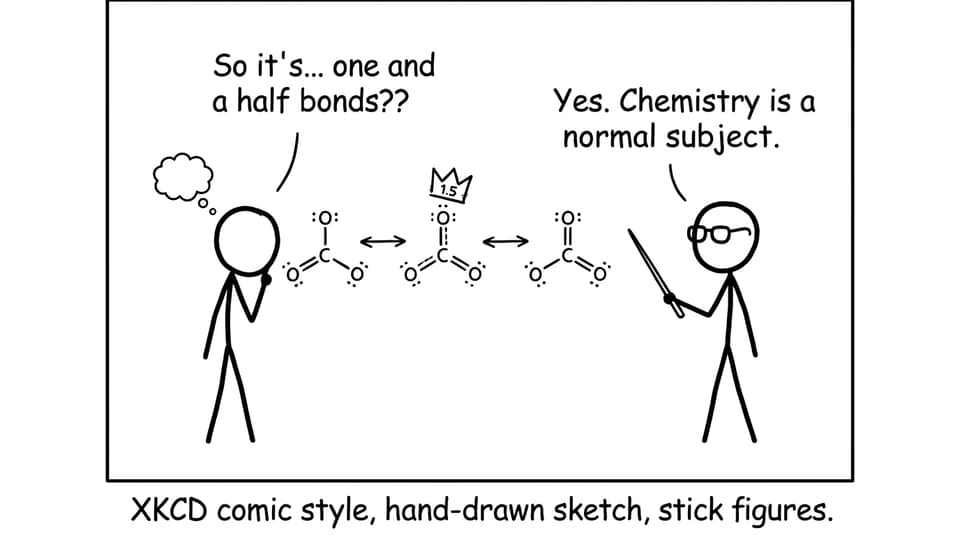
Ozone, O_3
There are 3 bonding pairs spread across 2 O-O positions.
Bond order = 3 / 2 = 1.5
Nitrate, NO_3^-
There are 4 bonding pairs spread across 3 N-O positions.
Bond order = 4 / 3 ≈ 1.33
Benzene, C_6H_6
There are 9 bonding pairs spread across 6 C-C positions.
Bond order = 9 / 6 = 1.5
Those fractional values explain a crucial observation: in benzene, all C-C bond lengths are identical, not alternating “single then double.”
If resonance itself is the sticking point, use: Resonance explained simply.
HL molecular orbital theory bond order (fast formula)
In HL IB Chemistry, bond order also comes from molecular orbital (MO) theory:
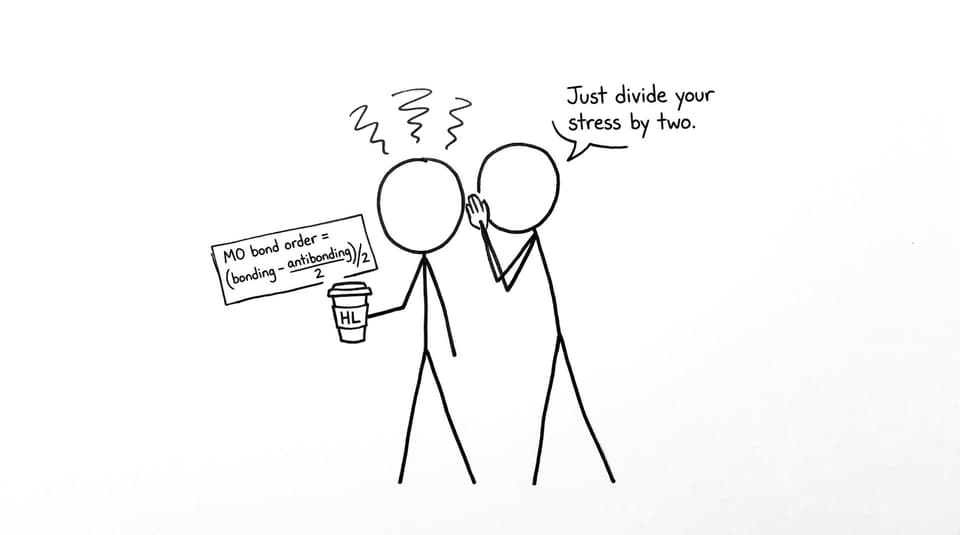
Bond order = (bonding electrons - antibonding electrons) / 2
Examples:
-
O_2: (10 - 6) / 2 = 2
-
O_2^+: (10 - 5) / 2 = 2.5
-
O_2^-: (10 - 7) / 2 = 1.5
This is not just arithmetic. It helps you justify properties: O_2 is paramagnetic because of unpaired electrons in antibonding orbitals, even though its bond order is 2.
To connect MO thinking to other bonding language you already know, revise: Sigma and Pi bonds explained.
How bond order predicts bond length, strength, and reactivity
In IB Chemistry, you rarely get marks for calculating bond order alone. You get marks for what you do next.
Bond length
Higher bond order pulls electron density between nuclei more effectively.
Trend:
C-C (single) > C=C (double) > C≡C (triple)
Typical values you may see:
-
C-C: ~154 pm
-
C=C: ~134 pm
-
C≡C: ~120 pm
Bond strength
Bond energy generally increases with bond order, but not in a perfectly linear way.
Typical values:
-
C-C: ~350 kJ/mol
-
C=C: ~610 kJ/mol
-
C≡C: ~830 kJ/mol
Reactivity and stability
A higher bond order often means a more stable bond that is harder to break. That is why bond order helps you explain why N_2 resists reaction, while species with lower bond order (or with electrons in antibonding orbitals) can be more reactive.
For a clean, syllabus-aligned recap, revise the Chemical bonding and structure Notes and the focused 4.2 Covalent bonding notes.
Bond order, remembered the exam way
Bond order in IB Chemistry is not just a definition. It is a prediction tool: calculate it, then immediately talk about length, strength, and stability. When resonance appears, think “average.” When HL MO theory appears, think “(bonding - antibonding)/2.”
To turn this into marks, use RevisionDojo as your bonding workflow: learn the core idea in the notes, drill it in the Questionbank, and cement the definitions with IB Flashcards with Spaced Repetition (SRS). Then, when a bonding question tries to intimidate you with a fraction, you can respond calmly, like someone who understands what the molecule is really saying.