


Resonance is one of those IB Chemistry ideas that feels slippery at first. You draw a neat Lewis structure, you feel briefly in control, and then the markscheme quietly suggests you should have drawn two, or three, and then talked about something called a hybrid.
The comforting truth is that resonance is not a trick. It’s chemistry being honest about electrons: sometimes they refuse to live at one address.
Resonance in IB Chemistry (the exam-friendly definition)
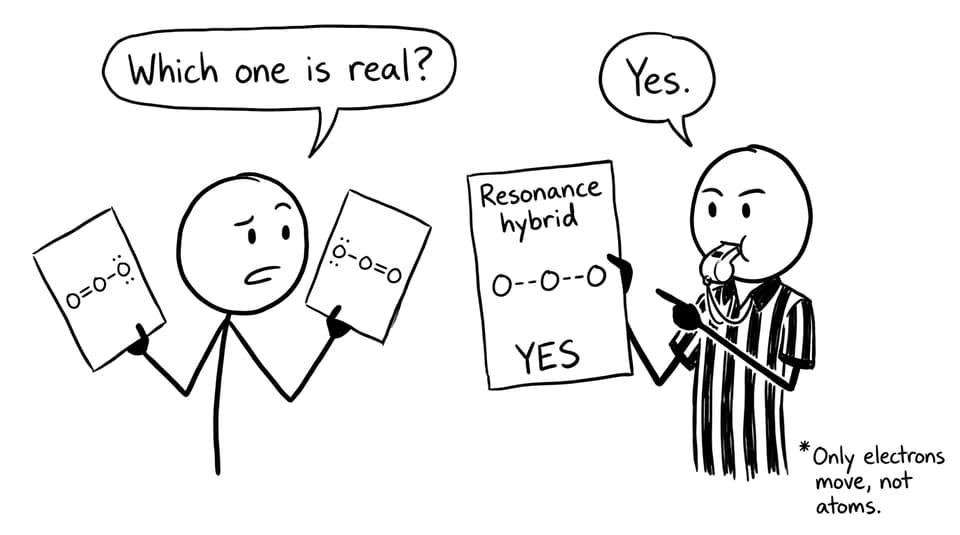
In IB Chemistry, resonance happens when you can draw two or more valid Lewis structures for the same arrangement of atoms, and the real species is best described as a resonance hybrid.
A resonance hybrid means:
-
The atoms stay in the same positions.
-
Only electrons move (usually pi electrons and lone pairs).
-
The actual molecule/ion is more stable than any single drawing suggests.
If you want the syllabus-aligned version, use RevisionDojo’s dedicated page on S2.2.11 Resonance structures (HL only).
Quick checklist: when to suspect resonance
Use this fast scan in IB Chemistry questions:
-
Lone pair next to a double bond
-
A negative charge next to a pi bond
-
Symmetrical polyatomic ions (often multiple equivalent structures)
-
Aromatic rings (benzene-style delocalisation)
Then confirm by checking whether you can shift pi electrons/lone pairs without breaking Lewis rules.
For a bonding foundation that makes resonance feel less random, review S2.2 The covalent model notes.
What resonance is not (and why that matters)
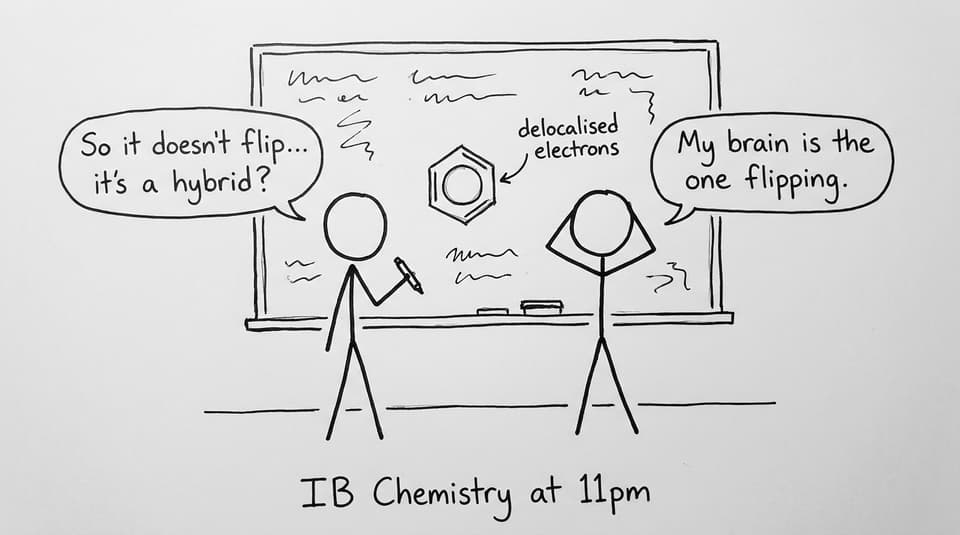
A common trap in IB Chemistry is imagining the molecule “switching” between drawings. That mental movie creates messy explanations later.
Resonance structures are models. The species is not flipping back and forth. Instead, the electrons are delocalised across multiple atoms, giving:
-
Intermediate bond lengths (not fully single or double)
-
Average bond order across equivalent positions
-
Charge spread out (lower energy, higher stability)
To tighten your wording, keep the IB Chemistry Key Definitions open while you revise. It’s an underrated way to write like the markscheme.
Core examples you should be able to explain
These show up constantly in IB Chemistry because they connect drawing skills to structure and stability.
Ozone, O3
You can draw two valid structures with the double bond in different places.
What to say in your answer:
-
The pi electrons are delocalised over three O atoms
-
The two O-O bonds become equal in length
-
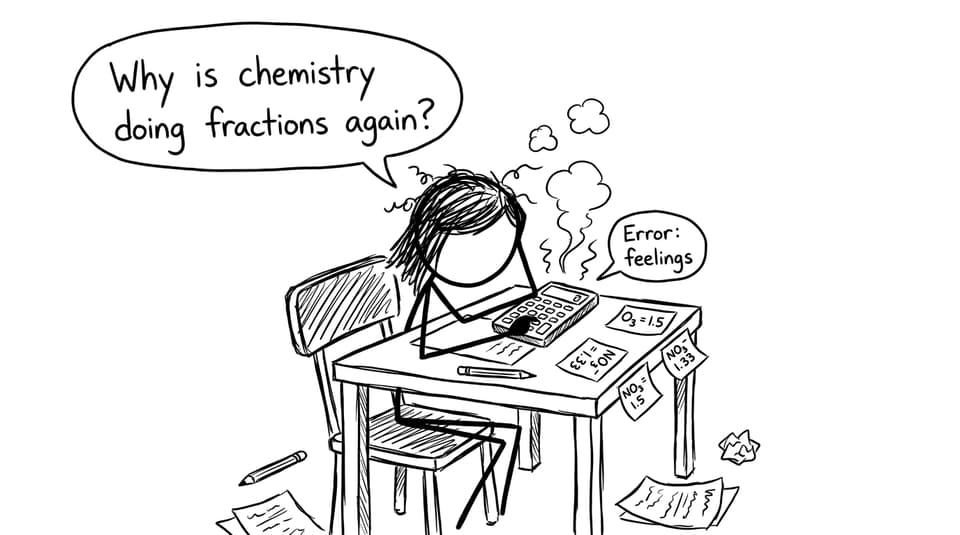
Bond order = 1.5 (average of one single and one double across two positions)
Nitrate ion, NO3-
Three equivalent resonance structures.
What to say:
-
All N-O bonds are identical
-
The negative charge is delocalised over the three oxygens
-
Bond order = 4/3 (1.33...)
If you want to drill these with exam-style prompts, try RevisionDojo’s resonance practice question Which species exhibit resonance? and then build momentum with the S2.2 Questionbank.
Benzene, C6H6 (HL)
Benzene is the classic story of resonance becoming a property.
In IB Chemistry, the key lines are:
-
The ring has delocalised pi electrons
-
All six C-C bonds are equal
-
Benzene is unusually stable (often discussed as resonance energy)
RevisionDojo’s Notes for S2.2.12 Benzene (Higher Level only) is the cleanest next step if your explanations feel vague.
Bond order with resonance: how to answer fast
Bond order questions in IB Chemistry reward calm arithmetic and a clear link to bond length.
Method:
-
Count total bonding pairs across the resonance structures
-
Divide by the number of bond positions
Examples:
-
O3: 3 bonding pairs / 2 positions = 1.5
-
NO3-: 4 bonding pairs / 3 positions = 1.33
Then add the interpretation: higher bond order means shorter, stronger bonds (on average).
For more practice phrasing, see IB Chemistry: Bond Order Explained Simply.
How to write resonance in IB Chemistry markscheme language
A strong response usually includes these three ingredients:
-
“There are multiple valid Lewis structures”
-
“Pi electrons/lone pairs are delocalised”
-
“The real structure is a resonance hybrid with equal/intermediate bonds”
If you’re unsure how detailed you need to be, use RevisionDojo’s IB Chemistry Revision Notes (SL/HL) as your baseline and then test yourself with targeted questions.
Closing: make resonance feel predictable
Resonance in IB Chemistry stops being scary when you treat it like a translation skill: you’re translating a messy electron reality into clean exam language. Multiple valid structures, delocalised electrons, resonance hybrid, intermediate bond lengths, and average bond order.
If you want to make that translation automatic, RevisionDojo is built for it: revise the concept in Study Notes, lock it in with Flashcards, practise with the Questionbank, ask AI Chat for step-by-step fixes when your arrows go wrong, and then pressure-test yourself with Predicted Papers and Mock Exams. Resonance is not a topic you “understand once”, but it’s a topic you rehearse until it sounds effortless.