
The evening before an IB exam has a strange kind of gravity.
Your desk looks smaller than it did yesterday. Your notes look like they gained weight. Even the air in your room feels more serious, as if your walls have started keeping score.
And then the thought arrives, dressed up as responsibility:
“Tonight I’ll finally learn everything I didn’t properly learn all year.”
That thought is The Biggest Mistake Before IB Exams (and the Fix).
Not because you are weak. Not because you do not care. But because the final 12--18 hours are not a time machine. They are a performance window. And what you do in that window determines whether your brain feels like a clean workspace or a cluttered drawer you have to search through under pressure.
The Biggest Mistake Before IB Exams (and the Fix) is simple: students use the day before to expand, when they should be using it to consolidate. The fix is not “do less.” It is “do the right kind of work, at the right intensity, with boundaries.”
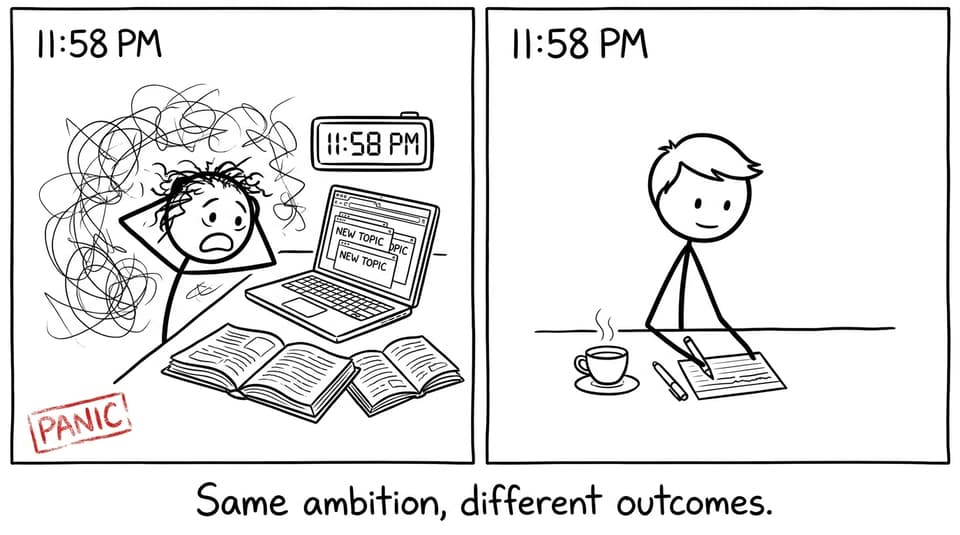
The day-before rule: consolidate, don’t expand
If you only keep one sentence from this article, keep this one:
The day before is for consolidation, not expansion.
Here is a practical checklist you can follow without needing motivation to be perfect.
A calm day-before checklist
-
No new content, unless it’s a tiny gap you can close in under 15 minutes and test immediately.
-
No new study system (no fresh app, no new “perfect schedule,” no resource-switching).
-
One retrieval block per subject (active recall, not rereading).
-
One light timed skills block (mini-set, not a marathon).
-
Close the loop on mistakes (high-return fixes only).
-
Prep logistics (bag, route, timing, permitted equipment).
-
Wind-down routine (sleep is part of the performance plan).
This checklist is the lived version of The Biggest Mistake Before IB Exams (and the Fix): protect the knowledge you already built, and make it usable tomorrow.
Why the “learn everything tonight” instinct backfires
The night before, anxiety tries to be helpful. It wants certainty. It wants control. So it points you toward tasks that feel productive: rewriting notes, opening new videos, starting a fresh unit, reorganizing your whole plan.
But the IB doesn’t reward the feeling of productivity. It rewards what you can retrieve, structure, and apply on a clock.
Familiarity feels like mastery (but it isn’t)
Rereading makes everything seem smoother. Your brain recognizes the words, and recognition is comforting.
But recognition is not retrieval.
In an exam, nobody asks, “Does this look familiar?” They ask you to produce: define, explain, evaluate, calculate, justify. If you want tomorrow’s marks, today’s work must practice output, not just input.
A useful companion read here is The Ultimate Guide to Revision for IB Students, especially the focus on active recall and timing.
You create interference right before you need clarity
When you cram new definitions, methods, and exceptions right before an exam, you increase cognitive interference. Old knowledge and new knowledge jostle for the same mental shelf space.
It’s like labeling a box while someone keeps throwing more items into it.
The result: you walk into the exam with a crowded working memory, and small, avoidable mistakes multiply.
You trade sleep for content, and the exchange rate is terrible
Sleep is not a reward for finishing revision. Sleep is when your brain consolidates memory and regulates emotion.
If you steal sleep to cover “one more topic,” you’re paying with focus, attention to command terms, and stamina across the paper.
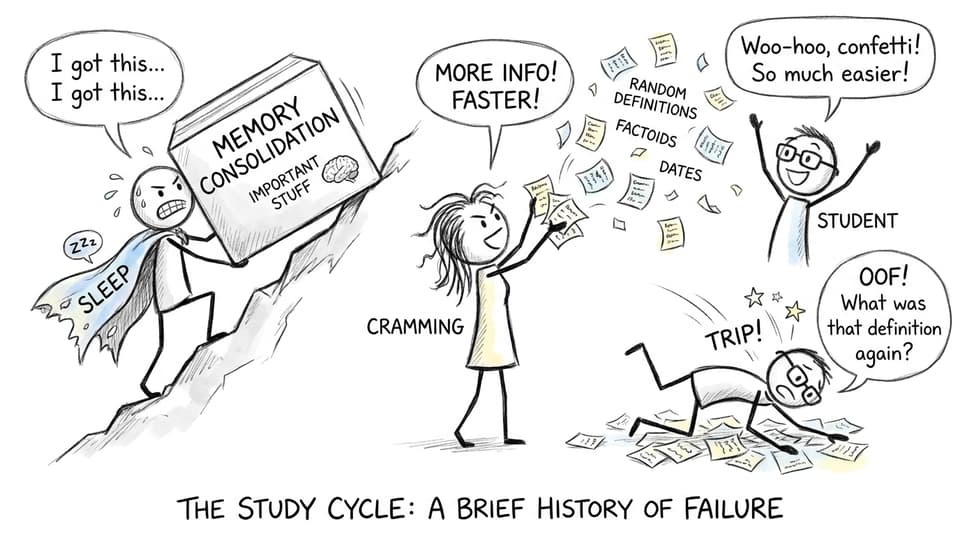
If you want a broader framework for building exam stamina over weeks (so you don’t feel forced to do it in one night), see How to Study for IB Exams: Step-by-Step Guide.
The real pattern: you switch into “firefighter mode”
Most students don’t just cram. They change identities.
All year, you were a student: learn, practice, fix.
The day before, you become a firefighter: chase hotspots, react to fear, try to put out every flame at once.
Firefighter mode looks like:
-
starting brand-new notes because the old ones suddenly feel “messy”
-
doing random questions without reviewing patterns
-
switching resources because someone said another one is “more accurate”
-
measuring your readiness by how stressed you feel
This is exactly why The Biggest Mistake Before IB Exams (and the Fix) matters. The day before is not where you reinvent your academic life. It’s where you protect the version of you that already knows things.
The fix: a day-before plan designed for performance
A good day-before plan does two things:
-
It creates confidence through proof (retrieval).
-
It reduces decision fatigue (clear boundaries).
The easiest way to keep it decision-light is to use one platform that already contains the whole loop: notes, recall, practice, feedback, and realistic timed sets.
RevisionDojo is built for this exact moment: you can move from Study Notes to targeted practice and then lock in memory with spaced repetition.
Step 1: one retrieval block per subject (30--45 minutes)
Retrieval means you practice pulling answers out, not pushing more information in.
Pick one of these per subject:
-
a mixed set of exam-style questions (ideally filtered by your weak topics)
-
flashcards with hard-stop timing
-
a blank-page “brain dump” of processes, formulas, definitions, and key essay points
If you want a structured way to do this, use the RevisionDojo Questionbank to target weak areas, then reinforce the same weak points with RevisionDojo Flashcards.
This matters because The Biggest Mistake Before IB Exams (and the Fix) is really a question of direction: are you building output or hoarding input?
Step 2: one small timed set (20--30 minutes)
Your timed set should end with energy left. The purpose is to rehearse pace and reduce surprise, not prove toughness.
Good options:
-
6--10 mixed short questions
-
one data-based question
-
one essay plan (not a full essay) from a prompt
Then do the part most students skip: review immediately, with a grader’s mindset.
If you struggle to see what the examiner is rewarding, use RevisionDojo’s AI Chat to ask, “What would a top-mark answer include?” and “Which mark bands is my response currently in?” Pair that with Grading tools so feedback turns into a concrete correction loop.
For a deeper look at the “practice, mark, improve” approach, read IB Exam Prep: Don’t Make These Mistakes Too Late.
Step 3: close the loop with high-return fixes only
The day before, you’re not rebuilding foundations. You’re sealing cracks.
High-return fixes look like:
-
clarifying one definition you keep mixing up
-
writing a tiny trigger rule: “If the question says X, I must do Y”
-
correcting one method step that repeatedly causes lost marks
Low-return fixes look like:
-
rewriting an entire unit
-
learning a whole optional topic from scratch
-
doing hours of unfocused practice and calling it discipline
The fix in The Biggest Mistake Before IB Exams (and the Fix) is learning to tell the difference.
Logistics: the boring routine that saves marks
Students rarely underperform because they forgot everything.
They underperform because they arrive stressed, late, under-fueled, or missing something basic.
Do an “exam bag reset” early in the evening:
-
ID and any required documents
-
pens, pencils, eraser, ruler
-
calculator charged (and spare batteries if relevant)
-
water bottle and a simple snack
-
allowed materials for your subjects
-
exam location and timing confirmed
Then put the bag by the door and stop thinking about it.
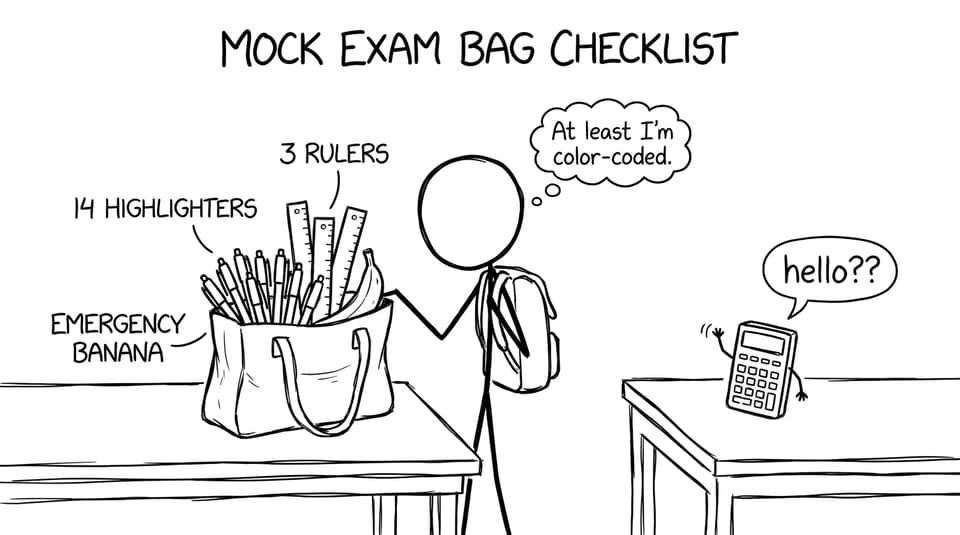
If you want a bigger systems-style checklist for revision season, The Ultimate Checklist for IB Revision complements this nicely.
The quiet skill: managing comparison the night before
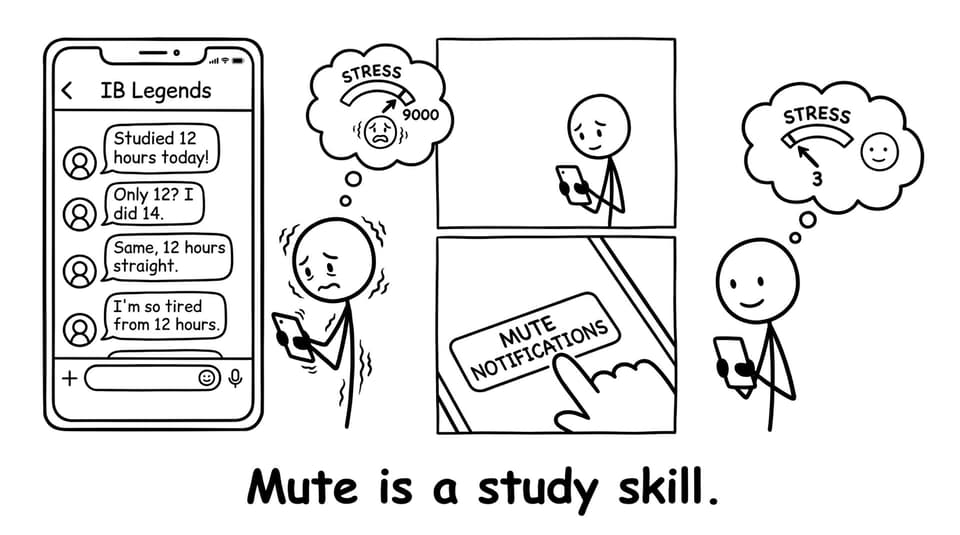
The day before, group chats become strange theaters.
Someone claims they revised “the whole syllabus again.” Someone posts a photo of color-coded folders. Someone says they only slept three hours, as if exhaustion is proof.
Comparison doesn’t just steal joy. It steals decision quality.
Here’s a rule that works: logistics only.
Mute the chat, or set a boundary that you’ll only discuss timing, room changes, and materials. The goal is to protect your attention so you can execute your plan.
If focus is currently your biggest struggle (and the night before often makes it worse), see IB Focus Fix: The Dopamine Problem.
How RevisionDojo fits a day-before routine
The hidden enemy on the day before is not difficulty. It’s choice overload.
RevisionDojo reduces decisions because your entire loop is in one place:
-
Questionbank for targeted retrieval practice and quick accuracy checks
-
Study Notes to patch gaps without rewriting everything
-
Flashcards for fast, repeatable recall
-
AI Chat to unblock confusion without opening ten new tabs
-
Grading tools to turn practice into mark-aware improvements
-
Predicted Papers and Mock Exams to simulate pressure in controlled chunks
-
Coursework Library to keep IA/EE/TOK context organized so it doesn’t leak stress into exam prep
-
Tutors when you need a human to simplify something fast and strategic
If you want a fuller overview of how the platform supports the whole workflow, RevisionDojo App: The Smarter Way to Prep for IB Exams is a strong starting point.
The takeaway: protect tomorrow’s version of you
The Biggest Mistake Before IB Exams (and the Fix) is not about laziness or willpower. It’s about misusing the final hours.
When you try to become a different student overnight, you often trade away the exact things you need tomorrow: clarity, recall, calm.
So keep it simple:
Consolidate. Retrieve. Do a small timed set. Pack. Wind down. Sleep.
If you want the lowest-friction way to do that, build your day-before routine inside RevisionDojo: use Study Notes to patch tiny gaps, Questionbank for proof-based retrieval, Flashcards for fast recall, and AI Chat plus Grading tools to sharpen what the examiner rewards. Add Predicted Papers and Mock Exams in controlled chunks when you want realism, and lean on the Coursework Library and Tutors when life outside exams tries to steal your focus.
Walk into the exam as yourself again. That’s the real fix.
