
Bias in religious research is not always obvious prejudice. More often, it is a quiet preference: the source we trust too quickly, the interview answer we hoped to hear, or the assumption that one believer can represent an entire tradition.
For an IB World Religions SL student, identifying these influences is central to a strong investigative study. You need to examine an aspect of religious experience, practice, or belief while showing that you understand the limits of your evidence. That means testing assumptions, comparing perspectives, conducting ethical fieldwork, and reflecting honestly on what your methods could not reveal.
This guide connects that process to the five IB World Religions IA criteria: A for rationale and preliminary research, B for the plan, C for significant findings, D for critical reflection and evaluation, and E for references and format.
A quick bias-checking framework
Before writing, ask five questions:
- Assumptions: What do I currently expect to find?
- Representation: Whose voice is present, and whose is missing?
- Method: Could my wording, identity, or setting influence the evidence?
- Interpretation: Have I considered a credible alternative explanation?
- Limits: What can my evidence support without overgeneralization?
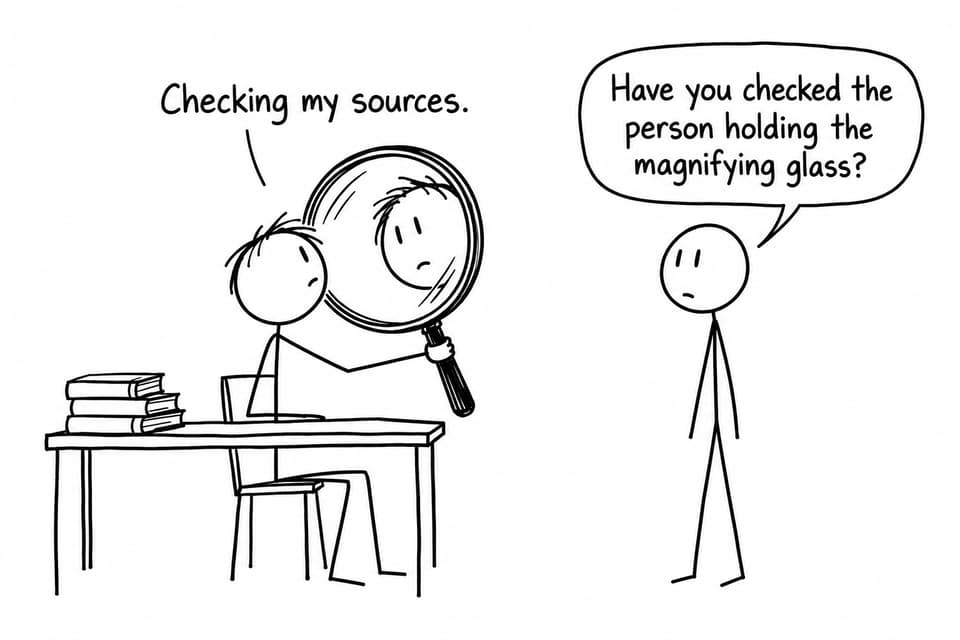
No researcher observes from nowhere. The purpose of these questions is not to promise complete neutrality, but to make your decisions visible and open to evaluation.
What bias looks like in religious research
Bias is a systematic influence on how evidence is selected, collected, or interpreted. A misconception is an inaccurate or oversimplified belief. The two often reinforce each other.
Suppose a student asks, “Why do young Sikhs no longer follow traditional practices?” The wording already assumes decline. A more neutral question might ask, “How do young Sikh adherents understand and negotiate selected practices in daily life?”
Common forms of bias include:
- Confirmation bias: favouring evidence that supports an initial belief.
- Selection bias: choosing participants or sources that represent only one perspective.
- Authority bias: treating a leader, scholar, or sacred text as the complete voice of a community.
- Question-framing bias: leading participants toward an expected response.
- Observer effects: changing behaviour through the researcher’s presence.
- Translation bias: losing cultural or theological meaning when terms are translated.
- Social desirability bias: receiving answers participants consider respectable rather than fully candid.
A recurring misconception is that a religion is internally uniform. Religious traditions contain differences shaped by denomination, geography, generation, gender, authority, culture, and personal experience. Formal teaching also does not automatically predict lived practice. What a source says adherents should do and what individuals actually do are related, but they are not interchangeable.
Connecting bias checks to all five IA criteria
The World Religions investigative study is marked out of 30. Its written analysis must remain within 1,500-1,800 words, so critical thinking must be selective rather than sprawling.
| Criterion | Focus | Marks | Practical bias check |
|---|---|---|---|
| A | Rationale and preliminary research | 8 | Compare sources and expose initial assumptions |
| B | Plan for study | 3 | Design a focused, fair, ethical method |
| C | Summary of significant findings | 6 | Select findings without hiding contradictions |
| D | Critical reflection and evaluation | 10 | Interpret evidence and evaluate limitations |
| E | References and format | 3 | Attribute ideas accurately and follow requirements |
Criterion A: challenge assumptions through preliminary research
First, write your provisional answer before investigating. This private note reveals what you expect. You might believe, for example, that meditation has the same purpose for every Buddhist practitioner. Recording that expectation gives you something concrete to test.
Next, build a varied source set. Combine relevant scholarship, primary religious material, institutional explanations, and adherent perspectives where appropriate. Ask who created each source, for whom, and with what authority. RevisionDojo’s World Religions resources and Study Notes can establish vocabulary, but your investigation still needs appropriately selected evidence.
Then, refine the question. Replace broad categories with a defined group, context, practice, and analytical focus. “What do Muslims believe about modesty?” risks treating a global tradition as uniform. A more manageable question could investigate how members of one identified community understand the relationship between modest dress and religious identity.
For Criterion A, do more than list preliminary sources. Explain how research changed the question, exposed a misconception, or justified the investigation.
Criterion B: design a plan that reduces avoidable bias
Your plan should state what you will do, whom or what you will study, and why the method suits the question.
Choose participants purposefully but acknowledge the limits. One interview can provide depth, not statistical representation. If feasible, seek more than one role or perspective, such as an adherent and a community educator. Do not imply that a small local sample speaks for every adherent.
Prepare neutral prompts. Prefer “How do you understand this practice?” to “Why is this practice important?” because the latter presumes importance. Use the same core questions across comparable interviews while allowing relevant follow-up questions.
Plan comparison before collecting evidence. Decide how interview material will be read alongside scholarship or primary material. This reduces the temptation to select whichever source later supports the most convenient argument. A realistic World Religions IA timeline also protects time for consent, transcription, and reflection.
Criterion C: report significant findings without flattening them
Criterion C rewards significant findings, not a diary of everything that happened. Organize evidence by theme or tension rather than by the order in which you found it.
For each major finding:
- State the pattern or insight precisely.
- Support it with evidence.
- Identify agreement or disagreement between sources.
- Keep the claim proportional to the evidence.
Imagine that an interviewee describes communal worship primarily as social belonging, while an institutional source emphasizes theological obligation. The contradiction is not a problem to erase. It may be the most revealing finding because it shows the distance between official explanation and individual experience.
Use careful language. “The participant described” is safer than “Hindus believe.” Likewise, “Within this investigation” is more defensible than “This proves.”
Criterion D: turn limitations into critical reflection
Criterion D carries 10 marks, making it the largest part of the assessment. Description tells the reader what happened. Critical reflection explains why the findings matter, how the method shaped them, and what remains uncertain.
Interpret rather than repeat. Connect findings to the research question and preliminary scholarship. Ask whether they confirm, complicate, or challenge your original assumptions.
Consider alternatives. If a participant emphasized communal harmony, this could express sincere belief. It might also reflect social desirability, the presence of an outsider, or the interview setting. You do not need to dismiss the testimony. Show that evidence can sustain more than one interpretation.
Evaluate specific limitations. Avoid writing only, “My sample was small.” Explain the consequence. The sample may have overrepresented active community members and offered limited insight into less observant or privately practising adherents.
Reflect on positionality. Your age, background, school affiliation, language, or familiarity with the tradition may affect access and interpretation. Positionality is not a confession of failure. It explains how knowledge was produced.
Propose realistic improvement. Suggest another participant group, a revised question, a different observation period, or a source that could test the conclusion. RevisionDojo’s guidance on reducing bias in IB marking offers a useful parallel: transparent criteria and evidence checks make judgement more defensible. AI Chat and Grading tools can help test whether your evaluation is specific, but they should support rather than replace your reasoning.
Ethics must come before interesting evidence
Religious identity can be personal, communal, and sensitive. Before interviews, observations, photographs, or recordings, obtain informed consent and explain the study’s purpose. Participation should be voluntary, and participants should know how their words will be quoted, anonymized, stored, or shared.
Follow your school’s procedures, especially when participants are minors. Ask permission before recording, entering restricted spaces, photographing ceremonies, or reproducing sacred material. Respect a participant’s right not to answer. RevisionDojo’s notes on ethics, permissions, and fair representation provide a focused preparation checklist.
Ethics continues during writing. Remove identifying details when anonymity was promised, preserve the meaning of quotations, and avoid presenting unusual testimony as typical merely because it is memorable.
Criterion E and the final word-count check
Accurate referencing allows readers to distinguish your interpretation from borrowed ideas. Cite quotations, paraphrases, definitions, images, and relevant claims consistently. Check names, religious terminology, page numbers, and bibliography entries.
If the report exceeds 1,800 words, only the first 1,800 words may be assessed and Criterion E can be affected. Confirm current submission and word-count rules with your teacher before finalizing the document.
During editing:
- Remove background that does not shape the investigation.
- Replace broad claims with evidence-based wording.
- Check that every finding contributes to the question.
- Give Criterion D enough space for interpretation.
- Audit every quotation, citation, caption, and reference.
RevisionDojo’s IA feedback and moderation guide can support a final rubric review. The Coursework Library and Tutors can help you recognize effective organization and seek targeted guidance without surrendering ownership of the work.
Better research begins with intellectual modesty
The strongest World Religions investigative study does not claim to have removed every bias. It shows where bias could enter, how the student tried to reduce it, and what the remaining limitations mean for the conclusion.
That habit is larger than the IB IA. It is the discipline of allowing evidence to complicate an attractive story. With RevisionDojo’s Study Notes, Questionbank, Flashcards, AI Chat, Grading tools, Coursework Library, Predicted Papers, Mock Exams, and Tutors, you can build the subject knowledge and evaluative control needed to tell that story responsibly.