



The moment you realize “hard” means something different
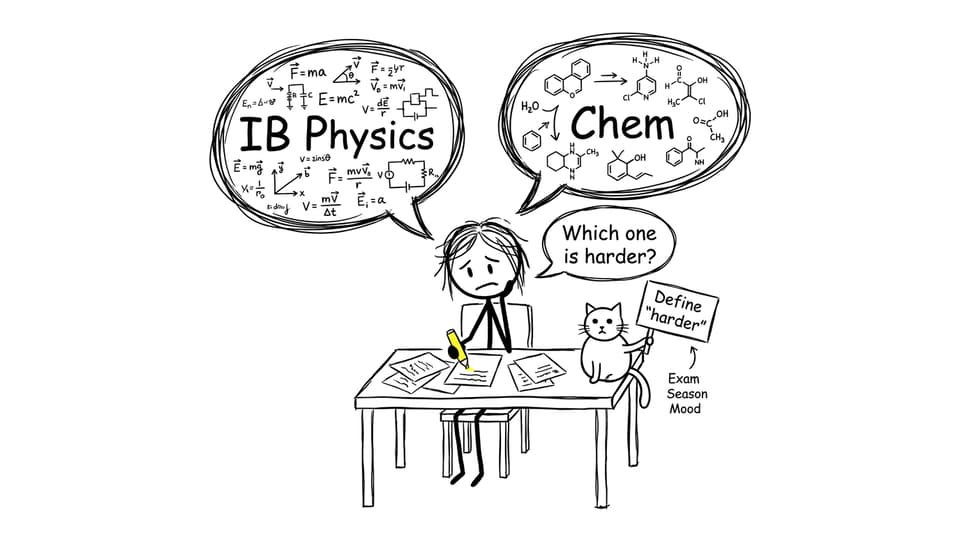
You sit down to revise and do what every IB student eventually does: you compare pain. The IB Physics question looks like three lines and somehow demands two pages of algebra. The Chemistry equation looks familiar… until the wording twists and suddenly you’re juggling concepts, units, and assumptions.
So, are IB Physics calculations harder than Chemistry equations?
Usually, IB Physics feels harder if you dislike abstraction and multi-step algebra. Chemistry feels harder if you dislike dense content and switching between ideas fast. Neither subject is “objectively” tougher. They just tax different parts of your brain.
Quick checklist: what “harder” usually means
When students say IB Physics is harder than Chemistry, they usually mean one (or more) of these:
-
More algebra per mark (you earn points by setting up a model)
-
More steps per question (one slip ruins the chain)
-
Less “real-world” intuition (symbols first, story later)
-
More reliance on fluency with formulas and the data booklet
When students say Chemistry is harder, they usually mean:
-
More content volume (lots of ideas to remember and connect)
-
More concept switching (structure, energetics, equilibrium, then back again)
-
More “why” behind the numbers (the calculation depends on the chemical story)
If you want a clean starting point for your IB Physics revision, keep a topic hub open so you can jump from confusion to clarity quickly: IB Physics resources.
Why IB Physics calculations can feel brutal
The best way to describe IB Physics is: math isn’t the tool. It’s the language.
In a typical IB Physics problem, the “calculation” is really a proof that you understand the model. You’re translating a situation into symbols, choosing an approach, then keeping your logic intact under time pressure. That’s why mechanics and fields questions often feel like puzzles with strict rules.
A small algebra error can collapse everything, not because the IB is mean, but because the model is chained. If you drop a sign, mess up units, or confuse a vector direction early, your answer doesn’t just get slightly wrong. It becomes a different universe.
Two RevisionDojo pages that help here:
-
Mechanics in IB Physics for building the habit of clean, stepwise setups
-
Physics data booklet for training “find the formula fast” muscle memory
And when you’re stuck mid-problem, that’s when RevisionDojo’s AI Chat and Study Notes matter: you don’t need a 40-minute video, you need a 90-second unblock so you can keep practicing.
Why Chemistry equations can feel deceptively heavy
Chemistry has calculations, but the grind often isn’t the algebra. It’s the context.
A Chemistry “equation” question usually asks: do you understand what’s happening, and can you apply that understanding accurately? Stoichiometry is rarely just arithmetic. It’s limiting reagents, conditions, states, proportional reasoning, and the meaning behind the coefficients.
In other words, the numbers behave once the chemistry is right.
If Chemistry feels hard, it’s often because the subject is interconnected. One shaky concept (bonding, structure, energetics, equilibrium) ripples into several topics. That’s why many students do better when they revise in loops: concept, then recall, then application.
Useful starting points on RevisionDojo:
RevisionDojo’s Flashcards shine here because Chemistry rewards frequent, low-friction recall (definitions, trends, conditions, common traps).
The real difference: failure modes
Here’s a practical way to compare IB Physics and Chemistry:
-
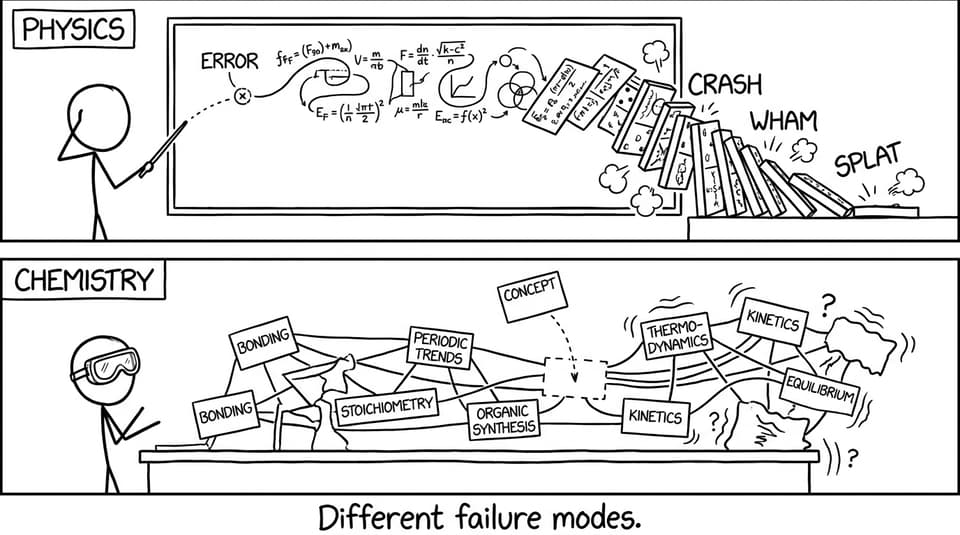
In IB Physics, you can understand the topic and still lose marks from execution: algebra slips, units, sign errors, rounding, vector components.
-
In Chemistry, you can do perfect arithmetic and still lose marks because the setup is conceptually wrong: wrong reaction logic, wrong assumptions, wrong interpretation of conditions.
That’s why your revision strategy should match the failure mode.
For IB Physics, use lots of targeted practice and immediate feedback loops. RevisionDojo’s Questionbank helps you repeat the same skill until it becomes automatic, then mix topics once accuracy is stable.
For Chemistry, use spaced recall plus mixed practice. The goal is not just “can I do this chapter?” but “can I recognize which chapter this question is secretly testing?”
A simple revision plan that works for both
Try this 60-minute block alternating IB Physics and Chemistry days:
-
10 min: RevisionDojo Study Notes on one sub-skill
-
35 min: Questionbank set on that exact sub-skill
-
10 min: review mistakes + create 5 Flashcards
-
5 min: ask AI Chat about your top 1 confusion (keep it tight)
Once a week, simulate pressure with a full paper-style experience using RevisionDojo Predicted Papers and Mock Exams (build stamina, not just knowledge). A helpful overview is: IB Predicted vs Specimen Papers: What They Mean.
The bottom line
If you’re asking whether IB Physics calculations are harder than Chemistry equations, you’re already noticing the truth: each subject is hard in a different direction.
IB Physics rewards precise modeling and algebraic fluency. Chemistry rewards connected understanding and fast recognition of what a question is really testing. Build your revision around those realities, and both subjects become less mysterious.
When you’re ready to turn that strategy into a system, RevisionDojo brings it together in one place: Questionbank, Study Notes, Flashcards, AI Chat, Grading tools, Predicted Papers, Mock Exams, Coursework Library, and Tutors. Start with one topic, one set, one loop, then repeat until IB Physics (and Chemistry) feels familiar under pressure.