


A good IA rarely starts with a genius idea.
It usually starts with a small, honest curiosity: Why does this happen? Then you test it carefully, measure what you can, admit what you cannot, and write it up like you respect the truth. That mindset is what quietly separates a high-scoring IB Physics IA from a stressful document that never quite feels finished.
This guide shares 10 fresh IB Physics IA ideas for 2026 that are practical, measurable, and built for strong analysis. You will also get a quick checklist for picking an IA topic that fits your equipment, your time, and the IB rubric.
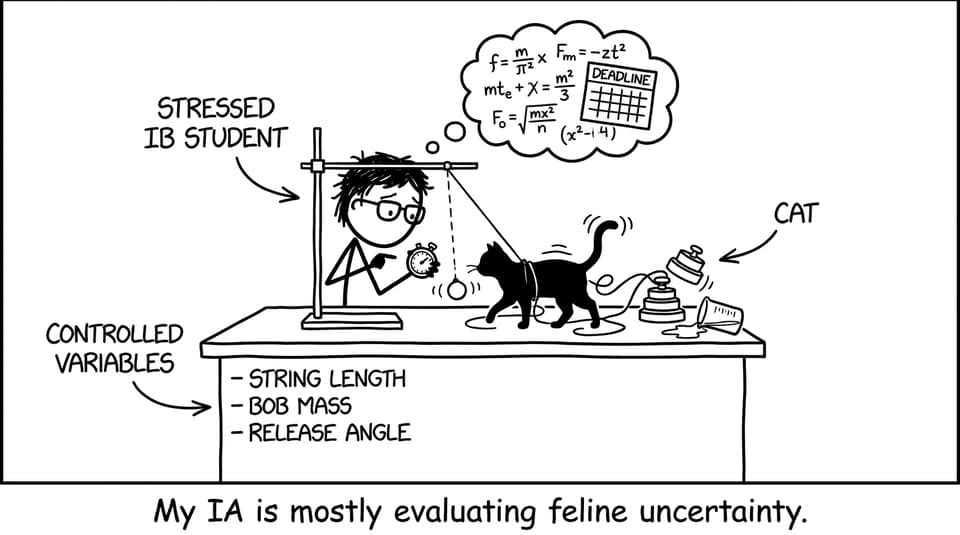
Why the IB Physics IA is worth getting right
Your IB Physics IA is worth 20% of your final grade. That is huge, not because it is scary, but because it is controllable. Unlike an exam, you can improve your IA week by week: tighten the research question, repeat trials, rethink uncertainties, and rewrite the explanation until it reads clean.
If you want to understand what examiners actually reward, keep this open while you plan: IB Physics IA Rubric Explained: Criteria, Tips & Tools. It turns the rubric into plain-English targets, so your IA decisions have a purpose.
A quick IA topic checklist (steal this before you choose)
Before you commit to any IA idea, sanity-check it:
-
One clear independent variable you can vary continuously (angle, length, temperature, distance, frequency).
-
One clear dependent variable you can measure quantitatively (time, voltage, current, intensity, speed).
-
Controls you can actually control (surface type, mass, ambient light, wire length).
-
Enough physics to model (a relationship you can linearise, compare to theory, or interpret with a mechanism).
-
Enough evaluation to discuss (systematic error, instrument limits, assumptions).
When you are stuck, browsing annotated exemplars can reset your instincts for what “good” looks like: IB Physics Examples.
10 fresh IB Physics IA ideas for 2026 (with guidance)
Each IA idea below includes a research-question angle and a practical twist that makes analysis richer.
Friction threshold vs surface texture using video analysis
Classic, but still high-scoring when done with care.
Idea: Measure the critical angle at which a block begins to slide on different surfaces, then infer the coefficient of static friction.
Make it fresher: Instead of just “different materials,” quantify surface roughness (for example, sandpaper grit number) and test how friction changes as grit changes.
Pendulum period with amplitude decay as “hidden variable”
Idea: Test the relationship between pendulum length and period.
Make it fresher: Track how amplitude decays over time and discuss how that changes period measurement accuracy. This gives your IA a natural evaluation section: damping, air resistance, and timing bias.
For the mechanics foundations behind this kind of modelling, RevisionDojo notes help you write cleaner theory: IB Physics A.1 Kinematics Notes.
Solar panel output vs tilt angle with a controlled light source
Idea: Measure current/voltage/power from a small solar panel as you vary the tilt angle.
Make it fresher: Control intensity with a fixed lamp distance, then compare your results to a cosine model. Your IA becomes less about “what angle is best” and more about “how well does the model explain reality, and why not?”
Drag force proxy using terminal velocity in a fluid
Idea: Drop small objects in a tall container of water (or glycerine mix) and estimate drag by measuring terminal velocity.
Make it fresher: Compare shapes with similar mass but different cross-sectional area, then fit a model that links drag to velocity. You get meaningful graphs and uncertainty discussion without needing a wind tunnel.
Thermal conductivity comparison using cooling curves
Idea: Compare how different metals transfer heat.
Make it fresher: Instead of “time to cool,” record temperature vs time and fit an exponential model. You can discuss assumptions, heat loss pathways, and sensor lag.
Resistance of a wire vs temperature (and the “real life” error sources)
Idea: Measure resistance as temperature increases and relate it to resistivity.
Make it fresher: Explicitly evaluate contact resistance and lead-wire effects. This is where many IAs become excellent: not by hiding messy realities, but by quantifying them.
To strengthen your circuits theory and vocabulary, use: IB Physics Topic B.5 Current and Circuits Notes.
Buoyancy vs liquid density with a calibrated volume method
Idea: Investigate buoyant force in liquids of different densities.
Make it fresher: Keep the object constant and vary density with salt solutions, then compare measured buoyant force to Archimedes’ principle. Discuss density measurement uncertainty and temperature dependence.
Refractive index measurement with multiple methods (Snell vs apparent depth)
Idea: Determine refractive index of a material.
Make it fresher: Use two methods and compare them: Snell’s law with a laser and protractor, plus apparent depth using a ruler and viewing angle. The comparison itself becomes analysis and evaluation.
V to I characteristics of a non-ohmic device with thermal modelling
Idea: Measure V to I curves for a filament bulb or diode.
Make it fresher: For a filament bulb, discuss how heating changes resistance and why the graph curves. You can even estimate filament temperature trends qualitatively from power.
For targeted practice while you write your explanation, RevisionDojo’s Questionbank is ideal: B.5 Current and Circuits Questionbank.
Resonance in air columns with smartphone audio analysis
Idea: Explore resonance frequencies in air columns of different lengths.
Make it fresher: Use a phone app to identify resonance peaks, then link frequency spacing to the speed of sound. Your evaluation can discuss background noise, end correction, and frequency resolution.
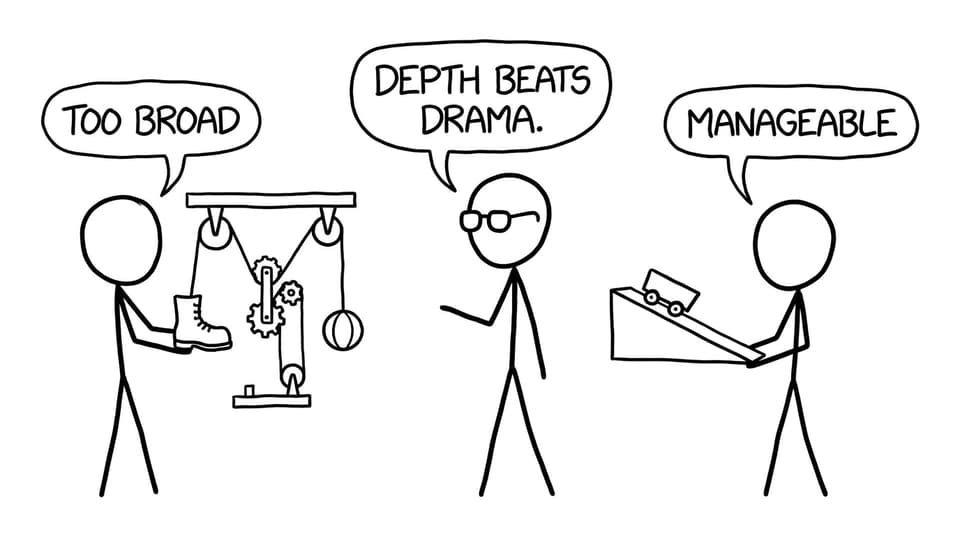
How to turn an IA idea into a high-scoring research question
Most students lose marks because the IA idea stays an idea. The turning point is a research question with a tight scope and a clear model.
A practical template:
- To what extent does (IV) affect (DV) for (system) under (controlled conditions)?
Then design your analysis before you collect data:
-
What graph will you plot?
-
What should the relationship look like?
-
How will you calculate uncertainty?
If you need help with uncertainty language and data processing practice, build confidence here: 1.2: Uncertainties and errors Questionbank.
How RevisionDojo supports your Physics IA (and your exams)
A strong IA is easier when your studying system is organised.
RevisionDojo helps in a way that feels practical during coursework season:
-
Study Notes to write theory that is accurate and concise, aligned to the updated IB Physics course: IB Physics Resources.
-
Questionbank practice to keep exam skills sharp while your IA takes time.
-
Flashcards for formulas and definitions when your brain is full of graphs.
-
AI Chat to sanity-check reasoning, variable choices, and explanations.
-
Grading tools that break down the rubric so you can self-correct early: IB Physics IA Grader.
-
Mock Exams and Predicted Papers to keep your timeline balanced as exams get closer.
-
A Coursework Library of exemplars to model structure and tone: IB Physics IA Examples.
-
Tutors when you want fast, human feedback on method and evaluation.
Closing: choose the IA you can finish brilliantly
The best IA is not the most dramatic experiment in your class.
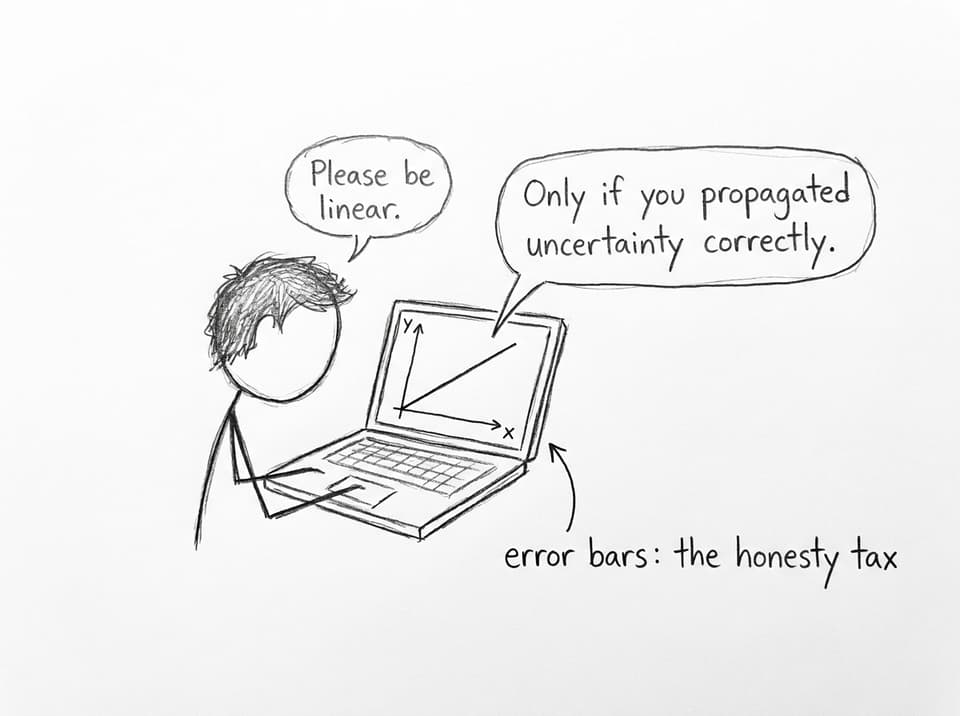
It is the one you can run repeatedly, measure cleanly, and explain with confidence. Pick a question that fits your time and tools. Build analysis into the design. Treat uncertainty like part of the story, not an apology.
When you are ready to turn an IA idea into a plan, use RevisionDojo to tighten your research question, learn the underlying theory fast, and self-grade against the rubric with confidence: IB Physics Internal Assessment Guide.
Your IA can be the calmest, most controllable part of IB Physics in 2026, if you build it that way.