
A strange thing happens when you reread a familiar novel right before exams: it stops being “a story” and starts feeling like a room you can walk around in.
The furniture is still the same, characters, plot, themes, symbols. But once you notice the room’s windows (history, culture, social norms), the lighting changes. A line you skimmed in September suddenly looks like a protest. A small image becomes an argument. And your IB English analysis starts sounding less like summary and more like understanding.
Writing about literary contexts is exactly that skill: learning to open the windows without forgetting to discuss the furniture.
Why literary context matters in IB English
In IB English, examiners reward analysis that explains not only what a text means, but why it might mean that, to its original audience, to the author, and to readers now. Context can help you explain:
-
Why a character’s “normal” behavior is actually shocking for the time
-
Why a theme (power, gender, identity, memory) appears with particular urgency
-
Why an author chooses specific forms and techniques (satire, fragmentation, symbolism)
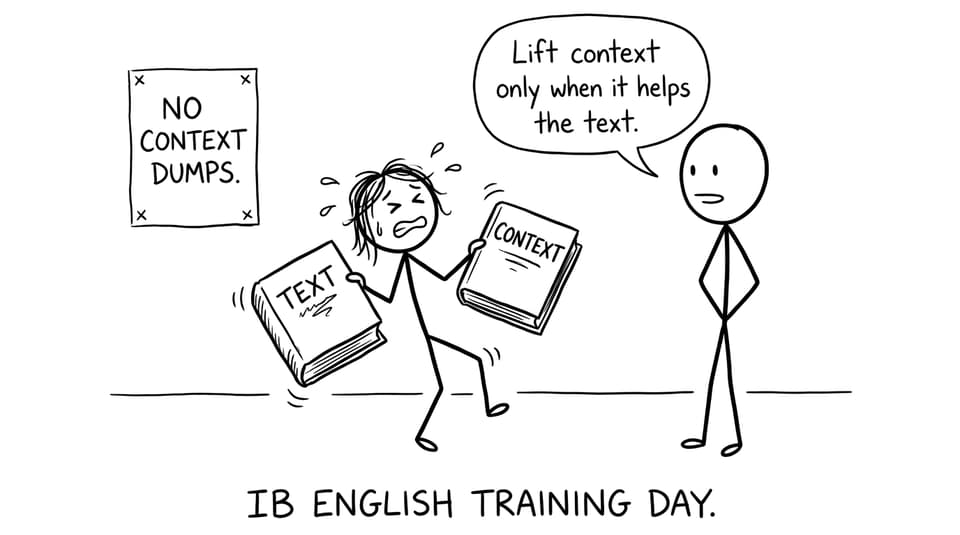
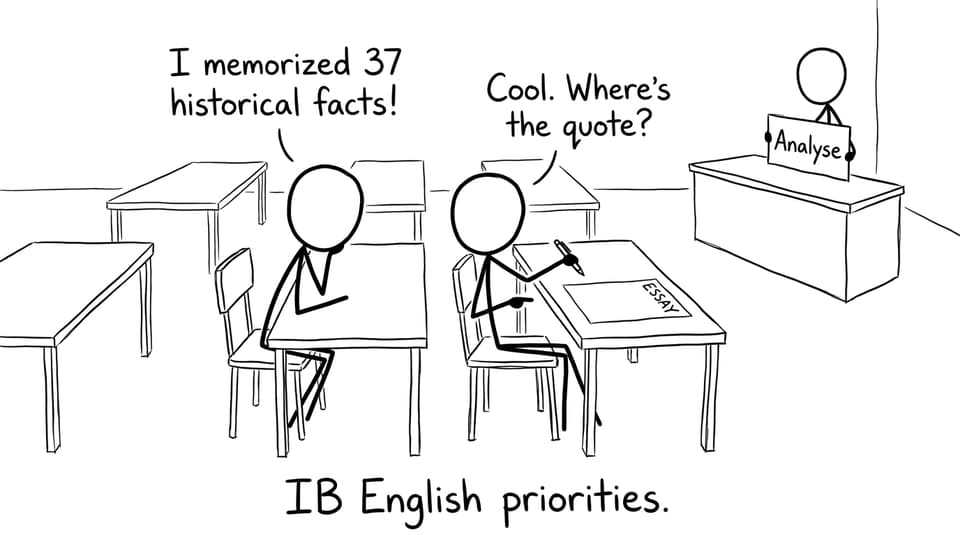
The key is balance. Context is a lens, not a replacement for close reading. If your paragraph could be written without referencing a single word from the text, it’s probably drifting away from IB English criteria.
If you want a clean framework for context types, RevisionDojo’s guide on Understanding Context: Historical, Social, and Cultural Perspectives is a strong starting point.
Quick checklist: context that actually earns marks
Use this before you write any context sentence in an IB English essay:
-
Does this context explain a specific choice in the text (language, structure, characterization)?
-
Can I link it to a short quotation or precise textual reference?
-
Can I state it in one or two sentences?
-
Does it help my thesis, not distract from it?
-
Would the paragraph be weaker without it?
If you answer “no” to most of these, context becomes trivia. And trivia rarely scores well in IB English.
The four most useful context lenses (and how to use them)
Historical context (events and power structures)
Historical context is the big-weather system: wars, political movements, colonialism, censorship, economic upheaval. In IB English, it’s useful when it clarifies stakes.
Try phrasing it like this:
-
“Written in the shadow of ____, the text frames ____ as…,”
-
“Against a backdrop of ____, the author’s use of ____ suggests…,”
Then return to technique. The history should push you back into the lines.
For more help applying this in a structured way, see Historical and Social Influences in IB Texts.
Cultural context (norms, values, and shared meaning)
Cultural context explains what a society assumes: gender roles, family structures, religion, national myths, “respectability,” what counts as success or shame.
This is where IB English analysis can sharpen quickly, because cultural norms often sit behind tone and subtext. When a narrator avoids naming something directly, culture may be the reason. When a character’s silence feels louder than dialogue, norms may be doing the talking.
Social context (class, race, institutions, everyday rules)
Social context is the street-level version of culture: who has access, who is watched, who is believed, who is punished.
In IB English essays, social context is often best used to explain relationships:
-
why certain conflicts repeat
-
why power feels “natural” to some characters
-
why a setting (home, school, court) functions like a trap
Literary context (genre and movement)
Literary context is about what a text is “in conversation with”: realism, modernism, dystopia, postcolonial literature, tragedy, satire.
This context is especially powerful for IB English Paper 1, where you may not know the author at all. You can still write something intelligent like: “The editorial voice relies on conventions of persuasive argument…” or “The poem echoes modernist fragmentation…” and then prove it with technique.
How to integrate context without doing a “context dump”
Most students don’t lose marks because they mention context. They lose marks because the context becomes a separate mini-essay.
A clean method for IB English paragraphs is:
-
Technique first: Identify what the writer does.
-
Micro-context: Give the smallest contextual fact that clarifies why it matters.
-
Meaning: Explain the effect on theme or reader.
-
Return to the text: Anchor with a quotation or reference.
Here’s what that sounds like:
-
Technique: “The author frames the domestic space as restrictive through repeated imagery of…”
-
Micro-context: “In a culture where ____ was expected of ____…”
-
Meaning: “This transforms the home from safety into…”
-
Text anchor: “The phrase ‘____’ reinforces…”
That loop is exactly what IB English examiners recognize as controlled, relevant knowledge.
Context in Paper 1 vs Paper 2 (what changes)
Paper 1: context is implied, not researched
In IB English Paper 1, you’re analyzing an unseen text. That means you should treat context as something suggested by the text itself: diction, references, genre markers, tone, audience.
A practical next step is RevisionDojo’s Mastering IB English Paper 1 guide and the Step-by-Step Guide to Revising IB English Paper 1. Pair that with targeted drills from the English Paper 1 Questionbank so you practice integrating context fast, not perfectly.
Paper 2: context becomes comparative leverage
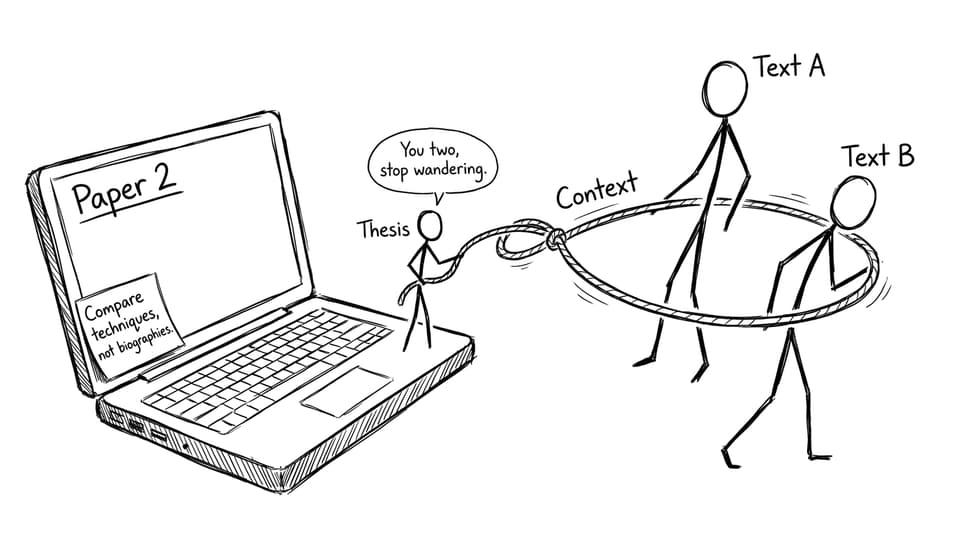
In IB English Paper 2, context can help you explain difference. Two authors might explore power, but one writes under repression and the other writes during cultural transition. That difference can shape tone, endings, narrative voice, even what characters are allowed to say.
If your comparisons feel messy, use RevisionDojo’s Comparative Essay Planning: Theme vs. Form vs. Content alongside the IB English Paper 2 guide and Paper 2 exam structure overview.
A RevisionDojo workflow for mastering IB English context
Context gets easier when it becomes a habit, not a last-minute paragraph.
A simple loop:
-
Use Study Notes to collect 3-5 contextual “micro-facts” per work (the kind you can state in one sentence).
-
Turn those into Flashcards so the facts are retrievable under time pressure.
-
Practice paragraph application in the Questionbank (so you’re not just remembering context; you’re using it).
-
Use AI Chat to test whether a contextual point is relevant: “Does this help explain technique X?”
-
Run a timed Mock Exam and check if your context sentences always link back to evidence.
-
If you’re drafting coursework, use the Coursework Library to see how top responses embed context without overexplaining.
-
When you want human calibration, book Tutors for feedback on whether your context is doing real analytical work.
For criteria-aligned writing, keep IB English assessment rubrics open while you practice.
Closing: make context serve the text (and your marks)
The best IB English essays don’t sound like historians who occasionally quote a novel. They sound like readers who understand that literature is made in a world, and that the world leaves fingerprints on every choice a writer makes.
If you keep context short, accurate, and always tied to technique, you’ll write essays that feel deeper without becoming heavier. And if you want one place to practice that balance with real feedback, use RevisionDojo’s Questionbank, Study Notes, Flashcards, AI Chat, Grading tools, Predicted Papers, and Mock Exams to turn context from “extra information” into exam-ready insight.
For more targeted support, browse all IB English posts and build a plan you can actually repeat.