
If you’ve ever opened an unseen text in IB English and felt the room get quieter, you’re not alone. It’s not that the passage is impossible. It’s that it arrives without context, without comfort, and with a timer running.
A strong IB English Paper 1 commentary isn’t a magic trick. It’s a repeatable sequence of small decisions: what you notice, what you ignore, and how you explain the writer’s choices with calm precision.
What a commentary is in IB English Paper 1
In IB English A: Language & Literature, a commentary is your analytical essay on an unseen text in Paper 1. Your job is to explain how the text creates meaning: through language, structure, style, and (when relevant) visual choices.
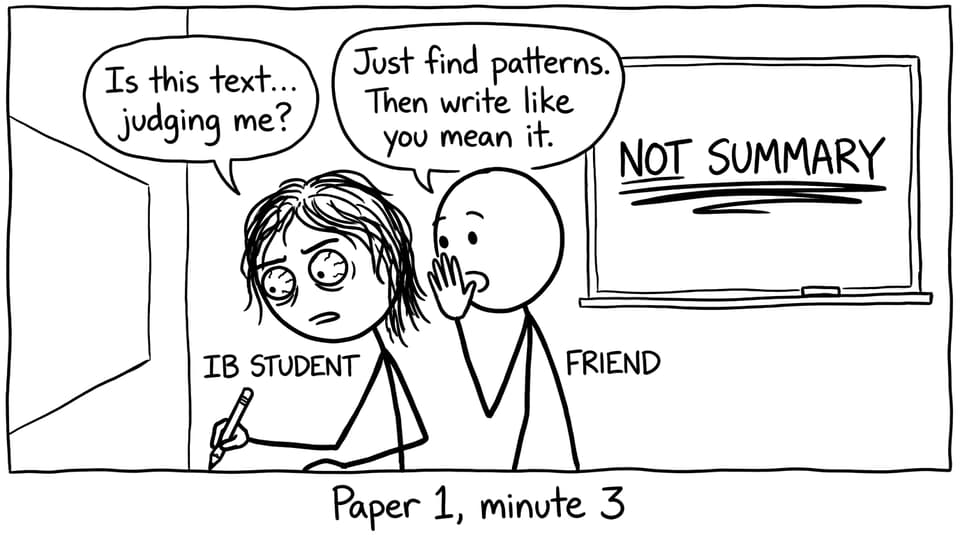
The trap is summary. Summary tells us what happens. Commentary shows how the writing makes the reader feel, think, or believe.
If you want extra practice material that mirrors exam expectations, start with the Paper 1 Lang & Lit hub and dip into the Paper 1 Questionbank.
A fast IB English checklist before you write
Use this quick loop to keep your IB English commentary focused:
-
Identify text type (speech, article, extract, ad) and intended audience
-
Find 2-3 patterns (tone shift, repeated imagery, contrast, argument stages)
-
Build a thesis that connects technique leads to effect, which serves a purpose
-
Plan 3 body paragraphs using PEEL
-
Save time to tighten links and clarity
For a common pitfall list, keep IB English: Common Essay Mistakes to Avoid nearby.
Step 1: Read and annotate like you’re hunting for patterns
Give yourself 10-15 minutes to read twice and annotate once. In IB English, the best annotations are not “metaphor!” scribbles. They’re pattern notes.
Look for:
-
Diction + tone: formal? intimate? ironic? urgent?
-
Structure: where does the text pivot, intensify, or soften?
-
Imagery + motifs: what keeps returning, and why?
-
Audience positioning: what does the reader get pushed to accept?
Your aim is to gather evidence that you can later “zoom in” on. Short quotations (2-6 words) are often enough.
To train this under time pressure, use timed sets from RevisionDojo’s Questionbank, then ask the AI Chat to challenge your interpretation (not replace it). That pushback is where your analysis sharpens.
Step 2: Identify text type, then connect form to purpose
Paper 1 rewards students who can explain why the form fits the function.
-
A speech often uses repetition, inclusive pronouns, and rhythm to persuade.
-
An editorial may build credibility through evidence order and controlled tone.
-
A poem might compress meaning through sound, line breaks, and imagery.
This is the quiet power move in IB English: you don’t just name techniques. You show why those techniques belong to that genre.
If you’re building broader strategy across both papers, see What’s the Best Way to Study for Paper 1 vs. Paper 2?.
Step 3: Write a thesis that has “a spine”
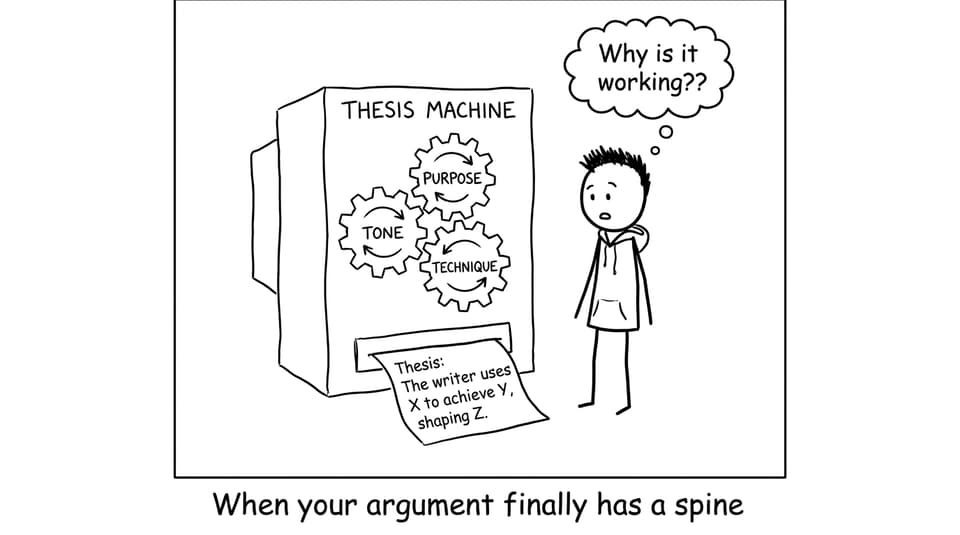
A thesis in IB English Paper 1 should do three things at once:
-
State the overall meaning/central idea
-
Capture the tone
-
Explain the writer’s purpose and main methods
A useful template:
Thesis: The writer uses [key choices] to create [effect], shaping the reader’s understanding of [main idea/purpose].
When you practice, RevisionDojo’s Study Notes and Flashcards help you internalize high-frequency moves (tone verbs, structure words, rhetorical effects) so your thesis comes faster.
Step 4: Build your IB English commentary with PEEL paragraphs
Most high-scoring IB English commentaries feel inevitable: each paragraph proves one part of the thesis, then hands the reader cleanly to the next.
Use PEEL:
-
Point: a specific claim (not “the author uses imagery”)
-
Evidence: short, precise quotation
-
Explanation: technique leads to effect, which conveys meaning
-
Link: return to thesis and show the paragraph’s purpose
If PEEL still feels mechanical, read Writing Analytical Paragraphs: PEEL Method for IB English A and The Importance of Structure in IB English Analytical Writing.
RevisionDojo’s Grading tools can then mark a draft quickly so you can see whether your “Explanation” is truly analysis, or just rephrased evidence.
Step 5: Control your time so your best thinking reaches the page
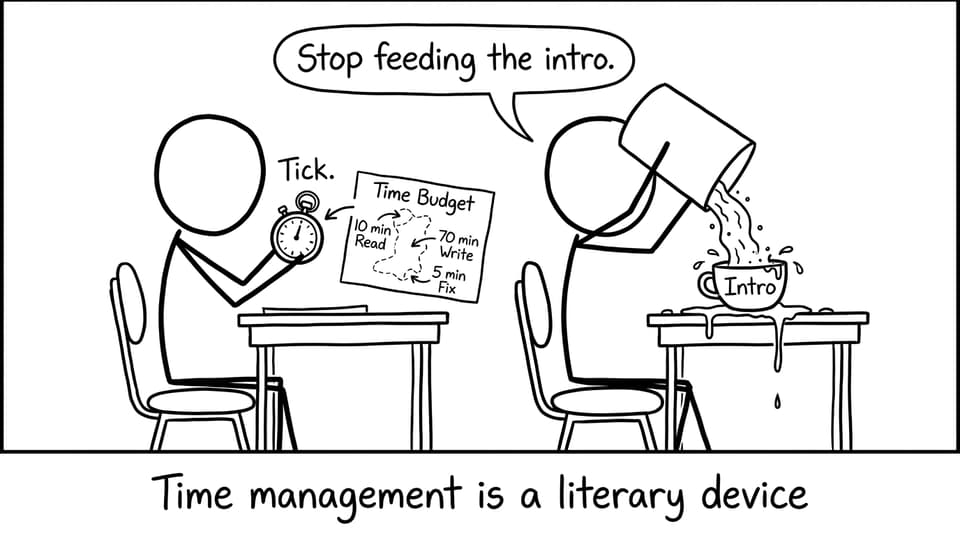
A simple time plan helps your IB English commentary stay complete:
-
10 minutes: read + annotate
-
70 minutes: write (intro + 3 body paragraphs + conclusion)
-
5 minutes: edit for links, clarity, and accuracy
When you simulate full runs, RevisionDojo’s Mock Exams and Predicted Papers replicate exam pressure without wasting your energy searching for materials. If you want a weekly plan, use IB English Paper 1: Best Ways to Prepare.
Step 6: Conclude with significance, not repetition
Your conclusion in IB English should answer: “So what?”
Don’t just restate your thesis. Instead:
-
name the overall effect on the reader
-
show how the final structural choice reinforces purpose
-
leave one sentence of insight about the text’s wider implication
A good conclusion feels like the last piece clicking into place.
Your next step with RevisionDojo
The best IB English commentaries aren’t written by students who “got lucky” with a nice text. They’re written by students who trained their attention: patterns first, thesis second, paragraphs with purpose, and a conclusion that lands.
When you’re ready to practice properly, use RevisionDojo as your home base: the Study Notes to build technique awareness, the Questionbank to drill unseen texts, Mock Exams and Predicted Papers to simulate pressure, AI Chat to challenge your interpretation, and the Grading tools to see exactly what your writing is doing. If you want a guided path, start at the IB English A: Lang & Lit resources page and build from there.