


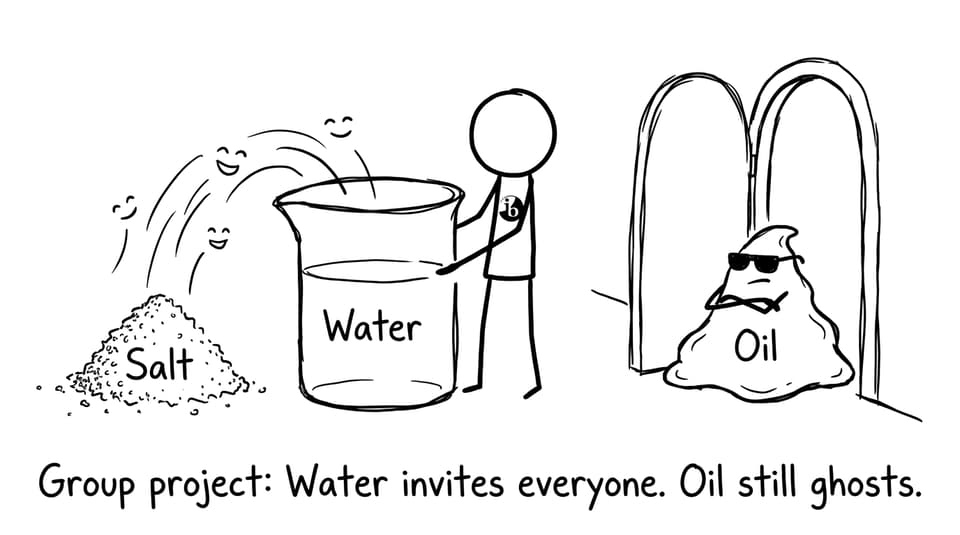
If you have ever watched salt vanish in a glass of water, it can feel like a magic trick you are somehow expected to explain in IB Biology. One moment there is a crystal. Next, it is gone. But nothing disappeared. The solid simply broke apart into particles too small to see, and water did the quiet work of keeping them separated.
That “quiet work” is one of the most testable ideas in IB Biology: water dissolves ionic and polar molecules because water is polar. Once you understand what polarity lets water do, you can explain transport in blood plasma, reactions in cytoplasm, and why membranes assemble at all.
The 20-second IB Biology explanation checklist
Use this as a fast structure in IB Biology long-answer questions:
-
Water has polar covalent bonds because oxygen is more electronegative than hydrogen.
-
Water is bent, so the dipoles do not cancel.
-
Water has partial charges: \u03b4- on oxygen and \u03b4+ on hydrogens.
-
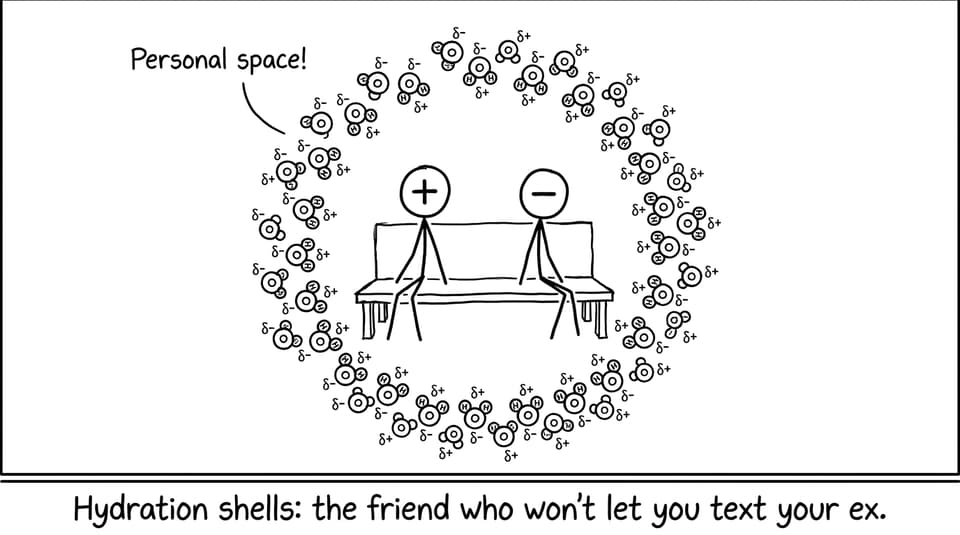
Water attracts ions and polar regions, forming hydration shells.
-
Water makes hydrogen bonds with polar molecules.
-
Hydration shells and hydrogen bonding prevent particles from re-clumping, keeping them in solution.
For syllabus-aligned support, the IB Biology Topic A1.1: Water Notes are the cleanest place to anchor these points.
Water polarity is the real “superpower”
In IB Biology, it helps to treat a water molecule like a tiny magnet. Oxygen pulls shared electrons closer, so the oxygen end becomes slightly negative (\u03b4-) and the hydrogen ends become slightly positive (\u03b4+). Because the molecule is bent, those charges do not balance out.
That single idea explains why water is such an effective solvent. Solvents work when they can surround solute particles and stabilize them so they stay dispersed. Water’s partial charges create constant, meaningful attractions to charged ions and to polar parts of molecules.
If you want a sharper link between polarity and hydrogen bonding, see How Hydrogen Bonds Form in Water. It turns a memorized statement into a cause-and-effect chain you can write under time pressure.
Why water dissolves ionic compounds: hydration shells
Ionic compounds (like NaCl) are held together by strong electrostatic attraction between oppositely charged ions in a lattice. To dissolve that lattice, something has to compete with those attractions.
Water can.
-
The \u03b4- oxygen end is attracted to cations (positive ions).
-
The \u03b4+ hydrogen ends are attracted to anions (negative ions).
When water molecules crowd around each ion, they form a hydration shell. This shell stabilizes the separated ions and lowers the chance they simply snap back into the lattice. In other words, water does not just pull the ions apart; it also prevents reunion.
This shows up directly in IB Biology markschemes as “water surrounds ions” and “hydration shells keep ions in solution.” If you want extra practice on the exact phrasing examiners reward, use the IB Biology Topic A1.1 Water Questionbank (SL/HL).
Why water dissolves polar molecules: hydrogen bonding and dipoles
Polar molecules are not fully charged, but they have regions with partial charges. Glucose, amino acids, and many vitamins are full of polar bonds (often O-H or N-H groups) that can interact with water.
Water dissolves these molecules because it can form hydrogen bonds and other dipole-dipole attractions with their polar regions. The effect is similar to dissolving ions: water surrounds and stabilizes the solute particles so they stay dispersed.
In cells, that matters because transport and metabolism depend on mobility. Dissolved substrates can diffuse, collide, and enter enzyme active sites. This is one reason “water as a medium for life” is such a recurring theme in IB Biology.
To connect this to the syllabus line-by-line, the Notes for A1.1.5 Solvent properties of water as a medium for metabolism and transport are a helpful quick read.
The hidden bonus: water also explains membranes and protein folding
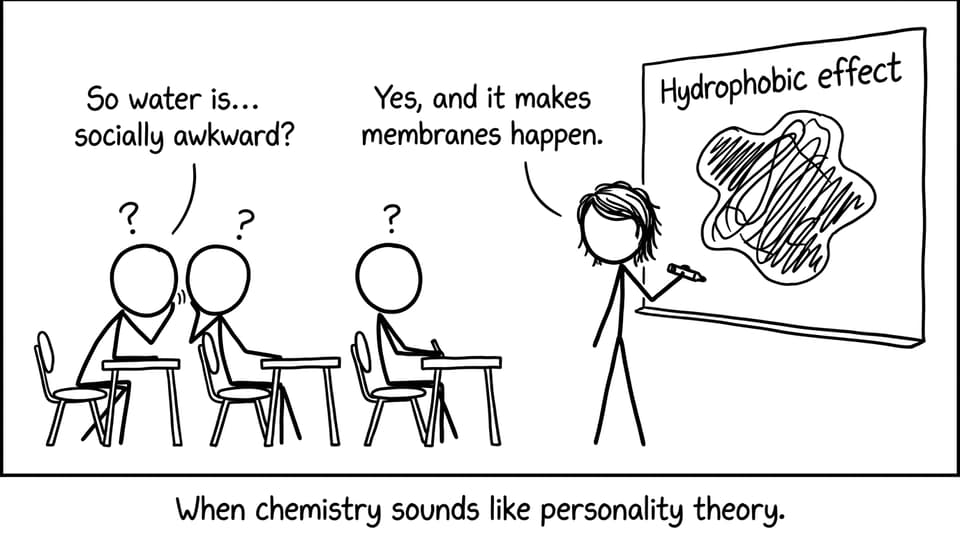
Water’s solvent behavior has a side effect that feels like it belongs in psychology: water “prefers” interacting with polar and charged groups. Nonpolar substances cannot form strong interactions with water, so water molecules instead bond with each other and effectively push nonpolar parts together.
That pressure is the hydrophobic effect. It is central to:
-
Membrane formation (phospholipid tails cluster away from water)
-
Protein folding (nonpolar side chains tend to end up inside)
This is why a small solvent rule becomes a big organizing rule in IB Biology.
How to revise this fast with RevisionDojo
If you are preparing for IB Biology exams, your goal is not just to understand water, but to explain it cleanly. RevisionDojo is built for that:
-
Use the D2.3.1 Solvation with water as the solvent Notes to lock in definitions like solvation and hydration shell.
-
Drill exam-style prompts in the D2.3.1 Solvation with water as the solvent topic hub.
-
Rapid-fire recall with Flashcards for D2.3.1 Solvation with water as the solvent.
-
Build confidence across the course via the IB Biology Resources page, then lean on Questionbank, Study Notes, Flashcards, AI Chat, Grading tools, Predicted Papers, Mock Exams, the Coursework Library, and Tutors when you need targeted help.
Closing: make water your easy marks
In IB Biology, water dissolves ionic and polar molecules for one main reason: polarity. From that, everything follows: hydration shells for ions, hydrogen bonding for polar solutes, and the hydrophobic effect that helps build membranes and fold proteins.
If you want this topic to become the kind you can answer calmly in any exam context, revise it once with the IB Biology Topic A1.1: Water Notes, then test it in RevisionDojo’s Questionbank and tighten your phrasing with AI Chat and Grading tools. Water is everywhere in the syllabus. Let it be everywhere in your marks too.