The moment “expected” stops meaning “next” (IB Math)
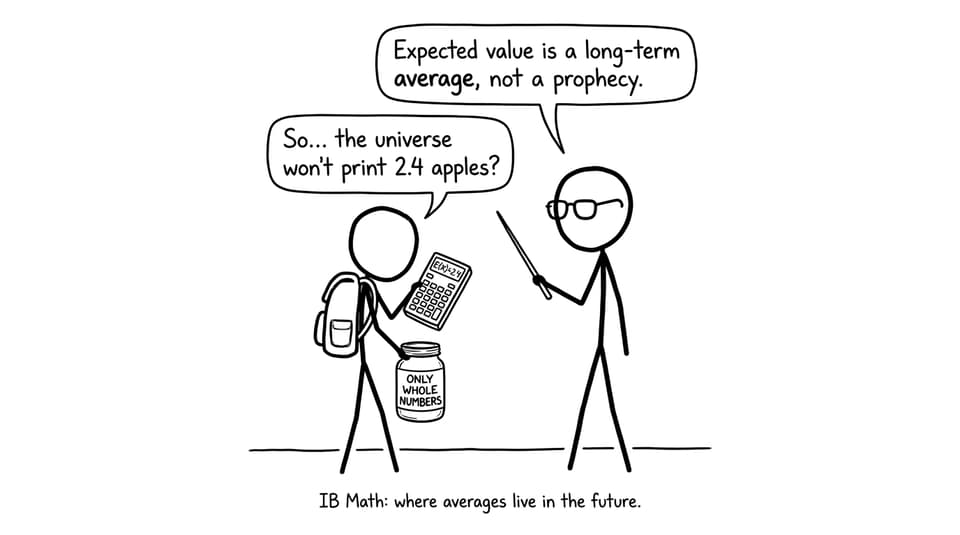
You calculate an expected value, get something like 2.4, and your brain immediately objects: But 2.4 can’t happen. In IB Math, that discomfort is the point. The word expected sounds like a promise about the next trial, but expected value is quieter than that. It’s a long-term average hiding inside a model.
Expected value is what you’d get over many repeats, not what you’re “supposed” to get once. And once you see that difference, a lot of probability questions stop feeling like riddles and start feeling like logic.
A quick IB Math checklist for interpreting expected value
Before you write a conclusion in IB Math, run this quick check:
-
Is the question asking for calculation, interpretation, or both?
-
Did you state that expected value is a long-term average?
-
Did you avoid calling it the most likely outcome?
-
Did you mention risk/variation if the context is games, profit, or decisions?
-
Did you connect E(X) to the whole distribution, not one outcome?
If you want a structured place to drill these interpretations, the IB Math AI Statistics and Probability hub is a clean starting point.
Why expected value is not an actual outcome
In IB Math, expected value compresses a whole probability distribution into one number:
That number is a weighted average. Averages don’t need to be “allowed outcomes.” If you average 2 and 3, you get 2.5, even if your experiment only produces whole numbers.
This is why students often lose marks: they write something like “the expected result is 2.4,” implying a single-trial prediction. Examiners want language like:
-
“The expected value is 2.4 on average over many trials.”
-
“It is not guaranteed and may never occur in one trial.”
For a deeper look at why this becomes even stranger with continuous variables, see Why Is Expected Value Harder with Continuous Variables in IB Maths.
The trap: expected value hides variability
Two situations can share the same expected value but feel completely different to live through.
-
Game A: small wins and small losses (low variance)
-
Game B: rare huge wins and frequent losses (high variance)
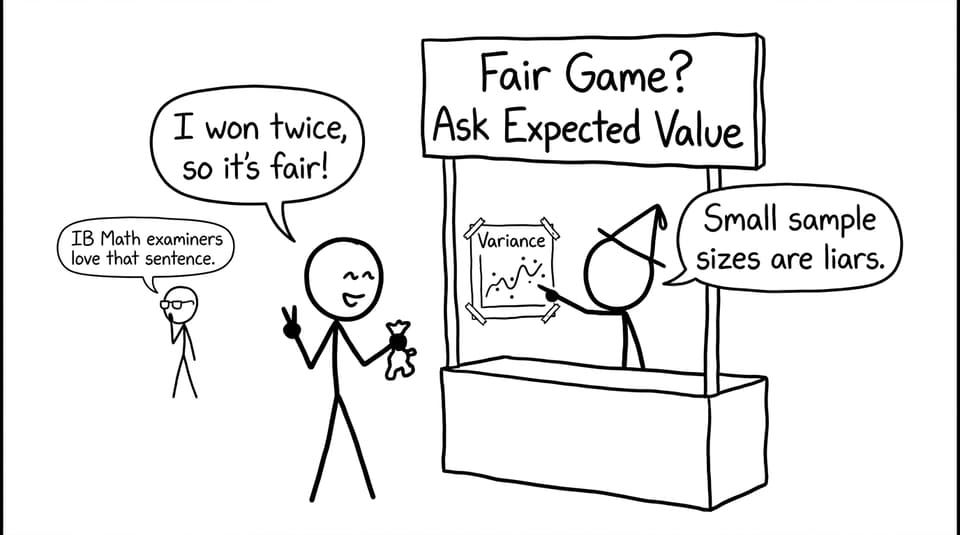
Both could have the same E(X). But in the short run, Game B will often feel “unfair” even if its expected value is positive.
That’s why IB Math often pairs expected value with questions about reliability, fairness, or decision-making. If you want to train that exam instinct, this article is worth keeping open while you practice: Why Expected Value Feels Misleading in Small Experiments.
What to write in IB Math to get the interpretation marks
When a question prompts you to “comment” or “interpret,” aim for three sentences:
-
Define what E(X) means (long-run average).
-
State what it does not mean (not a prediction; not a guarantee).
-
Mention uncertainty (results vary in small samples; spread matters).
Then practice until it becomes automatic. RevisionDojo makes that repetition painless: the Statistics and Probability Questionbank gives exam-style questions with markscheme-level clarity, and the Discrete Random Variables notes keep the definitions tight.
How RevisionDojo helps you turn “EV confusion” into easy marks
A lot of IB Math performance is not about knowing more content, but about making fewer predictable interpretation mistakes.
On RevisionDojo, you can:
-
Use the Questionbank to target expected value, variance, and interpretation prompts (How to Use the Questionbank for Targeted Math Revision).
-
Pair practice with Study Notes so your wording matches what IB expects (How to Master Probability and Statistics in IB Math).
-
Reinforce language with Flashcards (perfect for “definition + limitation” pairs).
-
Ask AI Chat to critique your interpretation sentence for examiner-style precision.
-
Use Grading tools to spot where your explanations lose method marks.
-
Build stamina with Mock Exams and Predicted Papers when you’re close to the exam window.
-
Check model answers and structure in the Coursework Library, or get targeted help from Tutors when a concept keeps slipping.
Bringing it home: expected value is a compass, not a prophecy
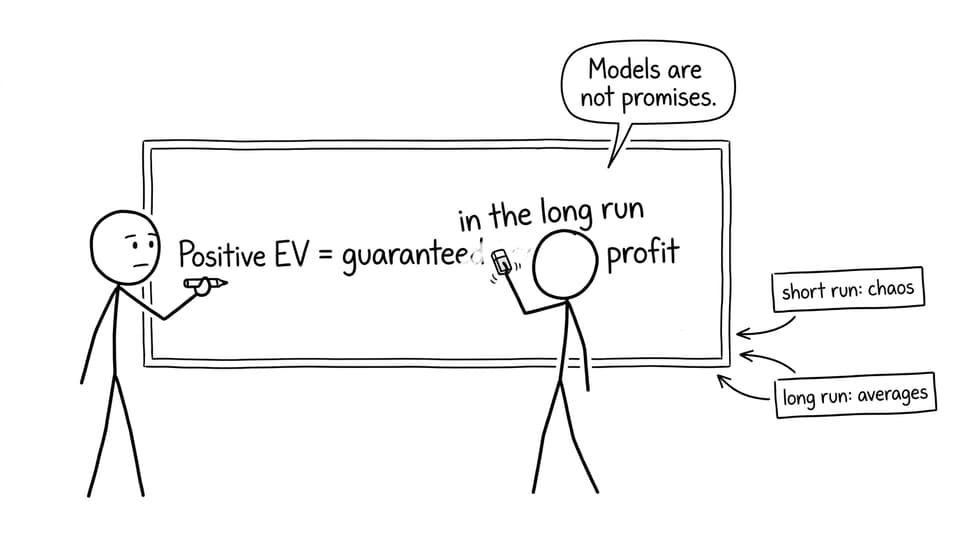
In IB Math, expected value is not what will happen next. It’s what the average drifts toward when life gives you enough repeats for randomness to cancel itself out. Once you treat E(X) as a long-run compass rather than an instant prediction, your explanations get clearer and your marks get more consistent.
If you want to lock this in, open RevisionDojo’s IB Math Probability and Statistics resources, practice a short set in the Questionbank, and use AI Chat to polish one interpretation sentence until it sounds like an examiner wrote it.