


The tiny phrase that costs marks in IB Math
In IB Math, the 90th percentile looks friendly. It’s just “a percentile,” right? You find it on a list, read it off a graph, write a sentence, and move on.
But under exam pressure, that last part, the sentence, is where marks quietly disappear. Not because you can’t calculate the value, but because percentiles are an interpretation test disguised as a calculation question. In IB Math, that’s a common theme: the arithmetic gets you to the door, but language gets you the marks.

A quick percentile checklist (save this)
Before you write anything in IB Math, run this mental checklist:
-
The 90th percentile is a value (a cutoff), not a group of people.
-
90% are at or below that value.
-
10% are above that value.
-
It describes position in a dataset, not “how good” something is.
-
In comparisons, it only talks about the upper tail, not the whole distribution.
If you can say those five lines clearly, percentile questions become much less slippery.
The most common mistake: flipping what it describes
The classic misconception in IB Math is saying: “The 90th percentile is the top 10% of values.”
What examiners want is the reverse emphasis: the 90th percentile is the point below which 90% of the data lies (and above which 10% lies). That sounds like wordplay, but it changes the meaning completely.
A strong exam sentence usually looks like this:
- “A value of 74 at the 90th percentile means 90% of the observations are 74 or less, and 10% are greater than 74.”
If you want a deeper refresher on why interpretation is the real skill here, read Why Percentiles Matter More Than You Expect in IB Statistics.
Why “high” is not an explanation in IB Math
Another trap: treating percentiles like a judgement of quality.
Students write things like “the 90th percentile is a high score, so the student did very well.” In IB Math, that’s usually not what the question is asking. “High” compared to what? A percentile only has meaning relative to the dataset it comes from.
A safer habit: remove opinions, add position.
-
Weak: “It’s a high value.”
-
Strong: “It is higher than 90% of the data values in this distribution.”
That precision is exactly the kind of communication RevisionDojo trains with guided explanations, marking logic, and model answers inside the Questionbank.
The cumulative frequency graph trap (interpolate, then interpret)
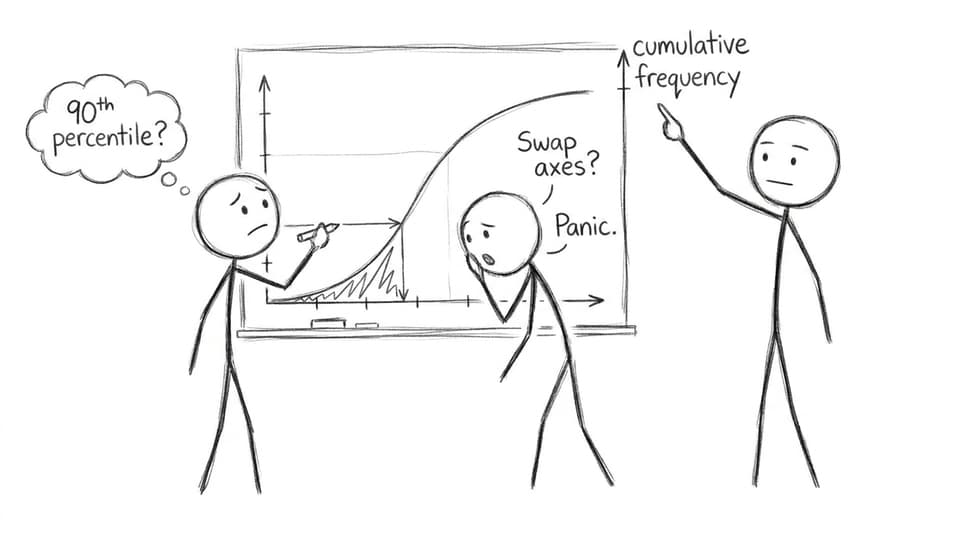
On cumulative frequency curves, the 90th percentile becomes a two-step test:
-
Read the value correctly (often by interpolation).
-
Explain it correctly (in context).
Students often rush step (2) and default to memorised phrases that don’t match what they just read. If cumulative frequency curves tend to scramble your confidence, you’ll find clarity in Why Cumulative Frequency Graphs Feel Hard to Read and targeted practice in the Cumulative Frequency Bootcamp.
You can also drill real exam-style percentile reads in the IB Math AI Presentation of Data Questionbank.
Comparison questions: “higher 90th percentile” doesn’t mean “everything is higher”
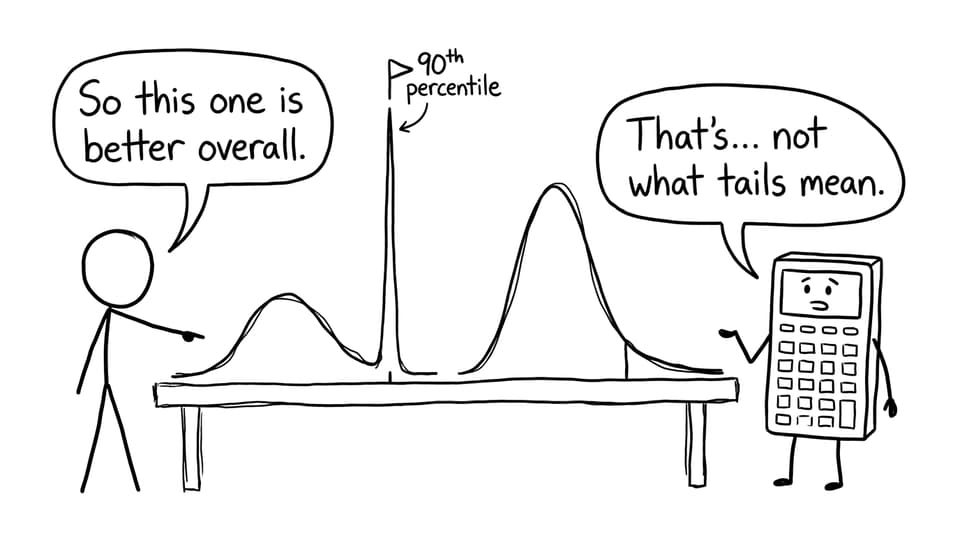
In IB Math, you might compare two classes, two experiments, or two products. If Distribution A has a higher 90th percentile than Distribution B, students sometimes conclude A is “better overall.”
But the 90th percentile only describes the upper end. The medians could be identical. The spread could be different. The lower half could even be worse.
This is why it helps to pair percentile interpretation with other positional ideas (quartiles, median, IQR). If that’s a common weak point, Why Students Misread Quartiles on Cumulative Frequency Curves connects the dots neatly.
How RevisionDojo helps you stop losing “interpretation marks”
Percentile questions improve fastest when you practise the sentence, not just the number.
RevisionDojo is built for that kind of improvement in IB Math: use Study Notes to lock in definitions, Flashcards to train wording, AI Chat to check your explanation in context, and Grading tools to see what an examiner would reward. When you’re ready for pressure, use Mock Exams and Predicted Papers to practise calm interpretation at speed.
To get started, open the IB Math hub and then anchor your revision with the course pages like Mathematics Analysis and Approaches (AA) - IB Resources.
Conclusion: treat the 90th percentile like a communication question
In IB Math, the 90th percentile is rarely “hard math.” It’s careful meaning. The students who score well are the ones who slow down for ten seconds, anchor the definition, and write a sentence that cannot be misread.
If you want that skill to feel automatic, build it the smart way: practise percentile questions with feedback on RevisionDojo using the Questionbank, lock in wording with Flashcards, and pressure-test it with Mock Exams and Predicted Papers. The goal isn’t just to find the 90th percentile; it’s to explain it like you mean it.