

Symmetry is the kind of fact everyone nods at in class, then forgets the second the calculator comes out. And in IB Math, that forgetfulness is expensive: it costs you time, clarity, and often the “easy” method marks hidden inside normal distribution questions.
The normal curve isn’t just pretty. It’s a mirror. If you learn to use that mirror, questions that once felt like a maze suddenly become shorter, safer, and easier to explain.
A quick symmetry checklist for IB Math normal questions
Before you touch a z-score or normalcdf, pause and ask:
-
Is the distribution explicitly normal (or “assume normal”)?
-
Where is the mean on my sketch?
-
Am I working with a left tail, right tail, central region, or two tails?
-
Can I use symmetry to halve or double an area?
-
Does my final probability make sense compared with 0.5?
If you want the official mechanics alongside examples, the notes on Normal distribution and calculations are a clean reference point.
Symmetry is a reasoning shortcut (not trivia)
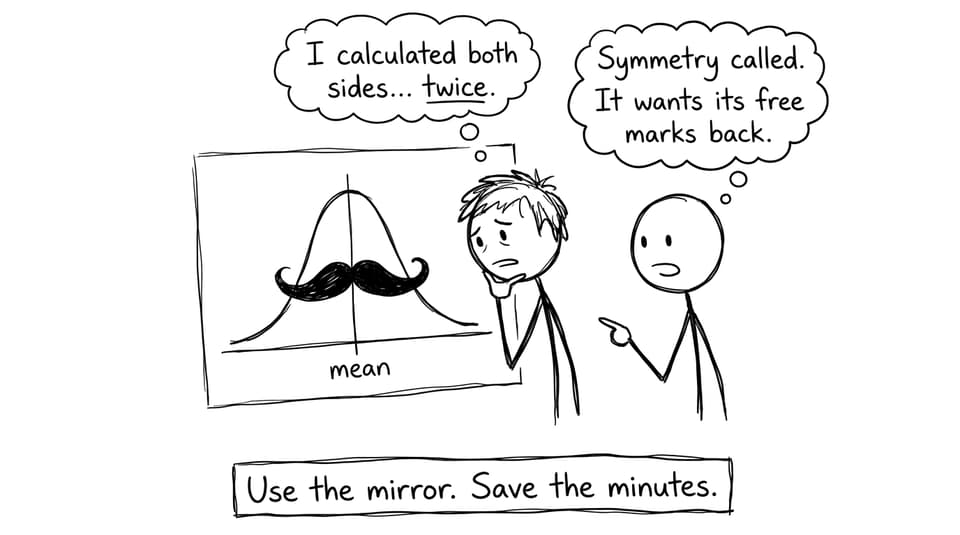
In a normal distribution, points equally far from the mean have equal probability. That single sentence quietly powers a lot of IB Math marking.
For example, if you find (P(X \le \mu - a)), then you automatically know (P(X \ge \mu + a)). Many students still compute both with technology, which works, but it’s like walking around a building to reach a door you can already see.
This is also why your sketch matters. A 5-second bell curve drawing can prevent a 5-minute “wrong region” detour. If normal distribution steps feel oddly unnatural, this article explains why: Why do normal distribution calculations feel so unnatural in IB Maths.
Two-tailed and central region questions: where symmetry saves you
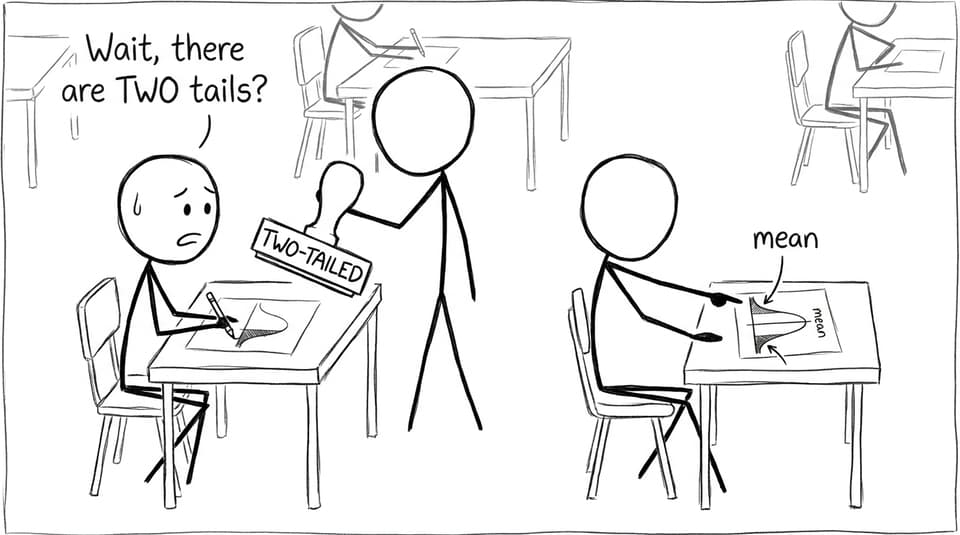
The most common symmetry-related slip is treating the tails differently when the question doesn’t justify it.
-
“More than 2 standard deviations from the mean” is two tails.
-
“Within 1 standard deviation of the mean” is a central region with equal cutoffs on both sides.
Symmetry tells you the left and right pieces match. So you either double one tail, or split the leftover area evenly.
For targeted practice on exactly these question styles, use SL 4.9 Normal distribution Questionbank (Math AI) and pair it with the topic hub SL 4.9 Normal distribution (Math AI). The fastest improvement in IB Math usually comes from seeing the same trap in five different wordings.
Symmetry as a built-in error detector
Here’s the quiet superpower: symmetry lets you sanity-check results.
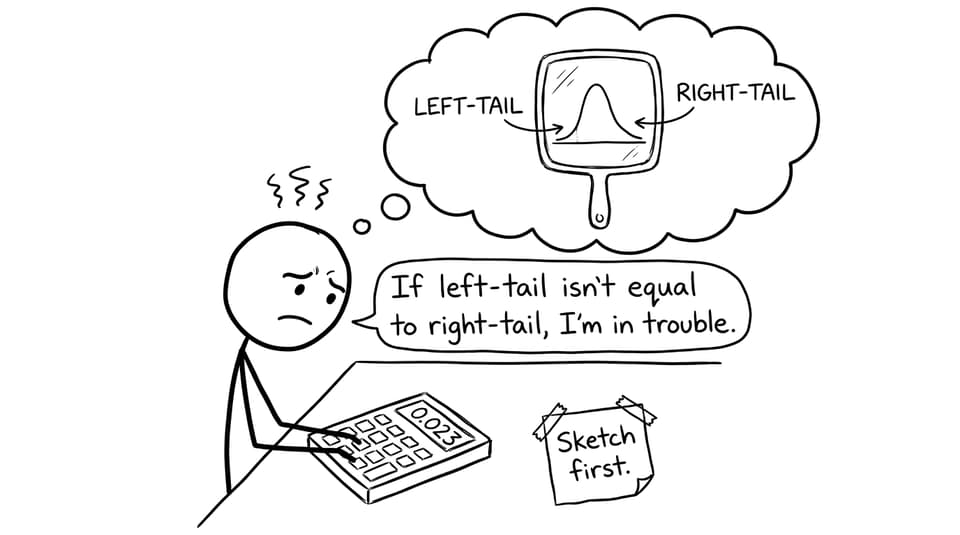
If your calculator gives a tiny left-tail probability for a value below the mean, the matching right-tail probability for the symmetric value above the mean must be the same. If it isn’t, something went wrong: wrong inequality, wrong bound, wrong region, or a misread of the command output.
To strengthen interpretation (not just button-pressing), it helps to revise the broader stats language too: Statistics & Probability Notes (AA) and the Statistics & Probability course hub.
How RevisionDojo helps you actually use symmetry under pressure
RevisionDojo is built for the moment when you’re tired, timed, and the phrasing feels unfamiliar.
-
The Questionbank forces the sketch-first habit and gives solution paths that highlight where symmetry replaces extra computation.
-
Study Notes keep the key ideas (mean-centered symmetry, tails, central regions) visible and exam-aligned.
-
Flashcards make “two-tailed vs central” language automatic: Statistics & Probability Flashcards.
-
AI Chat can interrogate your reasoning: “Why did you double this area?” not just “What button did you press?”
-
Grading tools, Mock Exams, and Predicted Papers help you test whether symmetry shows up in your written explanations, not only your calculator lines.
-
The Coursework Library and Tutors are there when you need context and feedback beyond a single question.
If you want a full revision workflow around probability topics in IB Math, this guide ties it together: How to Master Probability and Statistics in IB Math.
Closing: let the curve do some of the work
The normal distribution is generous: it gives you a mirror line for free. In IB Math, using symmetry turns normal distribution questions from calculator chores into small, explainable decisions. Sketch, locate the mean, mirror what you already know, and use symmetry to check yourself.
When you’re ready to make that habit automatic, RevisionDojo’s Questionbank, Study Notes, Flashcards, AI Chat, Grading tools, Mock Exams, and Predicted Papers turn symmetry into something you rely on under exam pressure, not something you merely remember exists.