



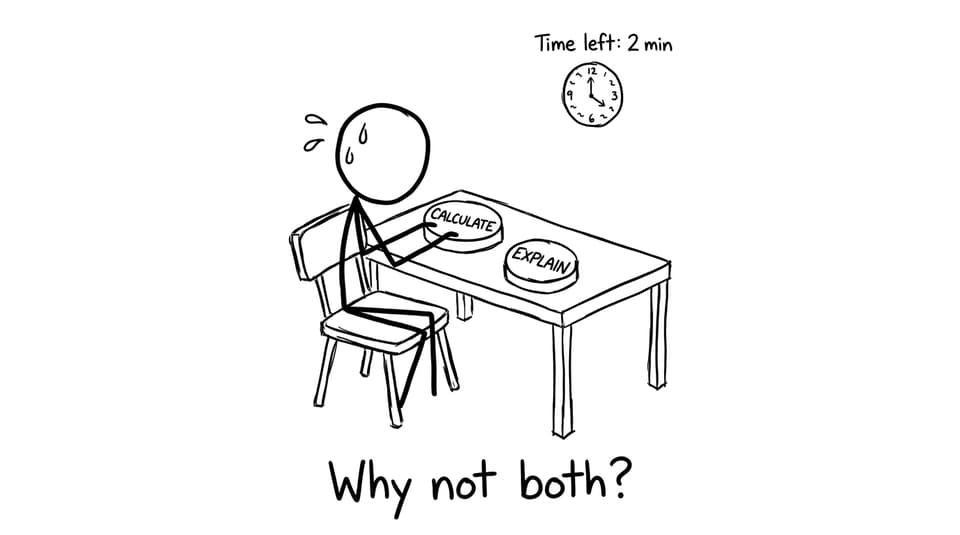
In the last two minutes of an IB Math exam question, something predictable happens: your brain turns into a calculator with legs. You chase the final value, circle it twice, and move on. Later, you read the markscheme and realise the marks were never hiding in the arithmetic. They were hiding in the sentence you didn’t write.
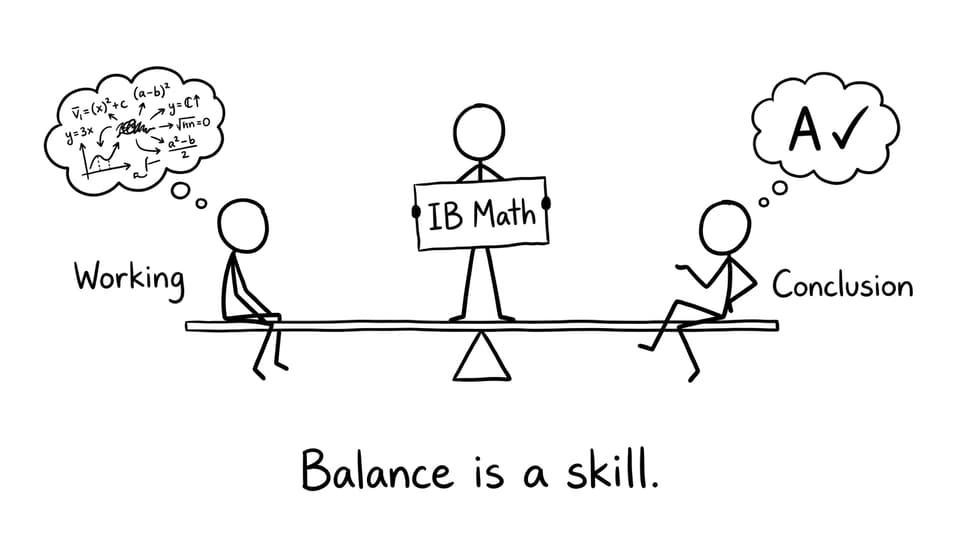
This is why so many IB students struggle to balance maths and explanation. Not because they’re “bad at writing,” but because most of their training taught them that maths ends when the number appears. In IB Math, the number is often just the beginning.
The quick IB Math balance checklist
Before you leave any solution, pause and check:
-
Did I state what the result means in context (not just what it is)?
-
Did I name the method (rule/model/approach) and why it applies?
-
Did I use units, labels, or variable definitions where needed?
-
Did I justify decisions (rounding, assumptions, calculator use)?
-
Did I write a conclusion that answers the actual question?
If you want models of what this looks like in real exam writing, RevisionDojo’s guide on How to Explain Calculations Clearly Without Losing Depth is a strong reference point.
Why students default to calculation-first thinking in IB Math
Most students were rewarded for being fast and correct. Earlier courses often treat explanation as optional decoration: show working, get answer, collect marks. IB Math quietly changes the contract. You’re now graded on reasoned application.
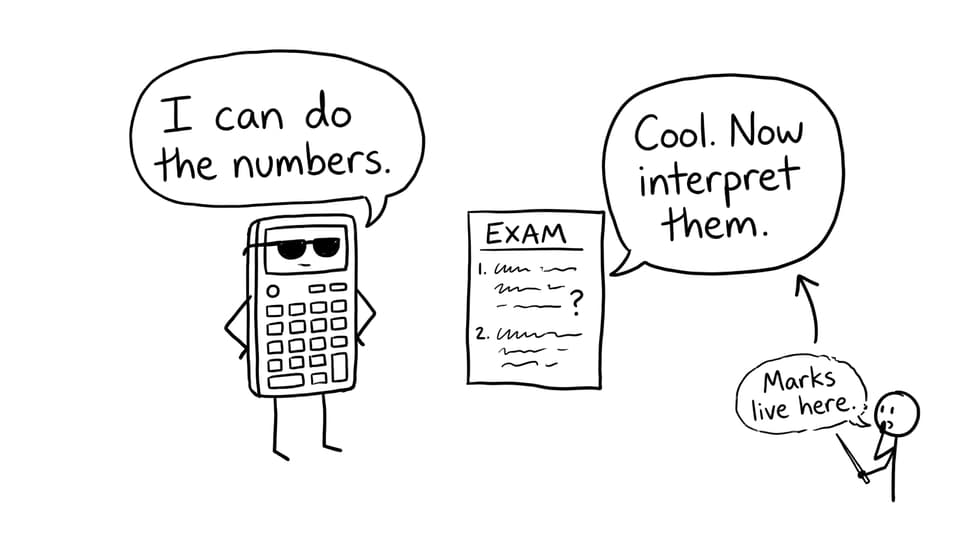
That’s why interpretation-heavy questions feel awkward at first, especially in modelling, statistics, and technology-active tasks. You can be numerically perfect and still lose marks if you don’t connect the result back to the situation.
A good way to retrain this habit is to practise with prompts that force interpretation. RevisionDojo’s IB Mathematics Applications & Interpretation Resources and IB Mathematics Analysis and Approaches Resources both organise practice by topic so you can repeatedly practise the same “explain what your result means” muscle.
Time pressure makes explanation feel like a luxury (but it isn’t)
Under exam stress, students feel they must choose: finish the algebra or write the conclusion. So they sacrifice explanation.
But in IB Math, a thin conclusion can be more expensive than a small numerical slip. The logic is simple: examiners need evidence you understood the journey, not just that your calculator produced a destination.
One practical fix is training under timed conditions with feedback loops. Use targeted sets like Functions - IB Questionbank or IB Mathematics AA Topic Calculus Questionbank to practise finishing solutions with a one- or two-sentence interpretation every time.
The biggest misunderstanding: what “explanation” actually means in IB Math
Many students think explanation is either:
-
restating the question in different words, or
-
adding vague commentary like “this shows a strong relationship.”
But strong IB Math explanation is concrete. It connects results to context, acknowledges assumptions, and justifies conclusions. In statistics, for example, interpretation is often where most of the thinking lives. RevisionDojo’s breakdown Why Is Interpretation Graded More Than Calculation in IB Statistics shows exactly how marks shift toward meaning.
If you’re working on longer-form writing (like coursework), the same principle applies. See How to Write Mathematically Precise Explanations in the IB Math IA for a structure that turns “math writing” into something repeatable.
Tech speeds up maths, which can worsen the imbalance
Technology is supposed to free your attention for reasoning. But many students let it do the opposite: the calculator makes calculation faster, so they rush, and they skip the interpretation that earns marks.
If Paper 2 timing is part of your problem, RevisionDojo’s How to Prepare for IB Math Paper 2 (Calculator Allowed) is a practical reminder: the point isn’t to compute faster. It’s to think clearer.
A simple training method: “Answer the question twice”
Here’s a reliable way to build balance in IB Math:
-
Answer with maths: compute, simplify, solve.
-
Answer with meaning: one sentence that interprets the result and directly addresses the command term.
Then check your own work like an examiner would. Better yet, use RevisionDojo’s ecosystem: Questionbank for exam-style practice, Study Notes for clean explanations, Flashcards for daily recall, AI Chat to clarify confusion quickly, and Grading tools to see what your explanation is missing. When you’re close to exam season, Predicted Papers and Mock Exams help you pressure-test the balance under time limits. If you need a human nudge, Tutors can help you turn messy reasoning into mark-ready writing.
For a sustainable routine, pair this with The Ultimate IB Math Study Routine for Busy Students.
Conclusion: in IB Math, explanation is part of the maths
Students don’t lose marks in IB Math because they can’t calculate. They lose marks because they don’t communicate what their calculations mean.
The fix isn’t writing more. It’s writing with purpose: a method, a meaning, and a conclusion that answers the question. Build that loop with RevisionDojo’s Study Notes, Questionbank, Flashcards, AI Chat, and Mock Exams, and your solutions start to look like what IB examiners are trained to reward.
If your working is strong but your marks aren’t, don’t learn more maths first. Learn to balance the maths you already know with the explanation that completes it, the IB Math way.