



The mistake that feels tiny (until it costs marks)
In IB Math, probability questions have a special way of making smart students feel reckless. Not because the math is impossible, but because two ordinary words, “and” and “or”, suddenly behave like strict legal terms.
Under pressure, it’s easy to treat them as interchangeable. You see a long sentence, you spot familiar numbers, and your brain grabs an operation on autopilot. Add? Multiply? Something with complements? Then you check the solution and realize you just built the right calculation for the wrong word.
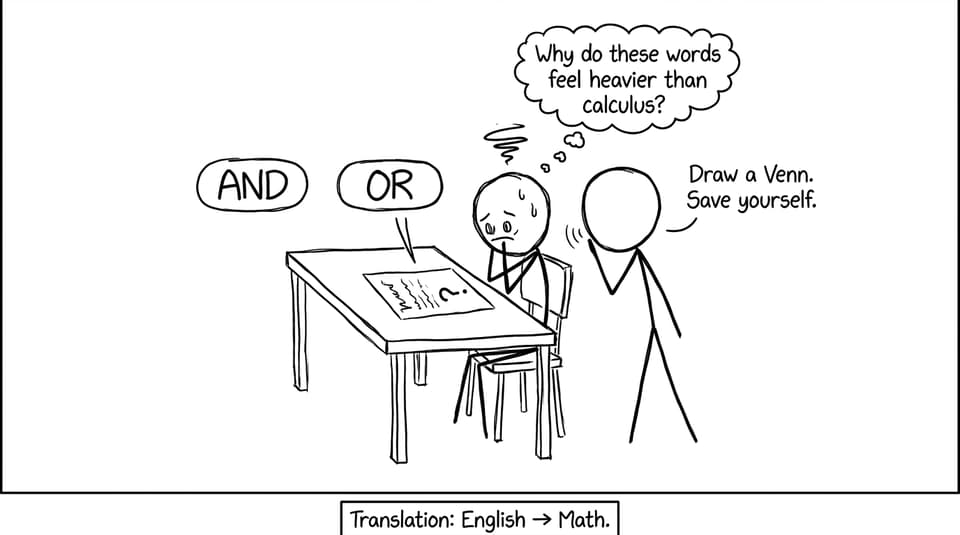
A quick “and vs or” exam checklist (IB Math)
Before you calculate, pause and run this mini-check:
-
Does the question want both events together? That’s A and B (an intersection).
-
Does it want at least one of the events? That’s A or B (a union).
-
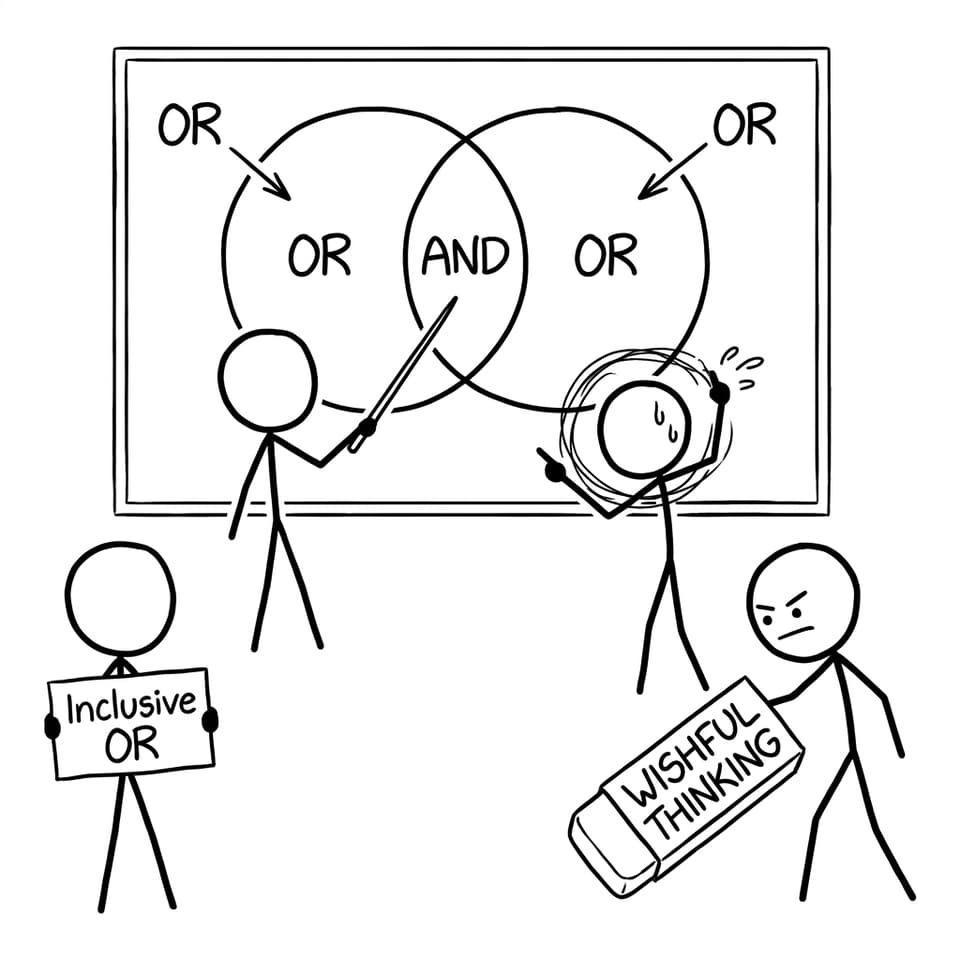
Could both happen at the same time? If yes, “or” is usually inclusive.
-
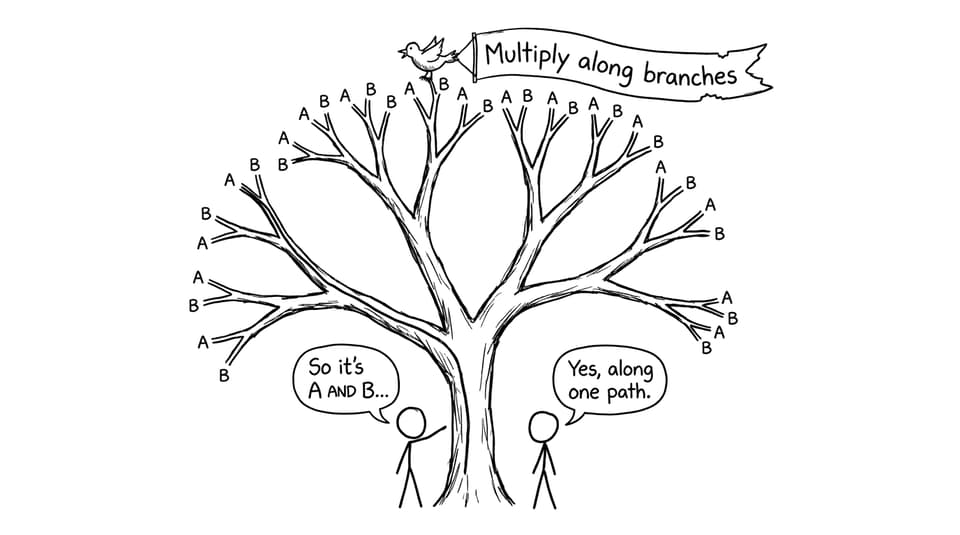
Is there a sequence? Tree diagrams often turn “and” into “along one path.”
-
Can you draw it in 10 seconds? If yes, do it.
If you want a structured method for these steps, keep How to Solve IB Math Probability Problems Step-by-Step open while you practise.
Why “and” vs “or” gets scrambled in your head
Everyday English trains the wrong instinct
In normal conversation, “or” often implies a choice: pizza or pasta. One, not both. But in IB Math, “or” typically means A, B, or both unless the question explicitly says otherwise (for example, “but not both” or “exactly one”).
That mismatch creates a quiet trap: you forget overlap exists, so you overcount or undercount without realizing.
To ground this properly, revise the official-style diagrams in SL 4.6 Venn Diagrams Notes (Math AI).
“And” often hides conditional thinking
Students hear “and” and think “multiply,” full stop. But the real IB Math idea is: what’s the relationship between events?
-
If events are independent, multiplication is straightforward.
-
If events are dependent, you need conditional probability: (P(A \cap B)=P(A),P(B|A)).
If you’re unsure when independence is valid, read Why Independence Matters So Much in IB Probability. That one concept fixes a surprising number of “and” mistakes.
Time pressure makes you stop reading logically
A common exam pattern: the question looks short, the marks are high, and the sentence contains one of those words. Many students skim, see “probability,” then start calculating before translating the logic.
The cure is simple but not easy: treat “and” and “or” as structure, not filler.
The diagrams that prevent the mistake
Venn diagrams are the fastest way to make overlap visible, while tree diagrams make sequences impossible to misread.
-
For A and B, look for the overlap in a Venn diagram, or a single path in a tree.
-
For A or B, you’re collecting regions: left circle, right circle, and possibly the overlap.
To practise this in a targeted way, use Math AI Statistics and Probability Questionbank right after reviewing the notes in Math AI Statistics and Probability.
How RevisionDojo helps you stop losing these marks
RevisionDojo is built for the exact moment you keep meeting in IB Math: you understand the chapter, but you misread the sentence.
Here’s the loop that works:
-
Study the core ideas quickly with RevisionDojo Notes for Math AI concepts.
-
Drill “and vs or” patterns in the Questionbank, where explanations force you to label union vs intersection.
-
Turn your specific mistake into recall using Flashcards.
-
Use AI Chat to ask: “Is this ‘or’ inclusive here, and why?”
-
When you’re ready, simulate pressure with IB Math AI Predicted Papers and Mock Exams, then use the grading tools to see if the error is reading, setup, or method.
If you want a broader plan for the final stretch, How to Score 7 in IB Math AI SL pairs well with focused probability work.
A final thought (and a simple action)
In IB Math, “and” vs “or” is rarely a knowledge problem. It’s a translation problem: English to structure, structure to rule, rule to calculation.
If this is a consistent mark leak for you, run a one-week fix: review Venn and tree diagrams, then do short daily sets from RevisionDojo’s Questionbank, and finish with one timed practice from the predicted papers. By the end, the words stop feeling ambiguous, because your brain starts seeing shapes and paths instead.
When you’re ready to make that practice feel real, start here: IB Math AI Resources on RevisionDojo.