

In IB Math, normal distributions can feel comforting at first. A smooth bell curve, a tidy mean, a neat standard deviation. It looks like the kind of topic where, if you memorize the steps, the marks will follow.
But then the exam happens. And suddenly “mean” becomes a promise, “standard deviation” becomes decoration, and a z-score becomes a random number you hope the calculator likes. That’s where students misuse the mean and standard deviation in normal distributions, not because they can’t compute, but because they don’t interpret.
A quick IB Math interpretation checklist
Before you write any conclusion about a normal distribution in IB Math, ask:
-
What does the mean say about the center (not the outcome)?
-
What does the standard deviation say about spread (not difficulty)?
-
Did I use both together to describe position and variability?
-
If I found a z-score, did I explain what that position implies about rarity or likelihood?
If any answer is missing, your solution may be correct but still feel “thin” to an examiner.
IB Math mistake: treating the mean like a guarantee
The mean is the balancing point of the distribution. In IB Math, it’s tempting to treat it like the value most outcomes “should” be.
But a mean is not a promise. It’s a reference point.
A student might write, “Most values will be close to 50 because the mean is 50.” That sounds reasonable, yet it’s incomplete because it ignores the thing that controls “close”: the standard deviation.
To sharpen this skill, it helps to practice with explanation-focused prompts like those in the SL 4.9 Normal distribution notes, where the language of center vs spread shows up again and again.
IB Math mistake: using standard deviation as a fancy extra
Standard deviation is not a technical flourish. It’s the story of variability.
In IB Math, students often quote it and move on: “The standard deviation is 12.” Full stop. No interpretation. No link to what that means for the data.
A better habit is to translate it into plain meaning:
-
Small standard deviation: values cluster tightly, the mean is a stronger summary.
-
Large standard deviation: values are scattered, the mean is a weaker predictor.
That “mean as a weaker predictor” phrase is exactly the kind of examiner-friendly interpretation that turns procedure into understanding.

IB Math mistake: separating mean and SD when they only make sense together
The mean tells you where. The standard deviation tells you how confidently.
If you discuss the mean without variability, you’re basically describing a location without a map scale. In IB Math, that’s how students lose marks on “comment,” “hence,” and “interpret” command terms.
RevisionDojo’s AI SL 4.9 Normal distribution Questionbank is useful here because you can drill questions that force you to write conclusions, not just compute probabilities.
IB Math mistake: doing z-scores without meaning
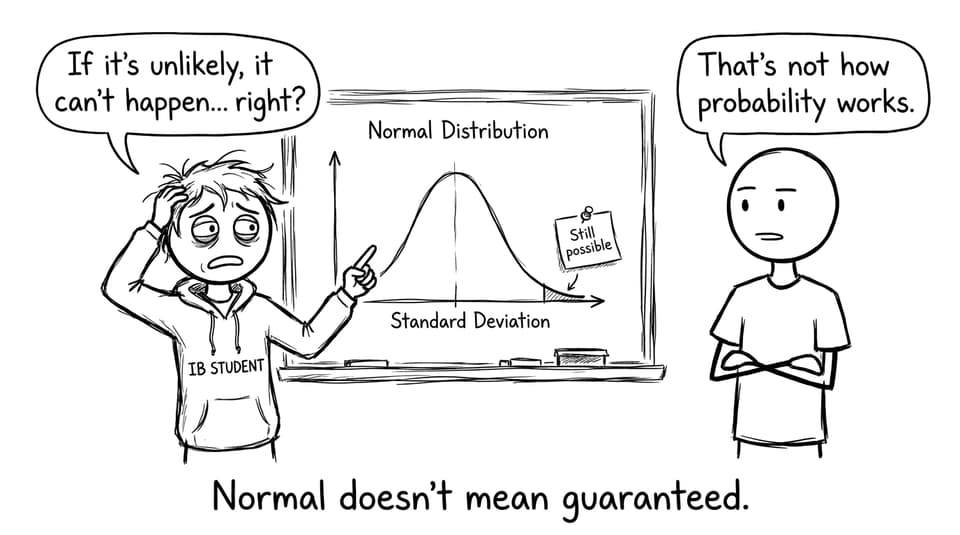
A z-score is a position: how many standard deviations a value lies from the mean.
Many IB Math students standardize correctly, then stop thinking. But “z = 2” is not the finish line. It’s the cue to interpret.
If a value is two standard deviations above the mean, your next sentence should explain what that implies: it’s relatively rare, it sits in the upper tail, and it’s meaningfully above average given the spread.
If you need a clean refresher that connects method to meaning, the AA SL 4.12 z-values notes lay this out clearly, and the matching AA SL 4.12 Questionbank makes it stick.
IB Math mistake: thinking “normal” means “reliable”
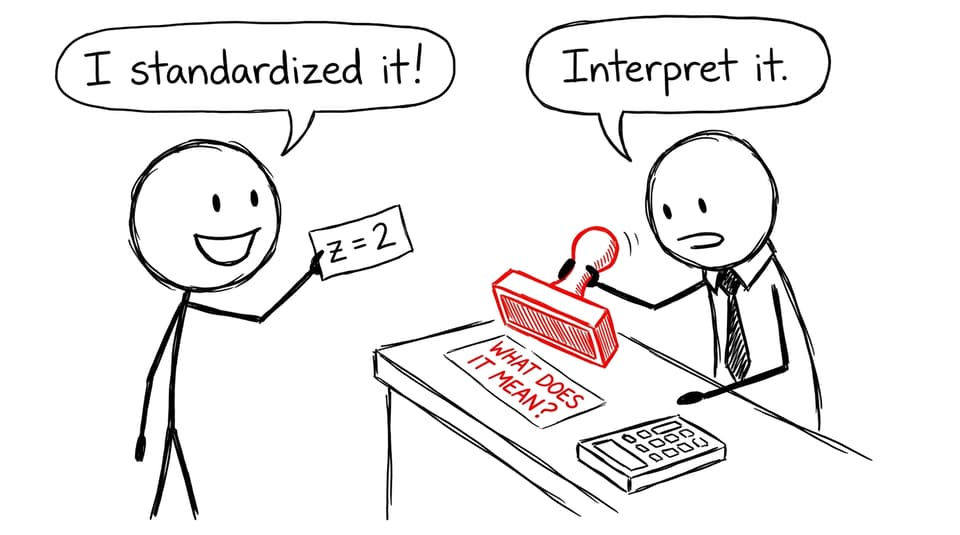
Even a perfectly normal distribution has extremes. Tails exist. Low probability does not mean impossible.
Examiners notice when students write absolute language: “This will not happen,” or “No values are above…” In IB Math, the stronger phrasing is probabilistic: “unlikely,” “rare,” “with small probability.”
If normal distribution questions still feel weirdly unnatural, the blog post Why Do Normal Distribution Calculations Feel So Unnatural in IB Maths is a helpful mindset reset.
Conclusion: the IB Math upgrade is interpretation
The big shift in IB Math normal distributions is simple: stop treating mean and standard deviation as formulas, and start treating them as a pair of descriptive tools.
To train that skill under exam pressure, RevisionDojo is built for it: the Questionbank for targeted practice, Study Notes and Flashcards for quick recall, AI Chat for “why does this mean that?” moments, and Grading tools, Mock Exams, and Predicted Papers to sharpen your exam writing. If you’re working on internal assessments too, the Coursework Library and Tutors can help you connect statistics to real contexts.
For your next practice session, pick one normal distribution question and force yourself to write two extra lines: one about the mean, one about the standard deviation. That’s where the marks are hiding in IB Math.