You compute a 0.7 chance, you do the thing, and then it doesn’t happen. Your brain doesn’t think, “Ah yes, variance.” It thinks, “I did it wrong.” That quiet panic is one of the most common traps in IB Math: treating probability as a long-term guarantee instead of a long-term pattern.
In exams, this misunderstanding shows up in the wording. Students make confident claims about what “will” happen next, as if the number on the page is a prediction rather than a model. And in IB Math, especially Applications and Interpretation, interpretation marks are often where grades quietly rise or fall.
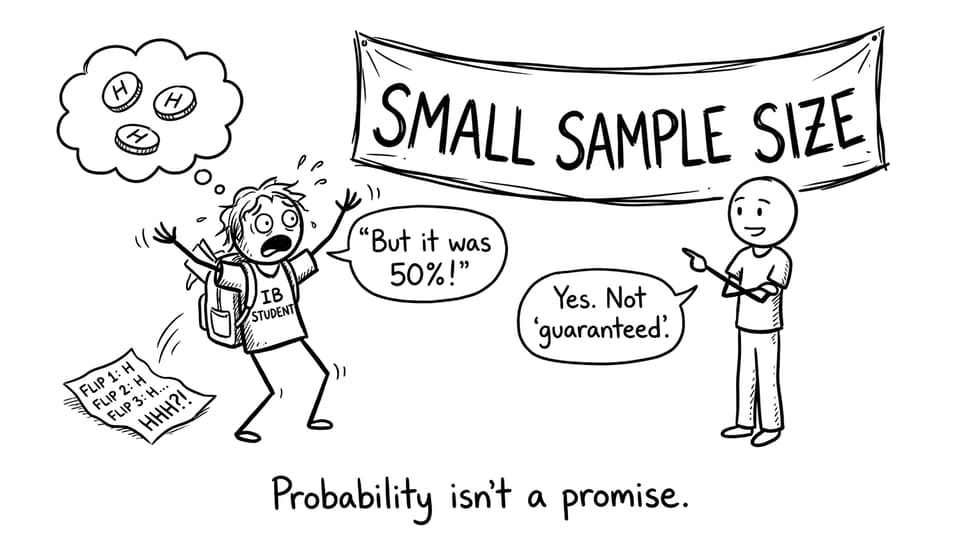
Coin flip panic: small sample size
The quick mindset checklist (before you write anything)
Use this mini-checklist whenever you see probability in IB Math:
Ask: “Is this about one trial, or many trials?”
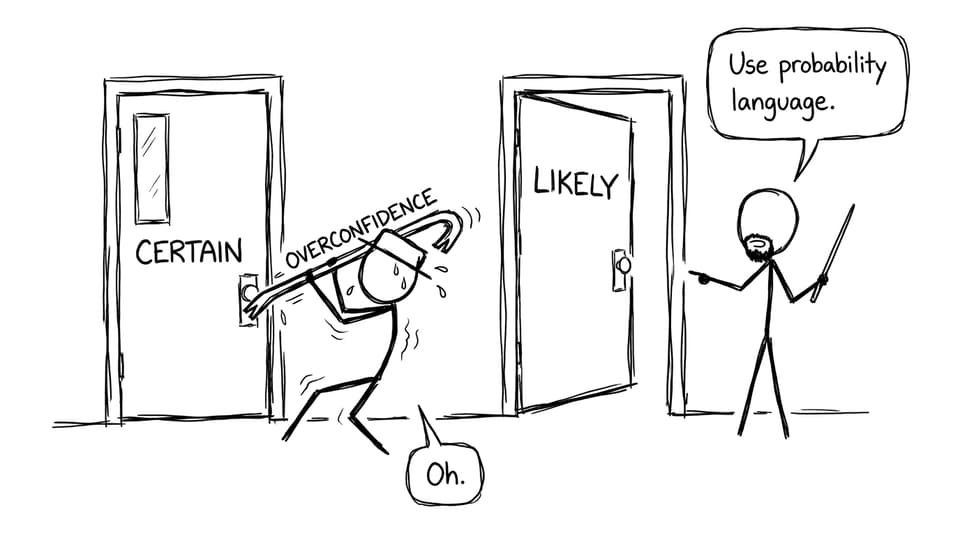
Replace “will” with “is likely to” or “in the long run.”
Mention variation explicitly when the question compares theory vs experiment.
If you used a calculator, state what the decimal means in context.
If independence is assumed, check it (don’t hope).
Humans are pattern-hungry. If you hear “70% chance,” everyday language translates it into “basically certain.” That’s useful when deciding whether to carry an umbrella. It’s dangerous in IB Math, where the number is not a guarantee but a description of a process.
A probability of 0.7 doesn’t mean the event must happen in your next 10 attempts. It means that across many trials, the relative frequency should tend to about 0.7. In the short run, randomness is allowed to be messy. In fact, the messiness is the point.
Small samples are where confidence goes to get dented
Most exam stress comes from tiny samples.
Flip a fair coin three times and get HHH. Students feel like 0.5 has been “violated.” But probability never promised a neat alternation of heads and tails. It only described a long-run tendency.
This is why IB loves questions involving simulations, experimental probability, and comparisons between theoretical models and observed outcomes. Those questions are designed to reveal whether you understand that IB Math probability allows variation.
To sharpen this, work through concept foundations like Trial and Outcome Notes and then immediately test yourself using the Trial and Outcome Questionbank. That pairing builds the habit of interpreting outcomes rather than arguing with them.
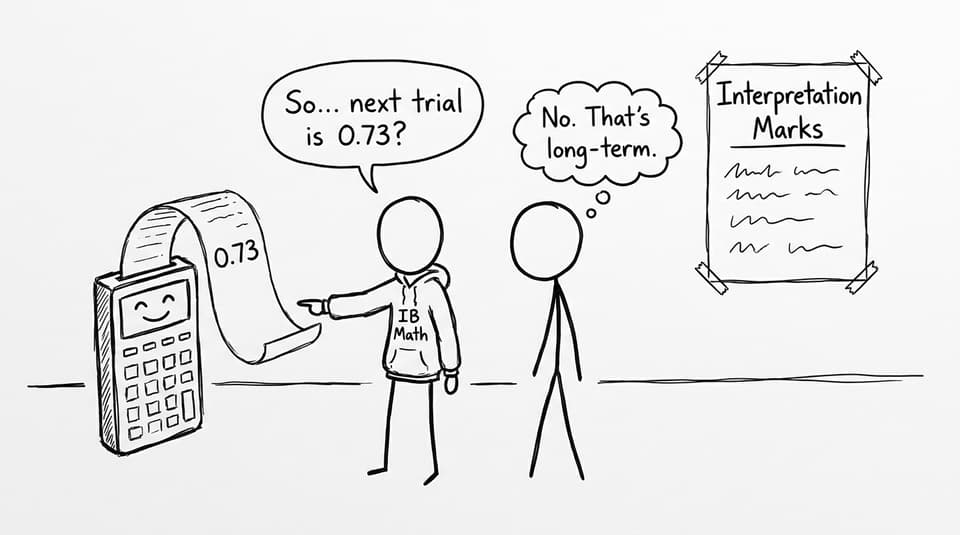
Calculator prophecy joke
Why calculators make the misconception worse
A calculator output looks authoritative: 0.7342 feels like certainty with extra decimals.
But in IB Math, those decimals are still describing a model of repeated trials, assumptions, and conditions. When students treat a calculated probability as a prophecy for the next outcome, they lose interpretation marks. Not because the number is wrong, but because the meaning is.
A high-scoring IB Math response often sounds slightly cautious. That’s not weakness; it’s precision.
Instead of:
“The student will choose kiwi.”
Write:
“The student is more likely to choose kiwi, and over many selections we would expect the proportion choosing kiwi to be around…
That tiny shift signals you understand probability as long-term behavior, not a short-term guarantee.
For a common related trap, review Why Independence Matters So Much in IB Probability. Students often assume independence because it makes the arithmetic easier, then write confident conclusions that are built on a silent incorrect assumption.
Certain vs likely door joke
Bringing it home: the point of IB Math probability
Probability isn’t here to comfort you. It’s here to teach you how to think clearly when outcomes are noisy.
Once you stop treating probability as a long-term guarantee, IB Math questions become calmer: deviations aren’t failures, they’re expected behavior. That’s also why RevisionDojo works so well for exam prep: the Study Notes teach the meaning, the Flashcards lock in definitions, the Questionbank and Mock Exams build pressure-proof habits, and Grading tools plus AI Chat help you refine the one thing examiners actually read carefully--your interpretation.
If you want your probability marks to rise, practice explaining uncertainty, not eliminating it, with RevisionDojo’s Statistics & Probability resources and targeted drills in the Questionbank.
IB Math · 6 min read
IB Math: Why Cautious Conclusions Win Marks
IB Math rewards cautious conclusions because models and data are uncertain. Learn the phrases examiners like, what to avoid, and how to write accurately.