



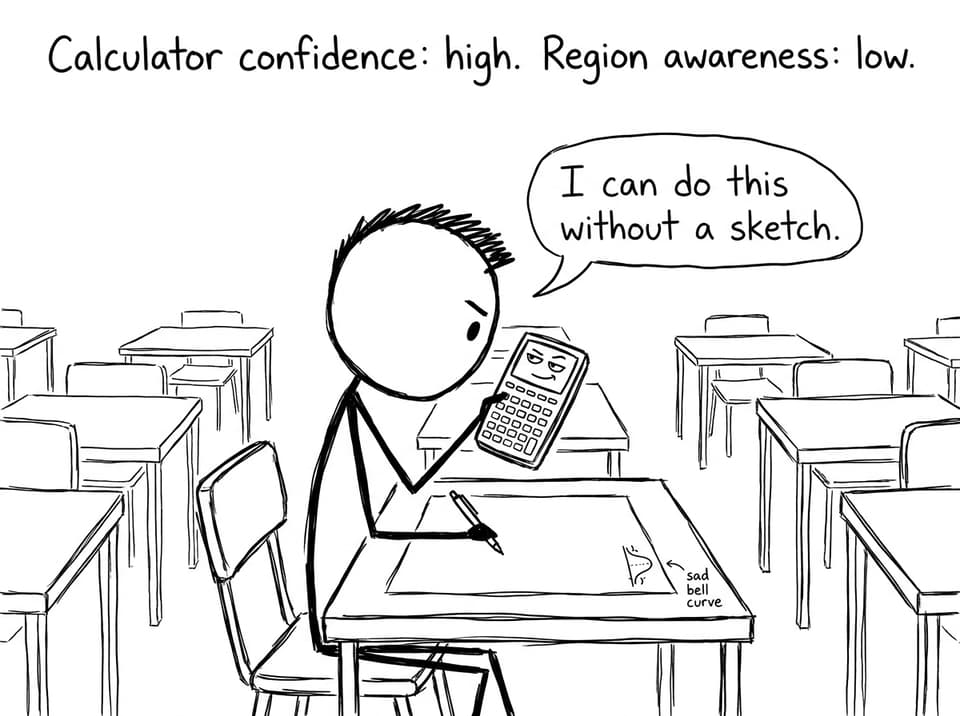
In the middle of an IB Math exam, there’s a moment that feels oddly modern: your calculator looks confident, your formula booklet feels familiar, and your brain says, “We don’t need a sketch.”
That’s usually the exact moment normal distribution questions start quietly stealing marks.
Sketching a normal distribution is not about drawing well. It’s about thinking in the right direction before numbers take over. In IB Math, where probability regions, tails, and interpretation matter, the sketch is less a picture and more a safety rail.
The fast checklist: what your sketch must show in IB Math
A normal curve sketch in IB Math can be rough and still be perfect. Aim for:
-
A bell curve (any bell curve)
-
The mean (\mu) marked in the center
-
Your value(s) placed left or right of (\mu)
-
The shaded region that matches the probability asked
-
A quick note like “right tail” or “between”
If you can do that, you’ve already protected yourself from the most common errors.
Why students forget to sketch normal distributions
Overconfidence in calculator methods (a classic IB Math trap)
Once you learn z-scores, inverse normal, and calculator area functions, it’s tempting to treat the problem like a button-pressing exercise. In IB Math, that’s risky because the hard part is usually not computing. It’s choosing the correct region.
A sketch forces one crucial question: Which side of the mean am I actually talking about? Without that pause, it’s easy to flip a tail, misread “greater than,” or interpret a z-score as a probability.
If normal distributions still feel “mechanical but scary,” it helps to review why the topic keeps showing up in the first place: Why the Normal Distribution Appears Everywhere in IB Maths.
Time pressure makes the sketch look optional
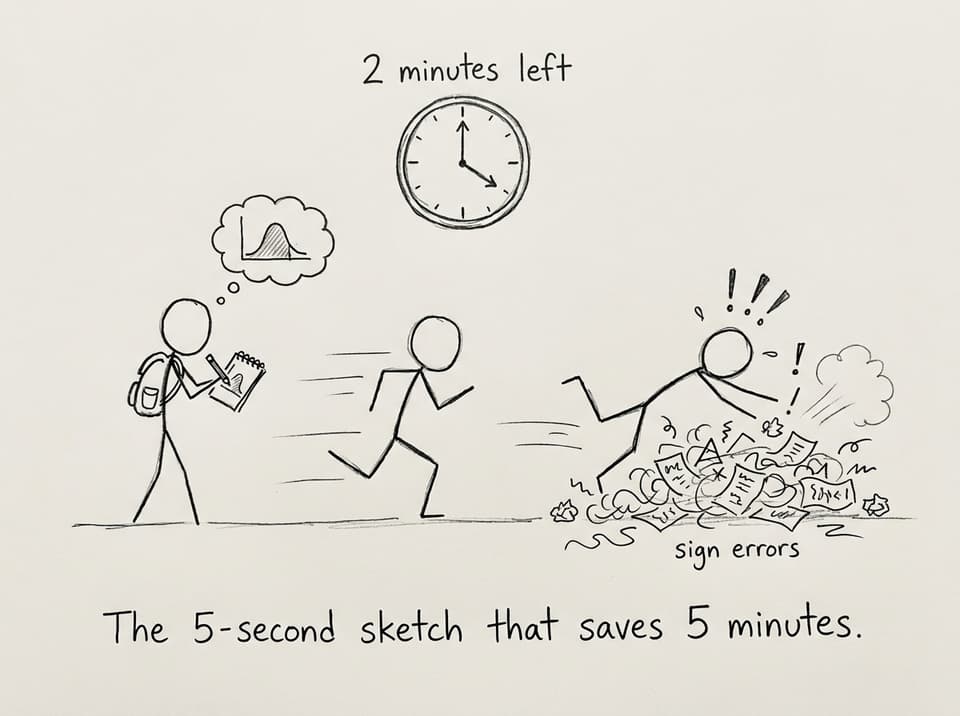
Under exam conditions, students think sketches waste time. But in IB Math, a 10-second sketch often saves minutes of rechecking, rewriting, and second-guessing.
The strange truth is that skipping the sketch doesn’t remove thinking. It just delays thinking until after you’ve already committed to a region.
The “it has to be neat” myth
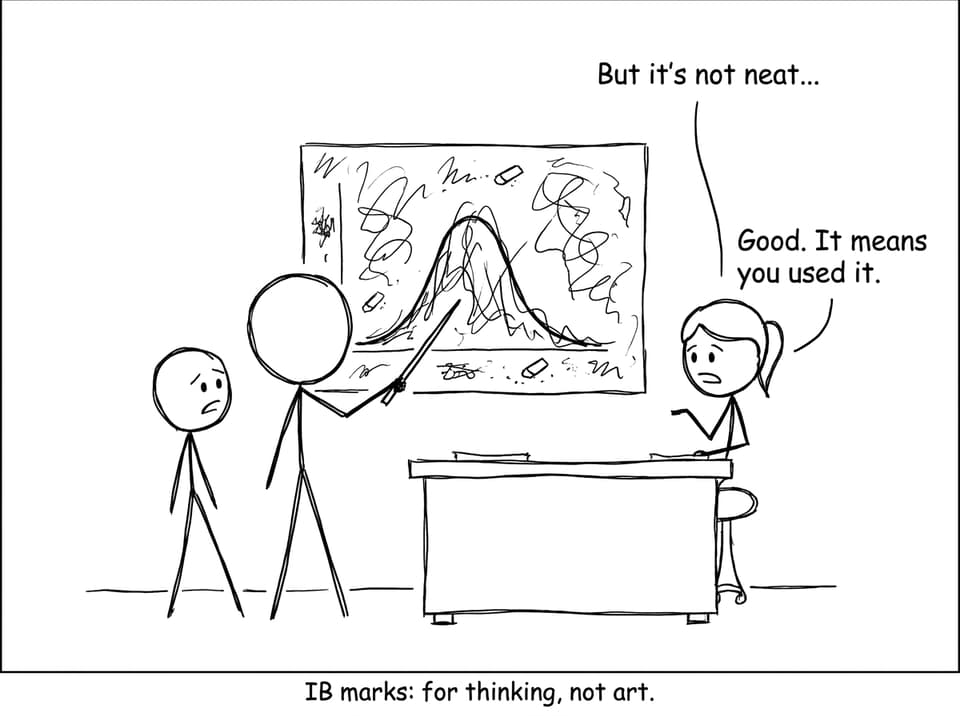
Many students avoid sketching because they assume the curve must be accurate. It doesn’t. Examiners want visible reasoning. A messy bell curve with correct shading communicates clarity.
This is especially important in IB Math AI, where interpretation and communication are graded in a way that rewards explicit thinking.
How sketching protects marks in IB Math
It prevents sign and region errors
Normal distribution questions are direction questions: above, below, between, outside. The sketch makes direction obvious. It’s the quickest way to see whether a z-score should be positive or negative and whether you’re shading one tail or two.
For extra practice with the exact question styles that trigger these mistakes, use RevisionDojo’s targeted resources:
It improves your written interpretation
A sketch anchors language. When you can see the area, your explanation becomes less absolute and more precise. That’s a big deal in IB Math, where students often lose marks by making claims that are too certain.
If you want to build that interpretation muscle across the whole unit, these are worth reading:
It gives “method protection” when numbers go wrong
Even if a calculation slips, a correct sketch can still show the examiner you understood the setup. In IB Math, that visible structure often separates a small error from a total loss.
A calm habit that raises your IB Math ceiling
In IB Math, marks often go to the student who looks “slower” but thinks visibly. Sketching a normal distribution is that kind of habit: small, quiet, and surprisingly powerful.
If you want this to become automatic, RevisionDojo is built for it. Use the Questionbank to drill normal distribution setups, the Study Notes and Flashcards to lock in meanings, and AI Chat to check why your region choice is right (or wrong). Add Grading tools, Mock Exams, Predicted Papers, the Coursework Library, and Tutors when you want full exam-level feedback and strategy.
Next time a normal distribution question appears, take 10 seconds, sketch the curve, and let the rest of your IB Math work feel simpler than it has any right to be.