



The mistake that feels too small to cost marks
In IB Math, there’s a rule so basic it almost becomes invisible: probabilities must sum to one. And yet, in the middle of an exam, students quietly break it all the time.
Not because they don’t understand probability. Not because they never learned distributions. But because stress changes what your brain prioritizes. Under pressure, you stop seeing the whole system and start chasing the next step that looks “mathematical.” That’s how a table of probabilities turns into a set of disconnected numbers, and suddenly your total is 0.93 or 1.17 and nobody notices until the marks are gone.
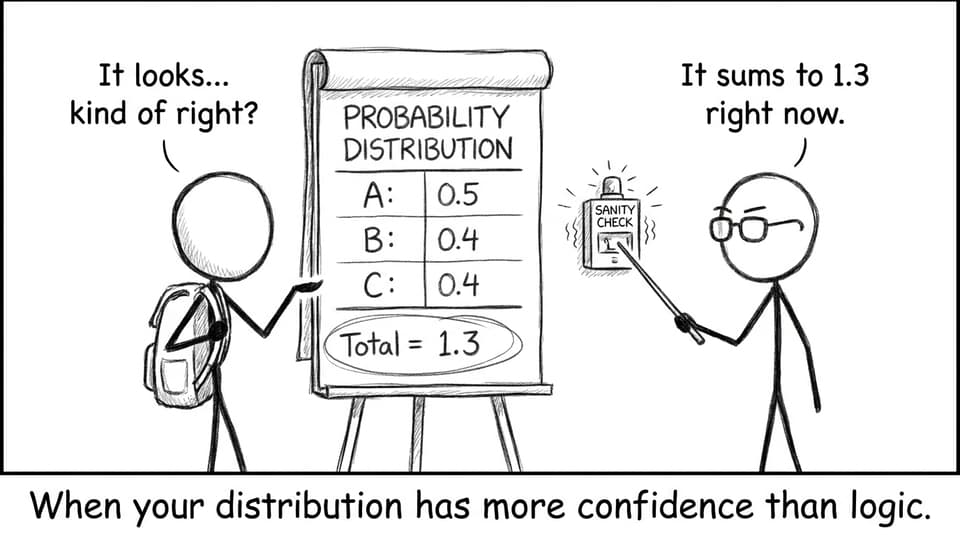
Quick checklist: the 10-second “sum to one” habit
Before you move on in any IB Math probability distribution question, do this:
-
List all outcomes (ask: “Is anything missing?”)
-
Add the probabilities (even if they look neat)
-
If totals are off, check for:
-
rounding or calculator settings
-
a missing outcome
-
double-counting
-
-
If a value is unknown, use: missing probability = 1 - (sum of known probabilities)
For targeted practice on distributions, start with Statistics and Probability (IB Math AA) or Math AI Statistics and Probability.
Why your brain forgets the “whole distribution” view
Fragmented thinking: solving parts, forgetting the total
A probability distribution is a complete story. But exam conditions encourage scene-by-scene thinking: compute one probability, then the next, then the next. In IB Math, this is especially common with discrete random variables, where each row feels like a separate task.
If you want a clean way to rebuild that “whole system” mindset, pair concept review with drills from Discrete Random Variables Notes (AA) and then immediately apply it in a timed set.
Calculator comfort: trusting outputs without a sense check
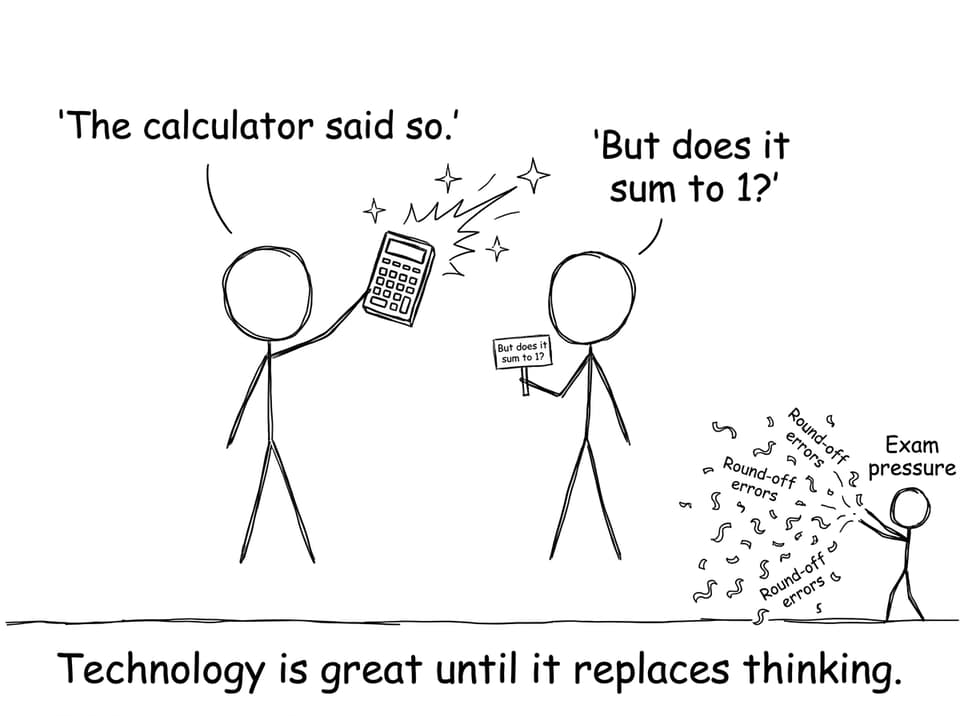
Technology is a powerful tool in IB Math, but it’s also a confidence machine: it prints a decimal, and your brain treats it like a verdict. The danger is subtle: a calculator can help you compute, but it can’t tell you whether your distribution still represents reality.
The fix is not avoiding tech. The fix is insisting on one final human check: “Does this still sum to 1?”
Incomplete tables: the most common trap
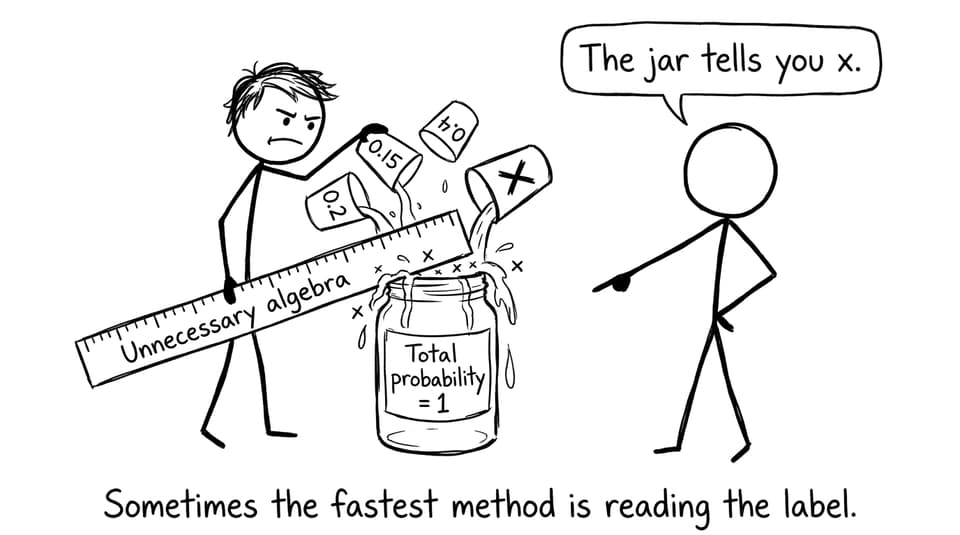
IB-style questions often give partial distributions and ask for a missing parameter. This is where the sum-to-one rule becomes the main tool, yet many students reach for heavier algebra because it feels more impressive.
The direct reasoning is usually the mark-saving move: treat 1 as the full “budget” of probability, and everything else must fit inside it.
To practice this exact skill in exam format, use SL 4.7 Discrete Random Variables (AA) Questionbank or AI SL 4.7 Discrete Random Variables Questionbank.
The mindset shift: probabilities are proportions, not “weights”
A quiet misconception in IB Math is treating probabilities like independent weights you can choose freely. But probabilities are proportions of a whole. If your outcomes cover the entire sample space, you don’t “hope” the total is 1. It must be.
This is also why expected value questions can go wrong: one incorrect probability early can poison the entire calculation while still producing a plausible-looking number.
If interpretation feels harder than calculation, read Why Interpreting Probability Distributions Is Harder Than Creating Them and Why Discrete Random Variables Feel Abstract at First.
Conclusion: make “sum to one” your personal checkpoint
In IB Math, the sum-to-one rule is less a formula and more a promise: “I have accounted for everything.” When you keep that promise, distributions become stable, expected value becomes safer, and your answers feel calmer.
To lock this in, use RevisionDojo as your practice loop: Study Notes to refresh the concept, Flashcards to keep it active, the Questionbank and Mock Exams to pressure-test it, AI Chat to clarify confusion fast, and Grading tools to catch the small slips before they become habits. Add Predicted Papers for realistic exam pacing, and if you want a more guided plan, RevisionDojo Tutors can help you build a strategy that holds up under time pressure.
One final reminder before you turn the page: in IB Math, if all outcomes are included, probabilities must sum to one. Check it. Every time.