



If you’ve ever read a statistics question and felt your brain quietly swap quartile and percentile like they’re the same word, you’re not alone. In IB Math, this mix-up usually isn’t a calculation problem. It’s a meaning problem. You can find a number correctly and still lose marks because your explanation reveals a fuzzy mental model.
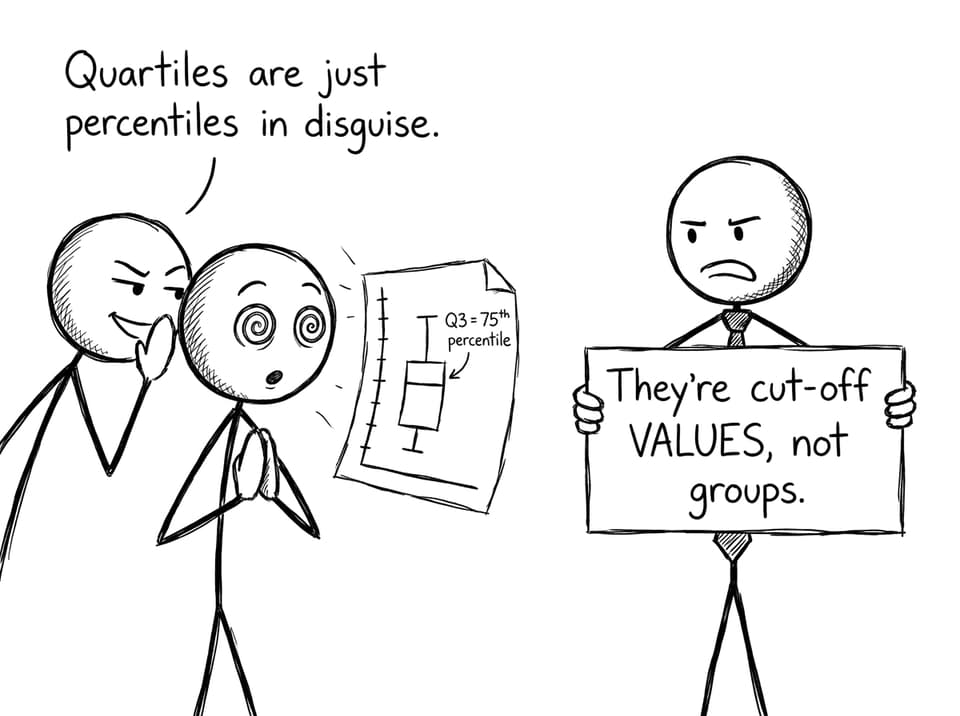
The truth is simple but easy to forget under time pressure: quartiles and percentiles both describe position in a data set. They just do it at different zoom levels. When you treat them as labels to memorise instead of cut-off points to interpret, the confusion becomes almost inevitable.
The 20-second clarity check (use this in IB Math)
Before you write any interpretation sentence, run this quick checklist:
-
Is my answer a value or a region? Quartiles/percentiles are values (cut-offs).
-
Did I say “below which” a percentage lies? That’s the cleanest wording.
-
Did I accidentally describe “the top 25%” instead of the cut-off point that separates it?
-
Can I connect it to the median? Median = Q2 = 50th percentile (same position).
For targeted practice on these skills, the IB Math AI hub is a good starting point.
Why the confusion happens
They feel like the same tool
In IB Math, quartiles and percentiles often appear in the same places: cumulative frequency graphs, box plots, and interpretation questions. The method can look identical: locate a proportion of the total frequency, move across to the curve, then drop down to read a value. That sameness tricks students into thinking the ideas are interchangeable.
If cumulative frequency graphs already feel uncertain, you’ll recognise this pressure: procedure takes over, meaning gets left behind. RevisionDojo breaks this down in Why Cumulative Frequency Graphs Feel Hard to Read and also in Why Interpolation on Cumulative Frequency Graphs Feels Uncertain.
Memorising labels replaces understanding
Many students memorise: “Q1 is 25%,” “Q3 is 75%,” “90th percentile is 90%.” That’s not wrong, but it’s incomplete. In IB Math, examiners reward the interpretation sentence, not the label.
A reliable sentence frame is:
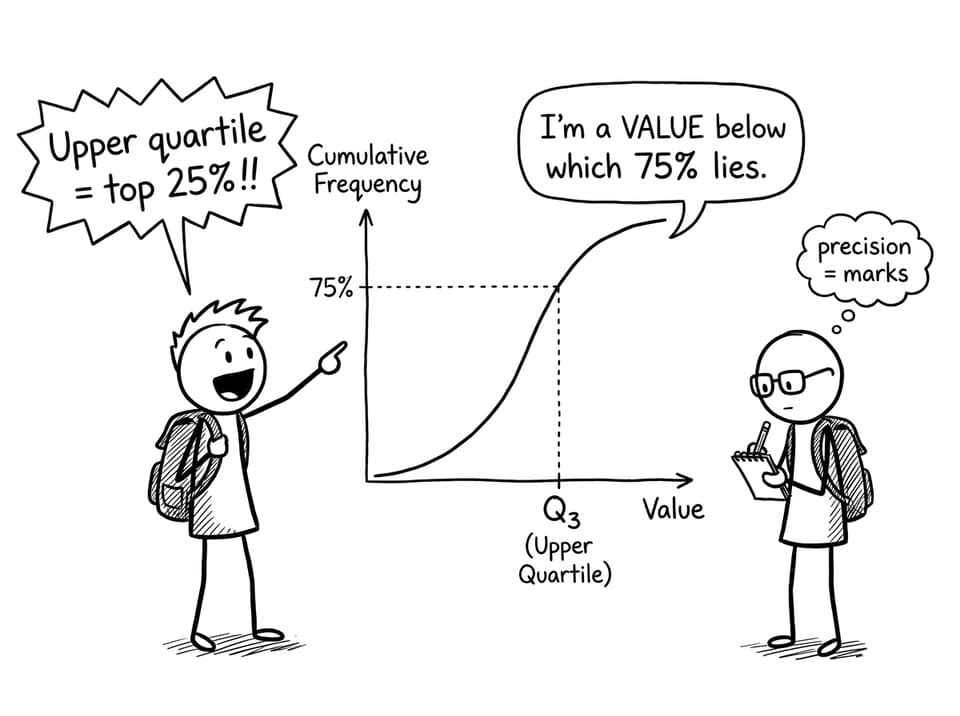
“The (kth percentile / upper quartile) is the value below which k% of the data lies.”
That single phrase “below which” prevents most definition errors.
Language creates the classic trap
A common wrong sentence sounds reasonable:
- “The upper quartile is the top 25% of values.”
But the upper quartile is not a chunk of the data. It’s the cut-off value where 75% is below it (and 25% above it). The same mistake appears with percentiles, especially when students describe “the bottom 10%” instead of “the value below which 10% lies.”
For more help building precise percentile explanations, see Why Percentiles Matter More Than You Expect in IB Statistics.
How to stop losing easy marks in IB Math
In the exam, aim for two steps:
-
State the definition in words (position, below-which language).
-
Attach it to the context (test scores, heights, times, etc.).
Then drill the skill with exam-style items. RevisionDojo’s practice paths make this easier because you can train one sub-skill at a time:
-
Box plots and CF graphs practice: SL 4.2Histograms, CF graphs, box plots
-
Notes support (definitions + examples): Histograms, CF graphs, box plots notes
-
Exam-style drilling: SL 4.2 Questionbank
-
Quartiles + IQR focus set: Quartiles, IQR Questionbank
-
Skill bootcamp (CF + quartiles/percentiles): Constructing cumulative frequency graphs bootcamp
If you want a structured routine, How to Use the Questionbank for Targeted Math Revision is a practical guide.
Conclusion: treat them as positions, not labels
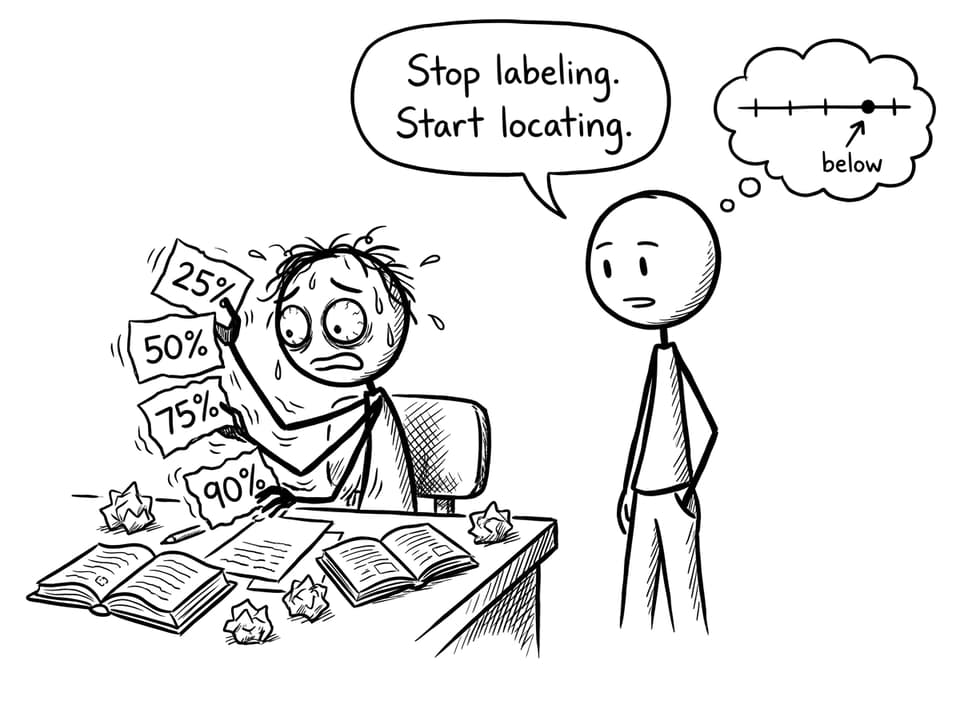
Quartiles and percentiles confuse IB Math students because they sit so close together: same purpose, similar methods, different resolution. The fastest way out is to stop memorising them as separate “definitions” and start treating them as the same idea expressed at different precision.
If you want to turn that clarity into marks, RevisionDojo is built for it: use the Study Notes to lock in meaning, Flashcards to keep definitions sharp, the Questionbank to practise exam phrasing, AI Chat and Grading tools to refine explanations, plus Mock Exams and Predicted Papers to pressure-test your wording before the real exam. When interpretation becomes a habit, quartiles and percentiles stop being tricky and start being easy marks in IB Math.