



The shortcut that feels safe (until it isn’t)
In IB Math, probability questions can feel like a race: read fast, compute faster, move on. Under that pressure, many students reach for the most comforting shortcut in the topic: assuming two events are independent. It’s not laziness. It’s a very human response to uncertainty.
The problem is that IB Math exam questions often expect you to notice when independence breaks. And the marks don’t just reward the final number; they reward whether you interpreted the situation correctly.
Quick independence checklist (use it before you multiply)
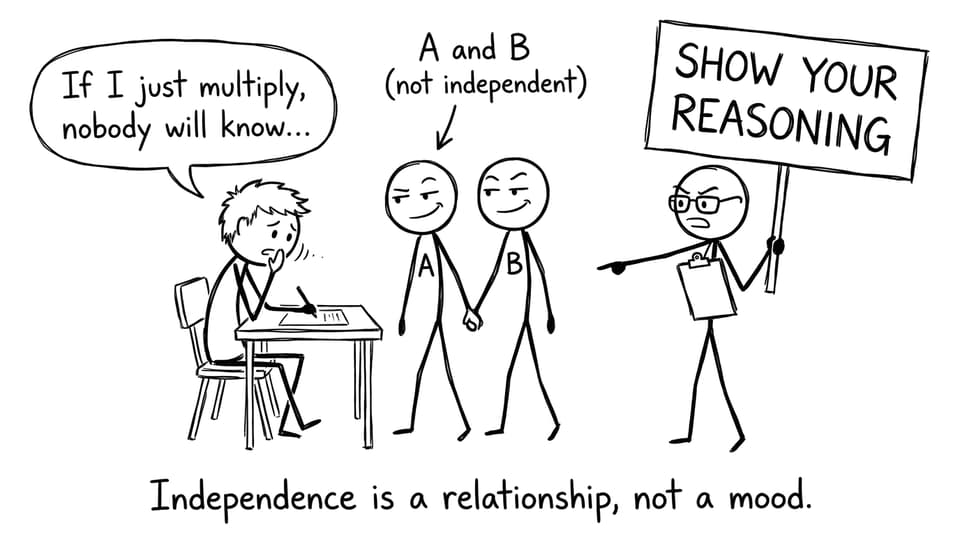
Before you write (P(A\cap B)=P(A)P(B)), pause and run this micro-check:
-
Does the first outcome change what’s possible next? (common with “without replacement”)
-
Does knowing the first outcome give you new information?
-
Would a tree diagram have different branch probabilities after the first event?
-
Is this a real-world context (people, choices, repeated selection)? If yes, dependence is likely.
If any answer is “yes,” independence is probably wrong in IB Math.
Why students assume independence in IB Math
Familiar patterns train your brain
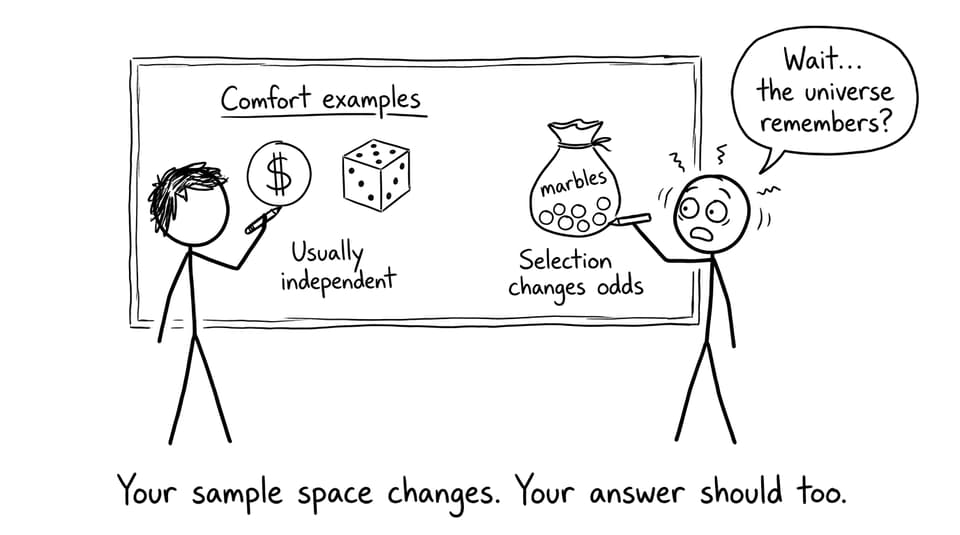
Early practice sets are full of coins, dice, and replacement scenarios. They build a reflex: “two steps means multiply.” That reflex is useful until the question switches to selecting items, choosing people, or drawing objects without replacement. In those cases, the sample space changes, so the probability changes too.
To rewire that reflex, it helps to practise the exact syllabus language and examples from RevisionDojo’s probability notes, especially the sections on conditional probability and testing independence: Conditional and independent probabilities (AA SL 4.11).
Time pressure makes “multiply” feel like survival
In IB Math, independence produces clean arithmetic: multiply two neat fractions, simplify, done. Under timed conditions, students often prioritise speed over interpretation. But examiners design worded probability problems precisely to test whether you can slow down for ten seconds and ask what changes.
A good fix is timed practice with feedback. RevisionDojo’s SL 4.11 Questionbank forces you to confront the moment where you’d normally assume independence.
Questions don’t always use “trigger words”
Students wait for explicit phrases like “independent” or “with replacement.” But IB Math often tests interpretation without handing you those keywords. If the story implies that information matters, you’re expected to notice.
A strong habit is to rewrite the events in conditional form: (P(B\mid A)). If (P(B\mid A)\neq P(B)), independence is broken.
Real-world contexts almost beg for dependence
When the context involves people making choices, stock levels shrinking, or repeated selections, the system “remembers.” Independence is rarer than students expect. That’s why visual tools (tree diagrams, Venn diagrams, sample space tables) matter so much.
For diagram practice aligned to IB Math, these notes are a strong companion: Probability diagrams and concepts (AA SL 4.6 notes) and Venn diagrams (AI SL 4.6 notes).
A better habit: “Does the system change?”
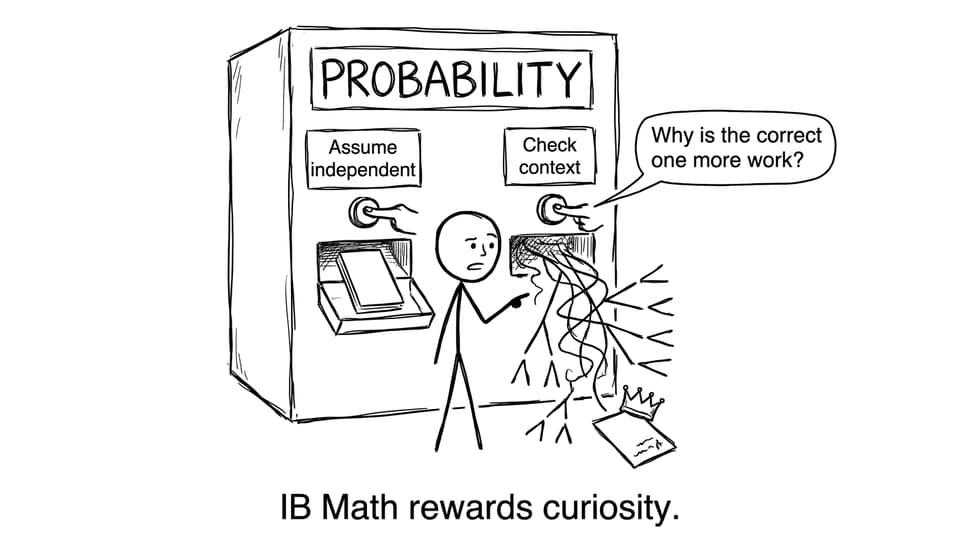
Here’s the single most useful independence check in IB Math:
Does the first outcome change the probability of the second?
If yes, write it as conditional probability, use a tree diagram, and let the structure guide you. This protects you from the most expensive kind of exam error: a method built on the wrong assumption.
For a bigger probability overview and revision plan, see How to Master Probability and Statistics in IB Math and Understanding probability in IB Math SL.
Bring it back to points on the page
In IB Math, assuming independence is rarely a knowledge problem; it’s a habit problem. The fix is small: stop for ten seconds, run the checklist, and make the situation prove independence before you multiply.
If you want that habit to stick, build a tight loop: learn the idea in RevisionDojo Study Notes, drill it in the Questionbank, reinforce it with Flashcards, and use AI Chat when a solution step feels mysterious. When you’re close to exams, add Mock Exams, Predicted Papers, and Grading tools to train accuracy under time pressure. And if you want a human to pressure-test your reasoning, RevisionDojo Tutors can help you turn “I kind of get it” into consistent marks.