



The moment IB Math humbles a “fast” student
A familiar scene: you finish the calculations quickly, your calculator output looks clean, and you feel confident. Then the markscheme comes back and your score is… fine. Not great. Meanwhile, the student who took longer, and wrote more, edges ahead.
That outcome isn’t unfair. It’s a clue.
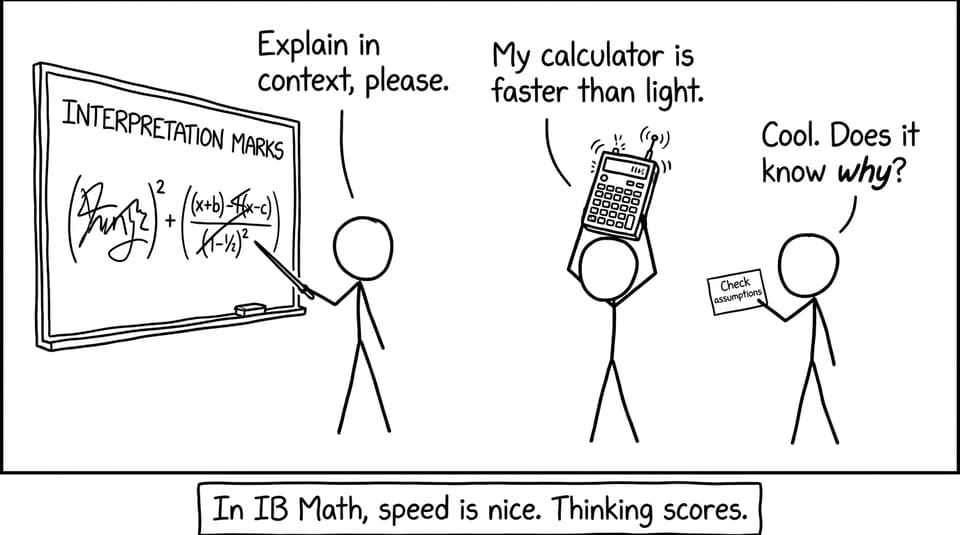
IB Math isn’t designed to crown the fastest button-pressers. It rewards students who can choose an approach, justify it, and explain what the result means in context. In other words: strong thinkers often outperform strong calculators because the course is assessing judgement, not just arithmetic.
A quick checklist: what IB Math actually rewards
Before you revise, keep this short checklist in mind (it works for IB Math AA and AI):
-
Pick the correct method before you calculate
-
Show structure: definitions, setup, and logical steps
-
Interpret results in words, units, and context
-
Check reasonableness and limitations
-
Manage time by chasing marks, not decimals
If you want a solid home base, start with the RevisionDojo hubs for IB Math AI or IB Math AA.
Method choice: the marks start before the numbers
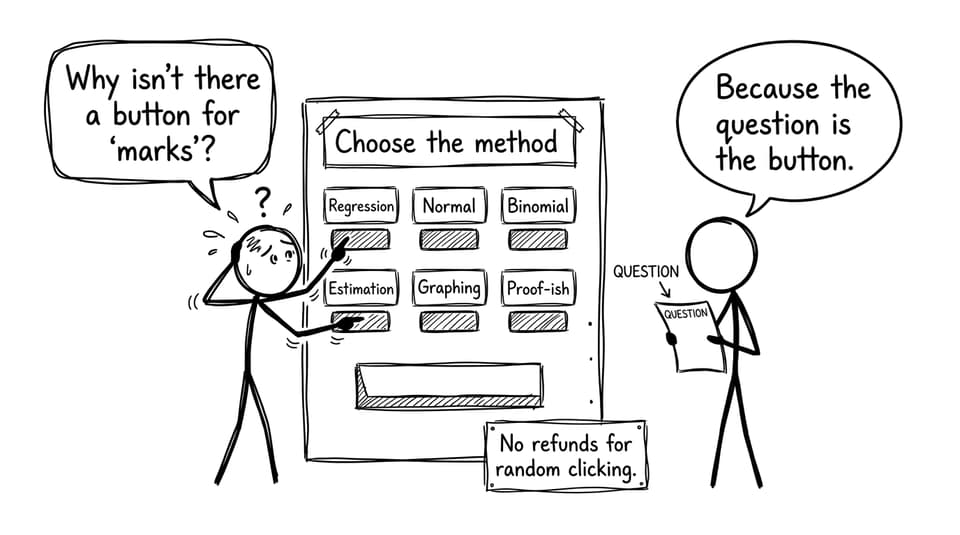
In IB Math, many questions don’t tell you what tool to use. They describe a situation and quietly test whether you can decide between regression, a distribution, a graphing approach, an algebraic method, or a modelling assumption.
Strong calculators sometimes rush into the first technique they recognize. Strong thinkers pause and ask: What is the question really asking? What information matters? What would a reasonable model look like?
A good way to train this is to practice with feedback that explains the “why,” not just the “how.” RevisionDojo’s How to Use the Questionbank for Targeted Math Revision is built around this exact loop, and it pairs naturally with the Questionbank and AI Chat when you’re stuck.
Interpretation marks: the hidden leaderboard of IB Math
Here’s the quiet truth about IB Math exams: often, the higher-value marks come after the computation.
You can do everything “right” on the calculator and still miss marks by:
-
not stating what the value means
-
not linking it to the scenario
-
not using cautious language (especially in statistics)
-
not commenting on limitations, validity, or assumptions
If you’re currently underperforming, the fastest improvement is usually exam technique, not harder content. This article on 3 in IB Math: How to Get Back to a 4+ is a practical reset, and it aligns with what RevisionDojo’s Study Notes and Grading tools reinforce: method marks and explanation marks are real, repeatable points.
Time management: stop buying precision you don’t need
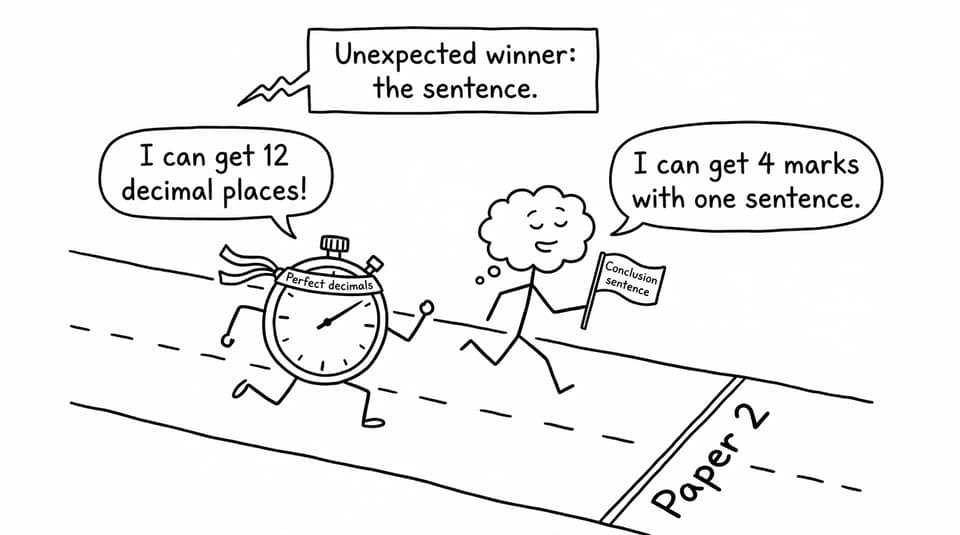
A calculator makes it tempting to polish answers endlessly. But in IB Math, perfect decimals are often low-return work. Strong thinkers aim for accuracy and momentum: they move on to the sentence that earns interpretation marks.
RevisionDojo’s How to Use RevisionDojo to Prepare for IB Math Mock Exams shows how to simulate pacing with Mock Exams, Exam Mode, and topic-based review in the Questionbank.
How to train “thinking” (without becoming slow)
To improve your IB Math score, build a routine that forces reasoning to show up on the page:
-
Do 10-minute “method selection” drills: read, choose, justify, then solve
-
After every answer, write one concluding sentence in context (units + meaning)
-
Keep a mistake log of decision errors (wrong model, wrong assumption, wrong interpretation)
-
Use RevisionDojo Flashcards for command terms and interpretation phrases, not just formulas
For a structured plan, adapt ideas from The Ultimate IB Math Study Routine for Busy Students. And if you need a deeper explanation of why AI rewards analysis so heavily, read Why IB Math AI Is Less About Maths and More About Thinking.
Closing: be the student who explains, not just the one who computes
Strong calculators do a lot of work. Strong thinkers get rewarded for the work that IB Math is actually measuring: judgement, clarity, and interpretation.
If you want that shift to feel straightforward, build your loop on RevisionDojo: practice in the Questionbank, review with Study Notes, lock in language with Flashcards, stress-test with Mock Exams and Predicted Papers, and use AI Chat or Tutors when your reasoning needs a second set of eyes.