



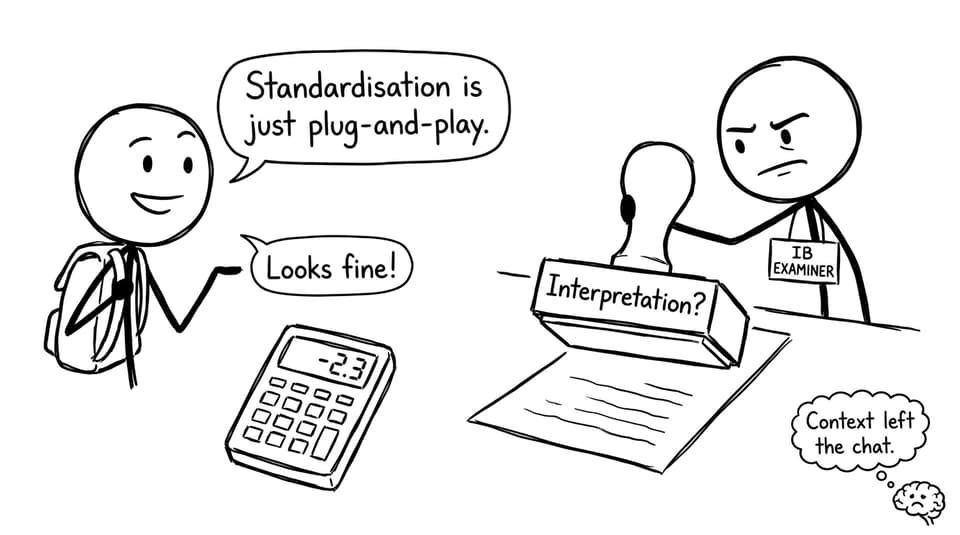
Standardisation in IB Math is the kind of skill that feels like it should be safe. You meet it early, you repeat the same steps, and your hand starts moving before your brain has fully arrived. Then you get a test back and discover you lost marks on the one part you thought was “automatic.”
That’s the quiet trap of standardisation: it looks mechanical, so we treat it like machinery. But exams reward meaning, not motion.
A quick checklist before you standardise (IB Math)
Use this 10-second pause to stop easy errors:
-
Identify what x represents in the story (mass, score, time, etc.).
-
Compare x to the mean first: is it above or below?
-
Predict the sign of the z-score before calculating.
-
Predict rough size: close to the mean (|z| < 1) or far (|z| > 2)?
-
After calculating, write one sentence of interpretation.
If you need a refresher on what z-values mean, keep Z values and inverse normal notes open while you practise.
Why standardisation feels mechanical in IB Math
The standardisation formula is short. The steps are familiar. And in IB Math, familiarity creates a dangerous illusion: “If I can do the steps, I understand the question.”
But standardisation isn’t tested because the algebra is impressive. It’s tested because it reveals whether you understand relative position. A z-score is a statement about distance from the mean measured in standard deviations, not a magic number that ends the problem.
When students lose marks, it’s usually not because they can’t compute. It’s because they compute without checking what the result is saying.
To build the bigger picture, it helps to revisit how the normal model is described and sketched in context: Normal distribution notes (Math AI SL 4.9).
The three errors that keep happening (even when the formula is right)
Autopilot mode: the calculator is working, but you aren’t
In IB Math, autopilot happens when your focus narrows to substitution: plug in x, subtract the mean, divide by standard deviation, done. The problem is that the exam question rarely ends at “find z.”
Examiners want you to connect the z-score back to the situation: what does it imply about rarity, comparison, or likelihood? If you stop at a number, you often stop before the marks.
Targeted practice helps here because it forces interpretation again and again. You can drill the exact skill with Z values Questionbank practice or, for AI students, combine it with distribution work from the Statistics and Probability Questionbank.
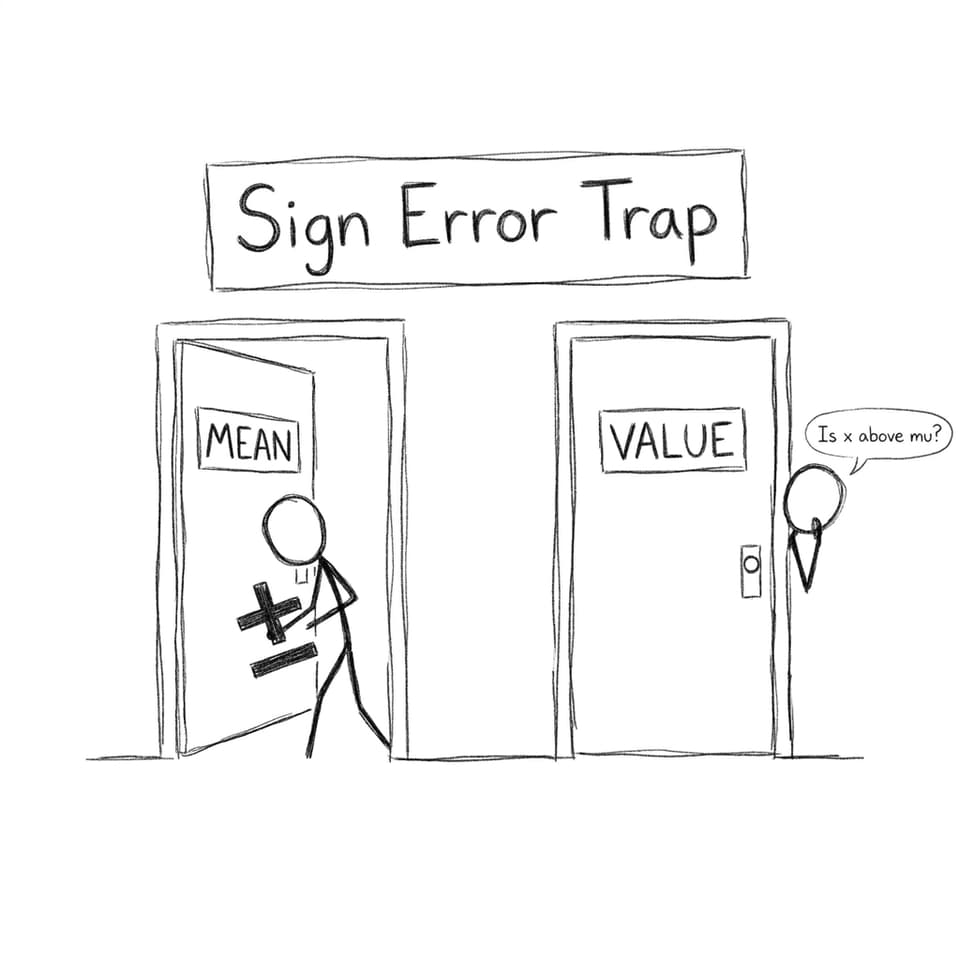
Sign errors: “above the mean” producing a negative z
This is the classic heartbreak. You do everything “right,” except your answer contradicts the story. In IB Math, sign errors usually come from treating symbols as decoration instead of meaning.
A good habit: before touching the formula, say out loud (or write) “x is above the mean, so z must be positive.” That tiny prediction catches the most common mistake.
Missing the point: using standardisation when the question wants interpretation
Sometimes the question is really asking for a comparison between two distributions, or a statement about proportion, or which outcome is more unusual. Standardisation is a tool to get there, not the destination.
If you want a strong companion article for this mindset, read Why do normal distribution calculations feel so unnatural in IB Maths and notice how often the “extra step” is actually the thinking step.
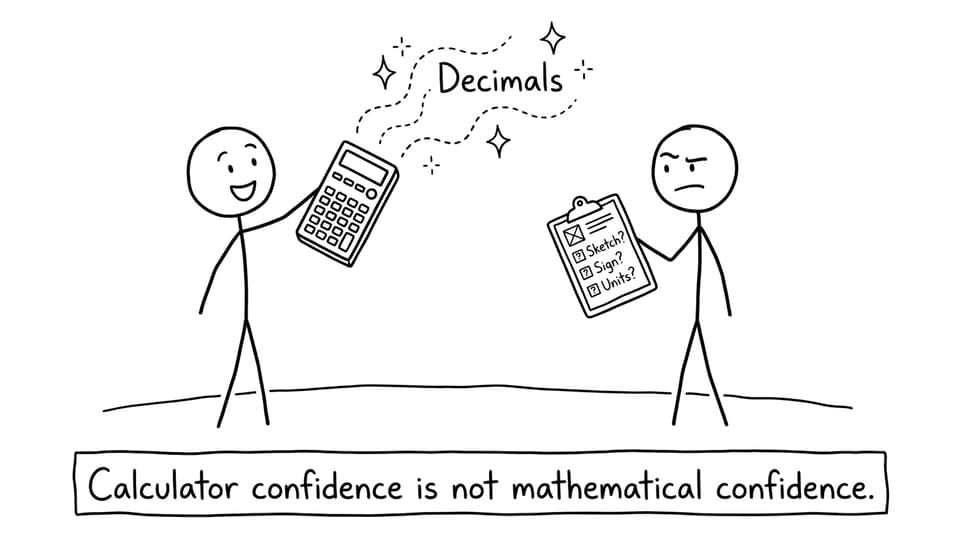
Calculator confidence is not IB Math confidence
Your calculator will happily output a neat decimal that looks authoritative. But in IB Math, a decimal isn’t the same thing as a checked conclusion.
A fast sense-check is enough: if x is clearly above average and your z-score is negative, don’t move on. Stop. Fix it. That pause is worth more than speed.
How RevisionDojo turns standardisation into reliable marks
The students who improve fastest don’t learn a new formula. They build a repeatable routine: predict sign, compute carefully, interpret in context.
RevisionDojo supports that routine in a very practical way:
-
Study Notes to anchor meaning (start with the Math AI notes hub).
-
Questionbank to practise standardisation under exam-style pressure (try Normal distribution Questionbank).
-
Flashcards to keep definitions and interpretations sharp (see Normal distribution flashcards).
-
AI Chat and Grading tools to check whether your explanation matches what examiners reward.
-
Mock Exams and Predicted Papers to test whether you can still interpret z-scores when you’re tired and rushed.
-
Tutors and Coursework Library for personalised guidance when a recurring misconception won’t budge.
Final thought: make standardisation human again
Standardisation in IB Math only feels mechanical when you remove its meaning. Put the meaning back in, and it becomes one of the most reliable scoring opportunities in the course.
If you want to turn “easy but error-prone” into “easy and accurate,” practise with RevisionDojo’s Questionbank, use the notes to anchor interpretation, and let the AI tools check your explanations the way an examiner would. Your marks improve when your thinking stays switched on, even for the most familiar formula.