



The moment probability feels “wrong”
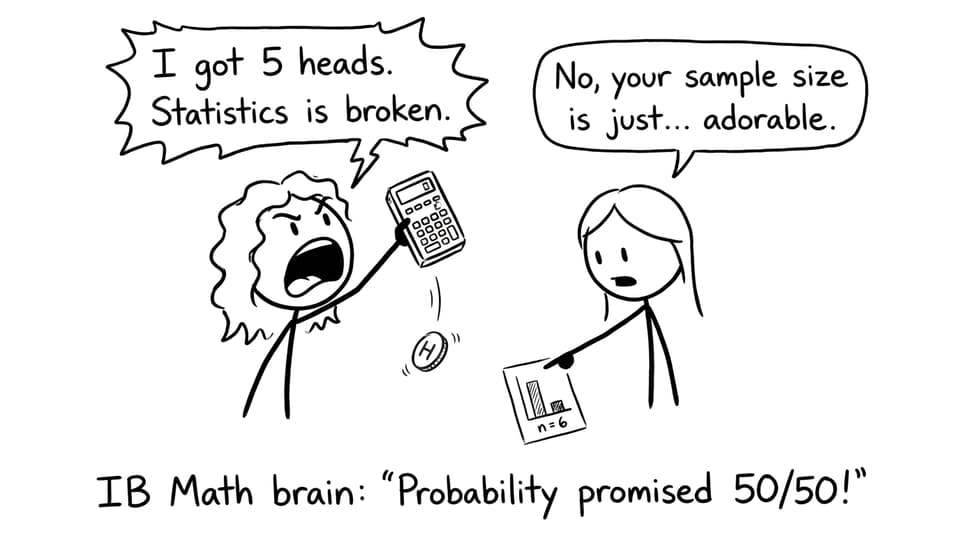
You run a quick experiment: flip a coin six times. You get five heads. Your brain, trained by tidy textbook examples, whispers that something has gone off the rails. But in IB Math, that uncomfortable moment is the lesson: probability isn’t a promise for short runs, it’s a long-run tendency.
Small samples don’t “break” probability. They expose how noisy reality looks before the noise averages out. In exams, IB often wants you to notice that gap between theory and what a tiny dataset can show.
Quick checklist: what to write when n is small (IB-friendly)
When a question uses a small sample size, IB Math marks often sit in your interpretation. Use this checklist:
-
State that random variation is high for small n.
-
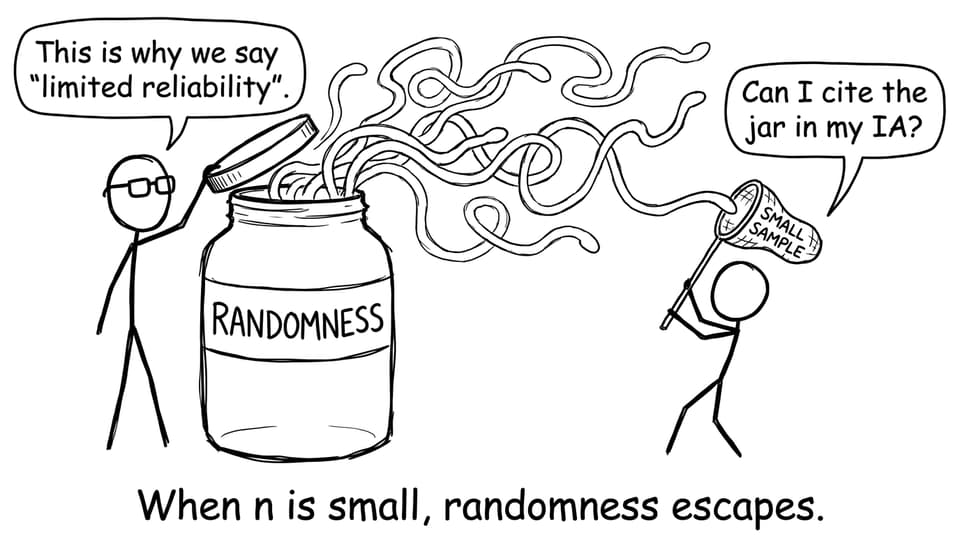
Say conclusions are limited reliability / weak evidence.
-
Avoid claiming “bias” or “unfairness” from a handful of trials.
-
Mention that increasing n would make results more stable.
-
If relevant, note outliers have a larger influence in small samples.
To practice how this language earns marks, build repetition with the Statistics and Probability Questionbank.
Why small sample sizes confuse IB Math probability
In IB Math, probability describes what happens on average across many trials. But with small samples, the average is fragile. A single unusual streak can dominate what you observe.
Think about the coin again. The theoretical probability of heads is 0.5, but with n = 6, outcomes like 5 heads are not shocking. They feel shocking because we expect “balance” to appear quickly. That expectation is psychological, not mathematical.
If you want a clean refresher on the rules behind those calculations (so you don’t doubt your method when the result looks weird), use How to Solve IB Math Probability Problems Step-by-Step.
The real danger: overinterpreting tiny data
Small samples don’t just wobble; they tempt you into confident stories.
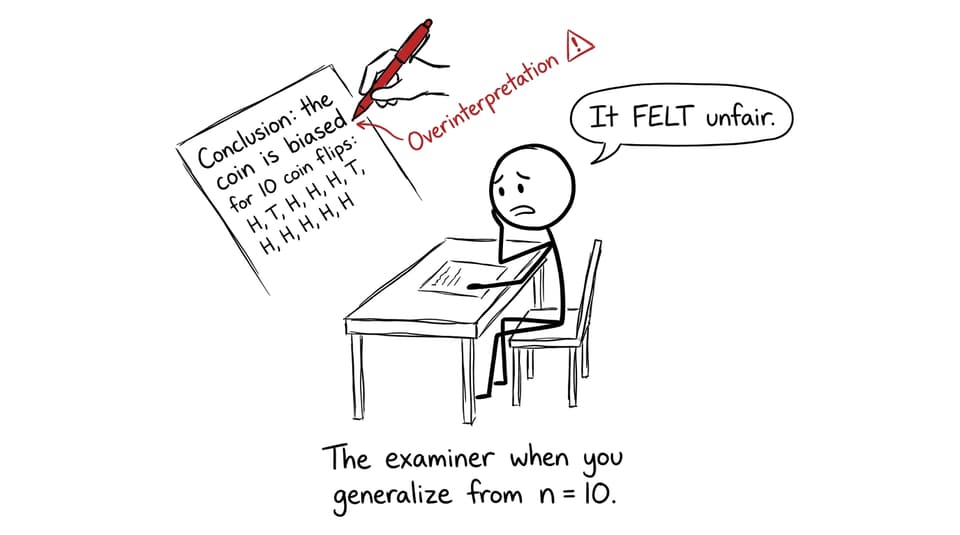
A common IB Math trap is concluding a process is biased because results don’t match expected probability in the first few trials. Examiners penalize that because you’ve confused “unexpected” with “impossible.”
A safe exam sentence sounds like:
“Because the sample size is small, random variation could explain the difference between observed and expected results, so the conclusion is not reliable.”
This is exactly the kind of reasoning you can drill with RevisionDojo’s tools: use Study Notes to learn the concept, then confirm it with the Questionbank, and finally ask AI Chat to critique your wording the way an examiner would.
Outliers hit harder when n is small
Another reason small samples feel like probability is malfunctioning: outliers matter more.
If you’re working with averages or proportions, one extreme outcome can heavily shift your statistic when there isn’t enough data to dilute it. In IB Math, this often appears in “comment on reliability” prompts: you’re being asked to recognize that a number can be calculated correctly and still be a weak basis for a conclusion.
For deeper context on sample behaviour as n grows, the Central Limit Theorem Notes help explain why large samples become more predictable.
Where RevisionDojo fits into your probability revision
Probability questions reward two skills: correct calculation and calm interpretation. RevisionDojo is built for both.
-
Use the IB Math AI hub to keep your revision syllabus-aligned.
-
Strengthen core definitions with Trial and Outcome Notes.
-
Visualize set relationships with Venn Diagrams Notes.
-
Practice explanation-heavy items with How to Master Probability and Statistics in IB Math.
Then layer in RevisionDojo’s Flashcards for key phrases (like “limited reliability”), Mock Exams for timing, Grading tools for feedback, Predicted Papers for realistic practice sets, the Coursework Library for IA inspiration, and Tutors when you want targeted help.
Conclusion: probability isn’t broken; your time horizon is
Small sample sizes don’t break probability expectations; they break intuition. In IB Math, the highest-scoring students learn to treat small-n results as noisy hints, not verdicts.
If you want to turn that insight into marks, use RevisionDojo to study the concept with Study Notes, test it with the Questionbank, and refine your explanations with AI Chat and Grading tools. Small samples will still look messy, but you’ll know exactly what to say when they do.