


In the middle of an IB Math AI exam, there’s a particular kind of panic that feels oddly modern: you get a decimal like 17.386492… and your brain whispers, That can’t be right. So you start “fixing” it. Rounding. Re-entering. Second-guessing. Sometimes you erase the only thing that was actually earning you marks.
That’s the quiet power of reasonable answer marks in IB Math AI: they reward mathematical judgement, not numerical perfection. And once you understand that, you stop treating messy answers like enemies and start using them like evidence.
What “reasonable answer” marks actually reward in IB Math
In IB Math AI, a lot of questions live in the real world: modelling, estimation, regression, sampling, interpolation, finance contexts. Real data is noisy. Real models are approximations. Exact values often do not exist.
So examiners look for signs that you can think with maths:
-
Your answer follows logically from your method
-
The order of magnitude makes sense
-
Units and context are consistent
-
You interpret what the number means (not just compute it)
If you want a strong overview of what AI values, start with IB Math AI Explained: Applications and Interpretation.
A quick checklist to secure “reasonable answer” marks
Before you move on from a final value in IB Math, pause for 10 seconds:
-
Did I write a clear chain of working (so the examiner can follow my logic)?
-
Did I include units where relevant?
-
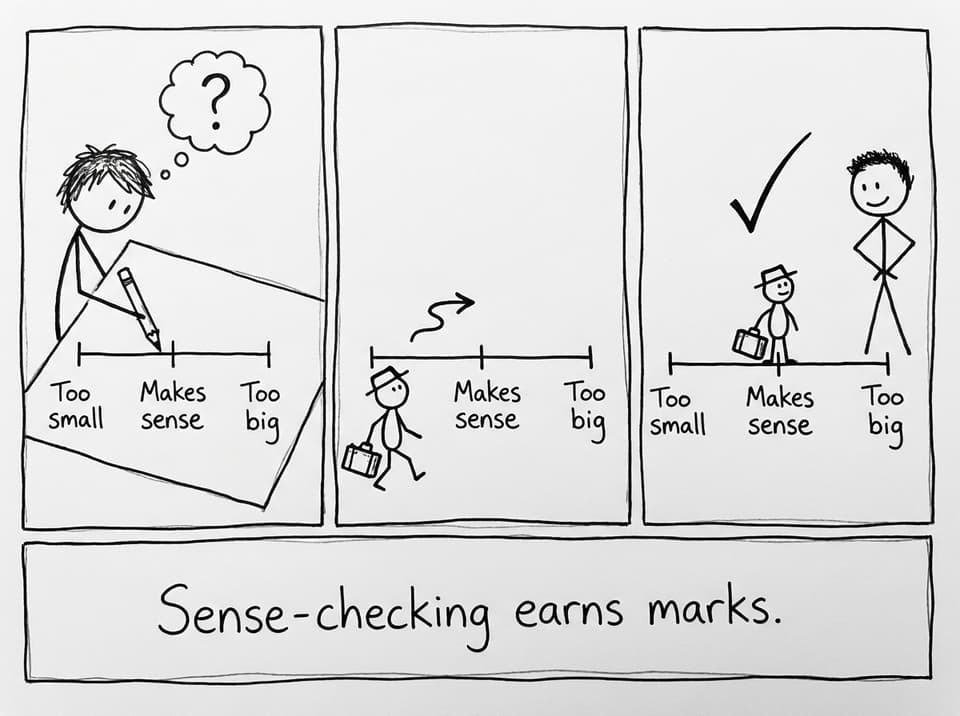
Did I sanity-check size (too big, too small, unrealistic)?
-
Did I explain the meaning in context (one sentence is often enough)?
That last step is where many students quietly win marks.
Why reasonable answer marks protect you from small slips
One of the fairest things about IB Math AI marking is that it often separates thinking from typing. If you make a minor arithmetic error but continue with a coherent method and a correct interpretation, reasonable answer marks can still credit understanding.
This is especially common in multi-step modelling problems: an early rounding or entry mistake can ripple, but your reasoning can remain solid. Examiners can reward that.
To train this properly, targeted practice matters more than volume. RevisionDojo’s IB Math AI hub links you into Study Notes, Flashcards, and a Questionbank that forces you to show method, not just outcomes.
The biggest trap: assuming there is only one “correct” number
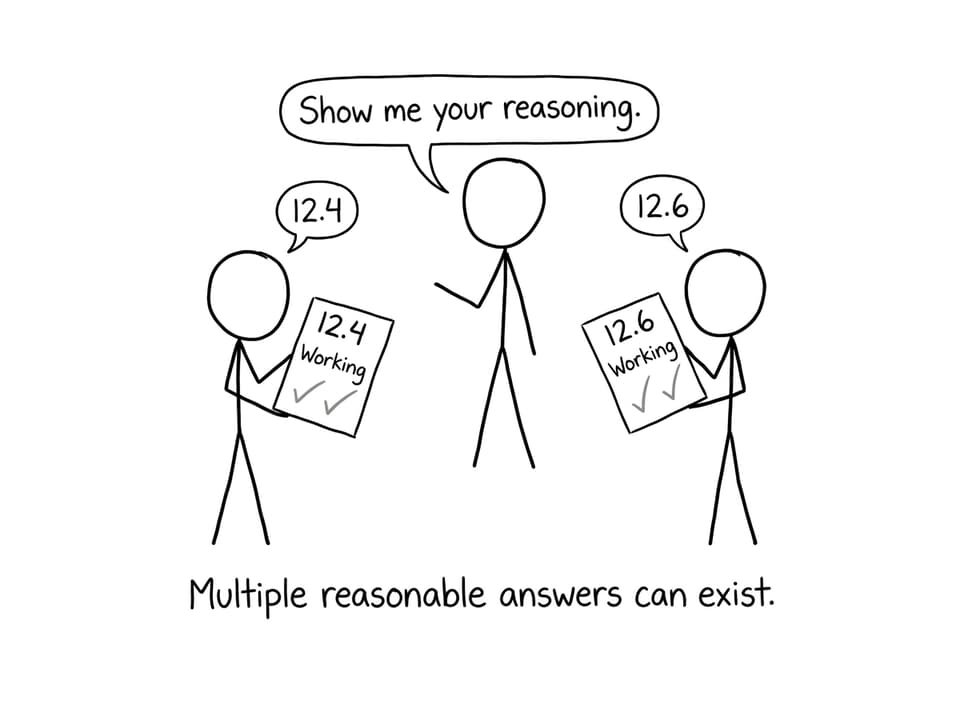
In many IB Math AI questions, two students can produce slightly different answers and both deserve credit if:
-
their assumptions are stated (explicitly or through working)
-
their method is valid
-
their conclusion matches their result
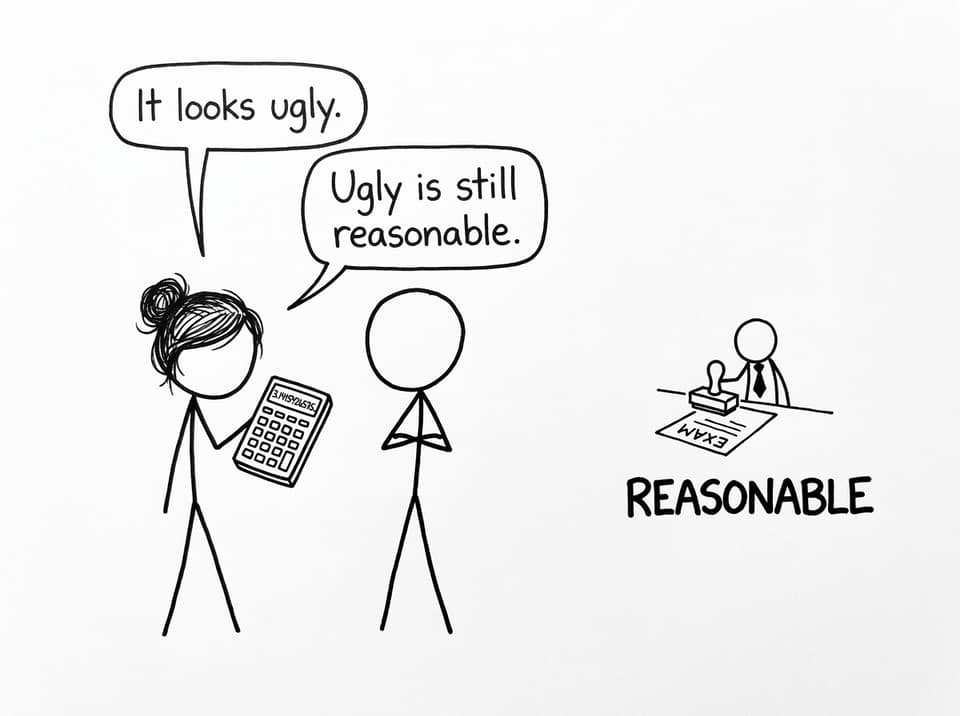
Students lose reasonable answer marks when they erase a sensible estimate because it “looks ugly.” But IB is fine with awkward decimals if the context and reasoning support them.
RevisionDojo drills this mindset well through How to Use the Questionbank for Targeted Math Revision, where you practise examiner-style mark allocation (method, interpretation, accuracy) instead of chasing perfect calculator outputs.
How to practise reasonable answers the smart way
Reasonable answer marks are a habit. You build them with repetition, feedback, and reflection:
-
Use RevisionDojo’s Questionbank to practise mixed-context questions (stats, modelling, finance)
-
Use AI Chat to ask, “What would an examiner accept as reasonable here, and why?”
-
Use Grading tools and worked feedback to see which lines of reasoning actually score
-
Use Mock Exams and Predicted Papers to practise the pressure moment where you want to second-guess yourself
If you’re choosing between courses or trying to understand how AI differs, AA vs AI, SL vs HL: How to Choose helps clarify what each path rewards.
Bringing it home: use IB Math the way AI intends
Reasonable answer marks exist because IB Math AI is built around reality: uncertainty, approximation, and decisions backed by reasoning. When you stop chasing perfect-looking numbers and start communicating sense, your marks become more stable, and your confidence stops depending on the calculator screen.
If you want that skill to feel automatic, RevisionDojo is built for it: Study Notes for method clarity, Flashcards for quick recall, a targeted Questionbank with feedback, AI Chat for examiner-style explanations, Mock Exams for pressure practice, Predicted Papers for exam readiness, a Coursework Library for strong examples, and Tutors when you want personalised correction. In IB Math, the “reasonable” student often out-scores the “perfect” one. Train for reasonableness on purpose.