



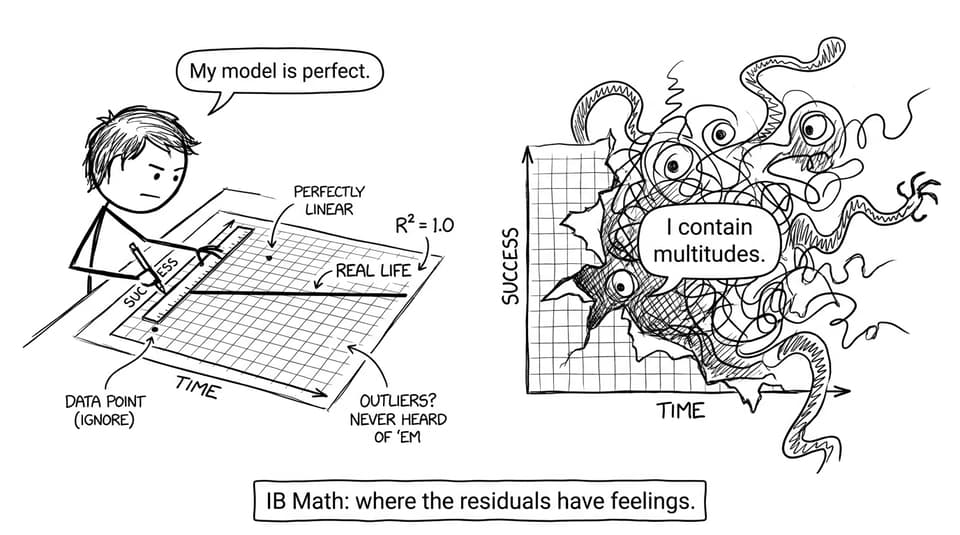
In IB Math, there’s a quiet moment most students recognize: you build a neat model, it fits beautifully, and then the real world does something rude.
The graph bends. The data spikes. A “reasonable” prediction becomes a comedy sketch.
That moment is not a failure. It’s the point.
Real-world modelling sits at the heart of IB Math because it forces you to think like a decision-maker, not a formula-reciter. And decision-makers don’t ask, “Is my model perfect?” They ask, “Where does it break, and how badly?”
A quick IB Math checklist for discussing limitations
When an exam or IA-style prompt asks you to evaluate a model, use this simple IB Math checklist:
-
Complexity: What important variables did the model ignore?
-
Assumptions: Which conditions must be true for your model to work?
-
Data quality: How trustworthy is the data feeding the model?
-
Domain: Where is the model valid, and where is it risky?
-
Impact: How do these limitations change your conclusion?
If you want modelling skills explained in a structured syllabus order, pair this with SL 2.6 Modelling Skills Notes.
IB Math truth: models simplify because they must
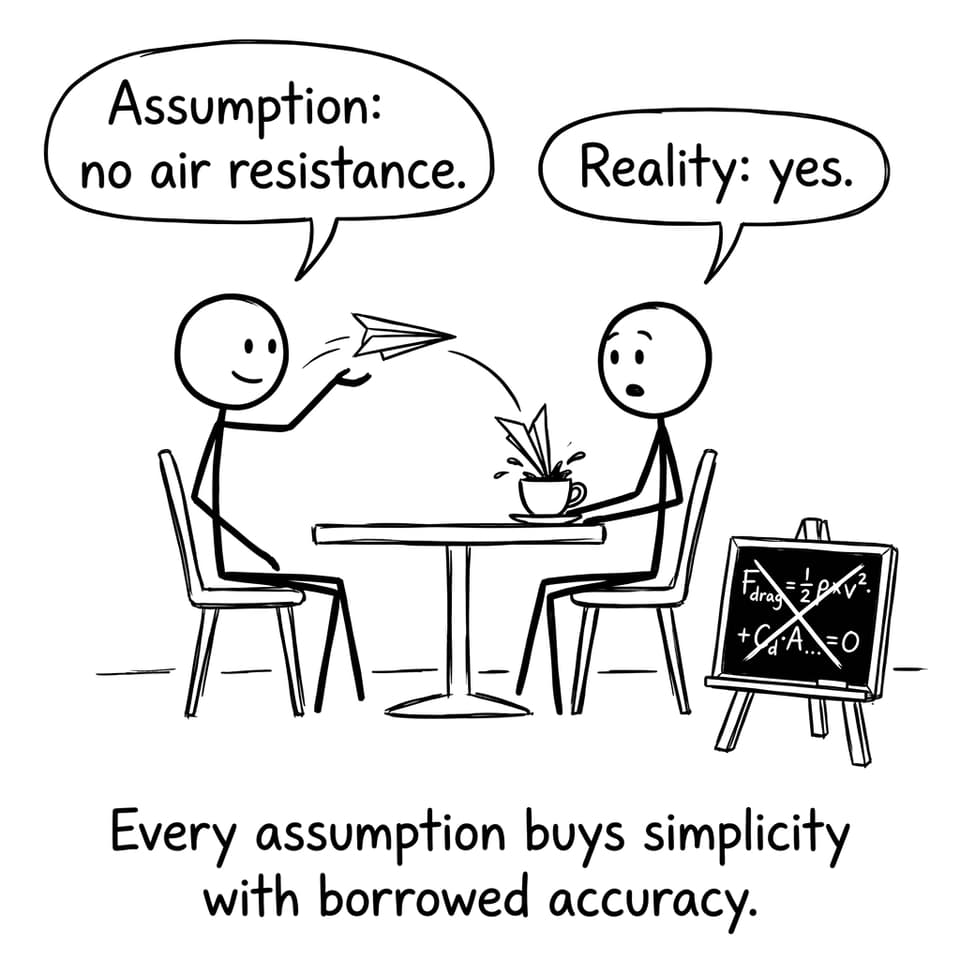
Every IB Math model is a trade: you give up realism to gain clarity.
To model something messy (traffic flow, rainfall, phone battery life), you select a few variables and pretend the others don’t matter much. That simplification is what makes the maths possible under exam conditions.
But simplification has a cost: error. Your job is to name that cost.
This is also why modelling questions can feel strangely under-specified. That “missing information” is intentional. It tests judgement. See Why Do IB Modelling Questions Feel So Under-Specified?.
Complexity is the first limitation (and the most honest one)
Real systems aren’t single-equation stories.
Even when your model looks sophisticated, reality includes interacting factors you didn’t measure: human choices, weather shifts, economic incentives, random noise, and feedback loops. A regression line can summarize a relationship, but it can’t fully explain why the relationship changes.
In IB Math, you score higher when you say this clearly and calmly: “This model captures the main trend, but the system has additional variables that may cause deviations.”
Assumptions: the hidden rules your model depends on
Many IB Math models quietly assume things like:
-
linearity (constant rate of change)
-
independence (variables don’t affect each other)
-
normality (data behaves like an ideal distribution)
-
constant conditions (nothing external changes)
These assumptions can be reasonable in a narrow range, and wildly wrong outside it.
The best exam answers don’t just list assumptions. They connect them to meaning: if the assumption fails, your conclusion becomes less reliable.
For a deeper IA-style approach, How to Reflect on Mathematical Limitations in the IB Math IA is a strong reference.
Data quality: elegant maths can’t rescue messy inputs
A model built on weak data produces weak conclusions, even if the method is flawless.
Common IB Math data limitations include:
-
measurement error (rounded values, inconsistent tools)
-
small samples (too few points to trust patterns)
-
biased sampling (data collected from a non-representative group)
In exams, this is an easy but powerful evaluation point: “Because the sample may not represent the wider population, predictions should be treated cautiously.”
Domain and extrapolation: where marks are won or lost
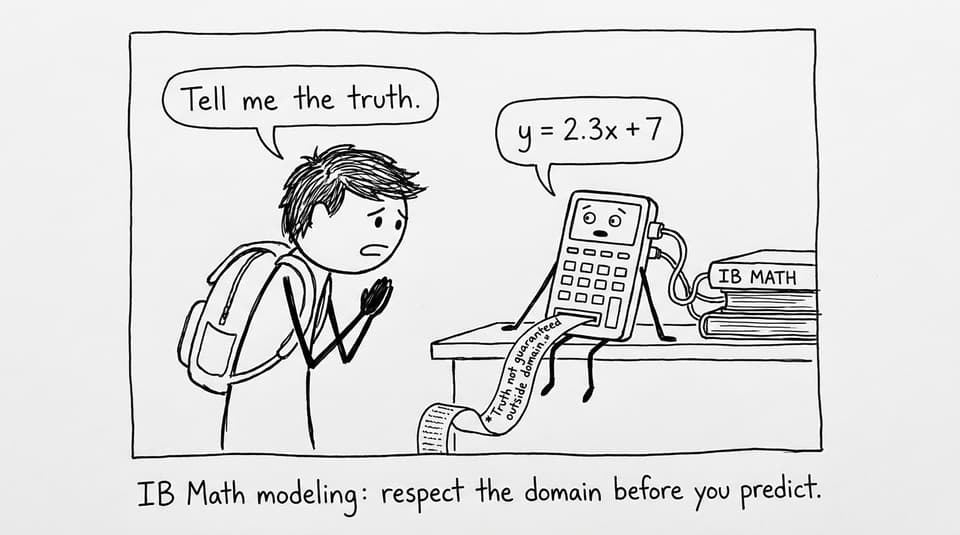
In IB Math, many modelling mistakes happen when students assume the model works everywhere.
A model is usually reliable within the data range (interpolation) and risky outside it (extrapolation). So when you’re asked to “predict” far beyond the given values, the correct move is to warn the examiner.
This connects neatly to the IB expectation that you interpret, not just calculate. RevisionDojo’s modelling pathway at IB Mathematics Applications & Interpretation Resources reinforces this habit through notes, drills, and timed practice.
How RevisionDojo helps you turn limitations into marks
The funny part about IB Math is that “limitations” sounds negative, yet it’s often where the top-band responses separate themselves.
RevisionDojo trains this skill in a practical loop:
-
Use the SL 2.6 Modelling Skills Flashcards to lock in the exact language of evaluation.
-
Drill modelling-style prompts through the Number and Algebra Questionbank (and other topics) so critique becomes automatic.
-
Study model-writing patterns in How to Approach Math AI SL Modeling Questions.
-
For coursework, compare against real structure using Math AI IA Examples and the wider Math AI Exemplars Library.
Behind the scenes, RevisionDojo’s Questionbank, Study Notes, Flashcards, AI Chat, Grading tools, Predicted Papers, Mock Exams, Coursework Library, and Tutors all point at the same endgame: make your reasoning examiner-readable.
Conclusion: limitations are the point, not the problem
Real-world models always have limitations because reality is larger than the maths we can write under timed conditions.
In IB Math, your advantage is not pretending the model is perfect; it’s explaining where it’s reliable, where it’s fragile, and what that does to your conclusion. That’s how modelling becomes a scoring opportunity instead of a risk.
If you want to practise this in an examiner-aligned way, RevisionDojo’s IB Math resources (Questionbank, Study Notes, Flashcards, AI Chat, Grading tools, Predicted Papers, Mock Exams, Coursework Library, and Tutors) are built to help you turn “limitations” into clear, confident marks.