

Random sampling sounds like the cleanest promise in statistics: close your eyes, pick fairly, and let the data speak.
Then you try it in real life.
In IB Math, random sampling is treated as a gold standard, but examiners love showing how that gold gets scratched the moment people, time, and imperfect lists enter the room. If you can explain why randomness breaks down, you stop losing “evaluation” marks and start sounding like someone who actually understands data.
The quick IB Math checklist for “random sampling” claims
Use this mini-checklist whenever an IB Math question says “random”:
-
Do we have a full population list (a sampling frame)?
-
Did everyone selected actually respond?
-
Did a human quietly “help” the randomness?
-
Is technology being used on a biased input list?
-
Did time, cost, or location force shortcuts?
If you can comment on two or three of these clearly, you usually capture the marks that separate a 5 from a 7.
Why random sampling is so hard to achieve in practice
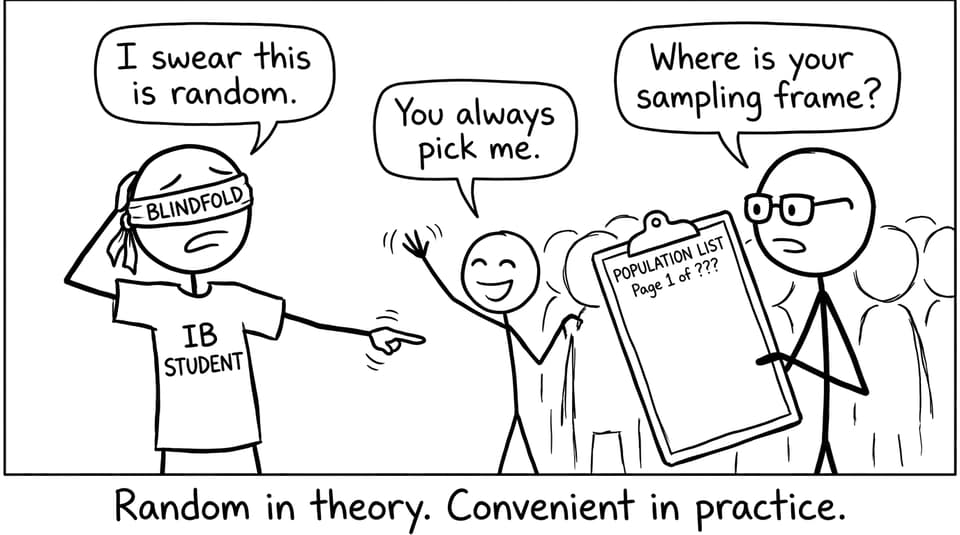
The sampling frame problem (you can’t random-pick what you can’t list)
True random sampling needs a complete list of the population, where each member has an equal chance of selection. In IB Math, this is often the hidden flaw: the “population” might be “all teenagers in a city,” “all IB students,” or “all customers,” but the only list available is “people we can reach.”
That gap creates undercoverage: certain groups never even had a chance of being selected. If you want a fast refresher on reliability and sampling language, the Concepts, reliability and sampling techniques notes are a strong anchor.
Non-response turns a random plan into a biased outcome
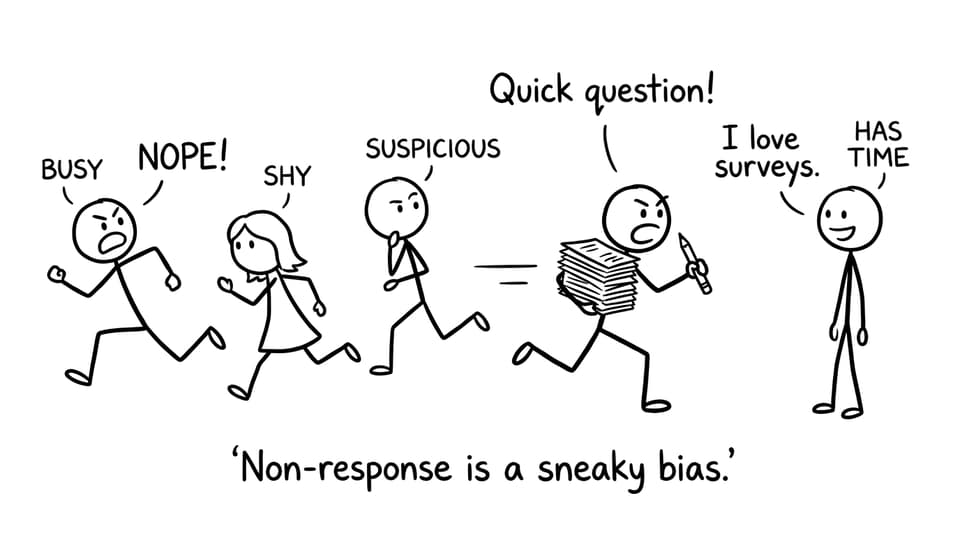
Even if selection is random, participation often isn’t. People ignore emails. Students forget forms. Parents say no. And the groups that opt out are rarely random.
In an IB Math explanation, you’re aiming for a simple sentence like: “Non-response bias may occur if certain subgroups are less likely to reply, so the final sample may not represent the population.” That’s the examiner-friendly idea.
Humans quietly “fix” randomness without noticing
In real settings, the person collecting data gets tired, rushed, or subtly selective:
-
Choosing the nearest students instead of the selected ones
-
Replacing an unavailable participant with “someone similar”
-
Surveying friends because it’s faster
That’s how intended random sampling becomes convenience sampling. In IB Math, your job is to spot when the method described and the method executed are not the same.
Random number generators don’t rescue biased inputs
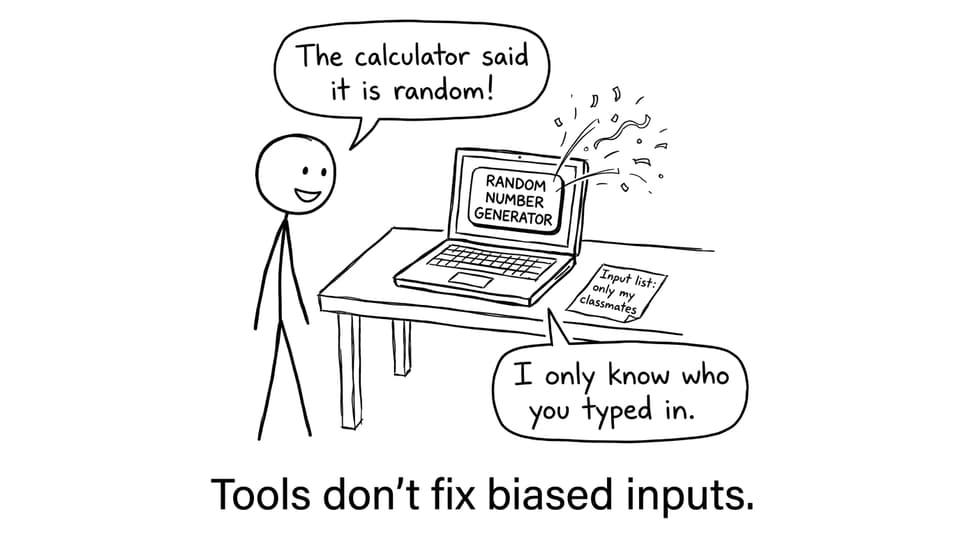
A calculator can generate random numbers perfectly and still produce a biased sample if the input list is incomplete.
If the “population” is all students in a grade, but your list is only students in your class group chat, pressing RNG is just randomizing a restricted group. If you want topic practice that forces you to write these evaluations, try the Statistics & Probability Questionbank (AA) or the Math AI Statistics & Probability Questionbank.
Practical constraints push “ideal” into “approximately random”
Time, cost, and location matter more than students expect. Schools sample one grade because it fits a timetable. Researchers sample one neighborhood because travel is expensive. Businesses sample whoever clicks a link.
In IB Math, you don’t need to pretend perfect sampling is common. You need to show you can acknowledge limitations calmly and explain what they do to reliability.
How to write the high-mark IB Math evaluation sentence
Try this template:
“Although a random method is stated, true randomness may be limited because ___ (missing sampling frame / non-response / convenience). This could lead to bias, so conclusions should be treated with caution.”
If sampling and reliability feel like a weak spot, build the foundation with Why Does Sampling Matter So Much in IB Statistics? and then connect it to exam practice through the Statistics & Probability topic hub or the IB Math AI course page.
Conclusion: use IB Math realism, not perfection
Random sampling is hard because the world doesn’t hand you a perfect population list, cooperative participants, and unlimited time. That’s exactly why IB Math keeps asking you to comment on limitations: it’s testing judgment.
To train that judgment quickly, combine targeted practice in RevisionDojo’s Questionbank with clear definitions in Study Notes, then tighten your wording with Flashcards and quick checks in AI Chat. When you’re ready to simulate pressure, use Mock Exams, Grading tools, and Predicted Papers to practice writing the evaluation lines that earn marks. If you want human feedback on your explanation style, RevisionDojo Tutors can help you turn “I think it’s biased” into an examiner-ready argument.
The next time a question says “random,” treat it as an invitation: explain why randomness is difficult, and you’ll score like someone who understands what data really costs.