



The uncomfortable truth about IB Math models
You finish the question, your regression line looks clean, and the calculator spits out a tidy equation. For a moment, it feels like the world finally behaves. Then the exam asks: “Comment on the reliability of your model.”
In IB Math, that line is not an insult. It’s the point. The IB isn’t asking whether your model is “good” in some absolute sense. It’s asking whether you understand why mathematical models can never be perfectly trustworthy, even when your working is flawless.
Once you accept that, modelling questions get calmer. You stop defending your equation and start explaining how much confidence it deserves.
Quick checklist: what makes a model unreliable?
When you evaluate a model in IB Math, you’re usually commenting on a few repeatable issues:
-
Simplifying assumptions (linearity, constant rate, independence, normality)
-
Imperfect data (small samples, measurement error, bias)
-
Changing conditions (relationships shift over time)
-
Overfitting (too complex to generalize)
-
Extrapolation (predicting outside the data range)
If you want structured practice on these evaluation points, RevisionDojo’s Math AI modelling notes are a solid starting place: SL 2.6 Modelling skills notes.
Why assumptions quietly control your answer in IB Math
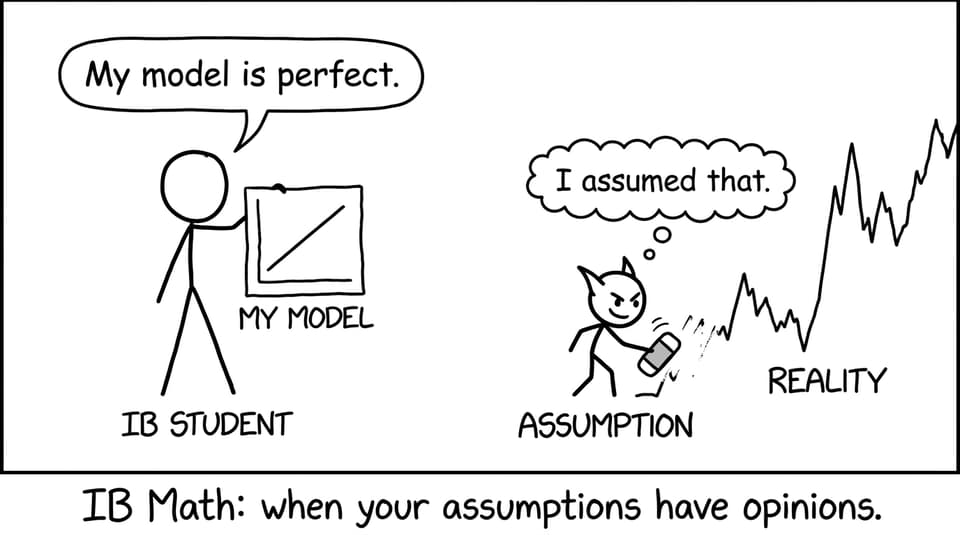
A model is a deal you make with reality. You say: “I’m going to ignore some details, so I can see the pattern.” That deal is built from assumptions.
In IB Math, the most common assumptions are the ones students forget to mention because they feel “normal”:
-
A linear model assumes the rate of change stays constant.
-
A normal distribution assumes symmetry and predictable spread.
-
A probability model often assumes independence.
Even when these assumptions are reasonable, they’re never fully true. Real life has friction. People change their minds. Measurements drift. So your model inherits a permanent gap between the world and the page.
To sharpen this skill, review modelling function choices and what they imply: Modelling functions notes (SL 2.5).
Data is never as clean as your calculator suggests
The calculator gives confidence with too many decimal places. But data comes with baggage: sampling bias, inconsistent collection methods, or instruments that simply weren’t precise.
That’s why IB Math rewards students who limit claims to what the data can support. A model built on weak data can still be useful, but its conclusions must be cautious.
If you’re revising reliability language (especially for stats), these resources help:
Changing conditions: the reason good models suddenly fail
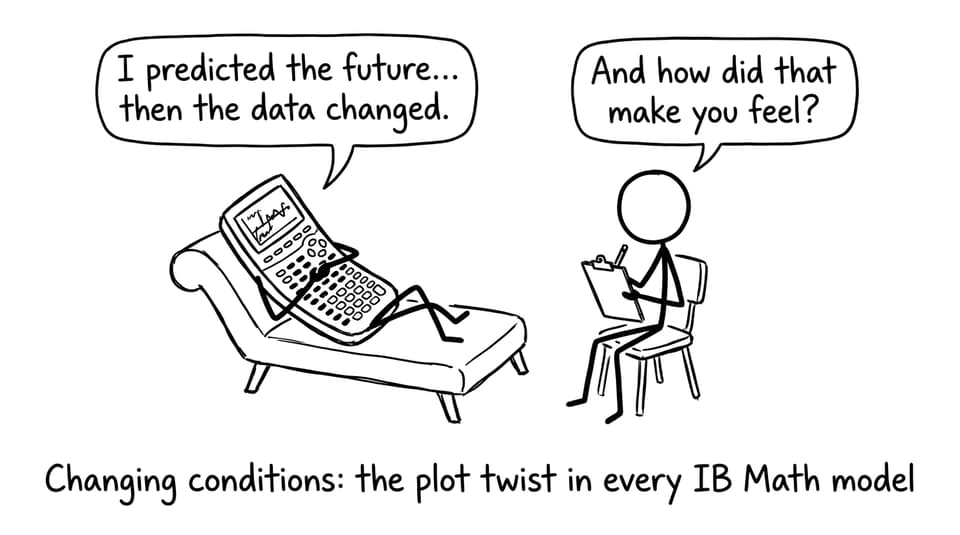
A model can fit past data beautifully and still collapse when the situation changes. That’s not a math error. It’s a reality error.
In IB Math, this often appears when students:
-
Extrapolate far beyond the observed range
-
Assume a trend will continue indefinitely
-
Treat a strong correlation as a permanent law
A simple exam-safe sentence is: “This model may be reliable within the observed domain, but predictions beyond this range may be unreliable due to changing conditions.”
For more exam-oriented modelling strategy, see: How to approach Math AI SL modeling questions.
More complexity isn’t the same as more reliability
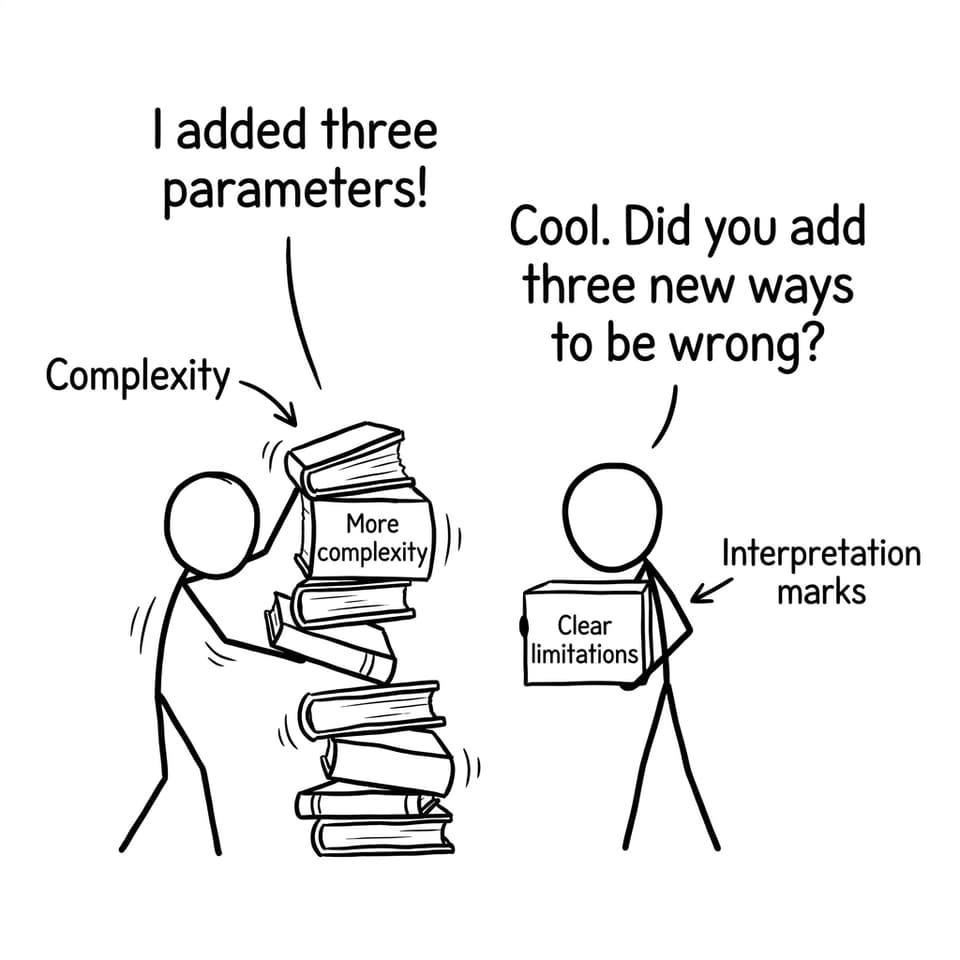
Many students assume the fix is to add sophistication: extra parameters, higher-degree polynomials, more features. Sometimes that improves fit, but in IB Math, complexity has a cost.
More complexity can mean:
-
More assumptions hidden in the method
-
More sensitivity to small errors in data
-
More ways for the model to “memorize” the sample instead of generalizing
The exam often rewards the simpler model with clearer limitations, because it’s easier to interpret responsibly.
If you want practice where evaluation is part of the marking, use RevisionDojo’s Questionbank to target modelling and reliability skills, such as: Data collection, reliability and validity tests Questionbank (AI AHL 4.12).
How to turn “unreliable” into marks in IB Math
The highest-scoring evaluation is rarely dramatic. It’s specific.
Try this structure in IB Math:
-
State the limitation (assumption, data, domain, changing conditions)
-
Explain the effect (over/underestimation, weak prediction, restricted validity)
-
Bound your conclusion (works here, not there)
For IA-style wording, these guides are excellent:
Conclusion: reliability is a skill, not a warning label
In IB Math, saying “no model is ever fully reliable” isn’t pessimism. It’s competence. It means you understand assumptions, data limits, and the fact that the world changes even when equations don’t.
If you want to turn that understanding into consistent marks, build a tight practice loop with RevisionDojo: Study Notes for the concept, Questionbank for exam-style practice, AI Chat for feedback on your evaluation wording, Grading tools for mark-aligned improvement, and Predicted Papers plus Mock Exams to rehearse under time pressure. When modelling questions stop feeling like a trap, IB Math starts feeling like a language you can actually speak.