




Multi-part questions have a special talent: they look like a marathon before you have even started.
In IB Math, that long chain of (a), (b), (c), (d) can trigger the same feeling as seeing a staircase disappear into fog. You assume the point is to keep moving until your legs give out. But multi-part questions aren’t built to test your endurance. They’re built to test whether you can build understanding in layers.
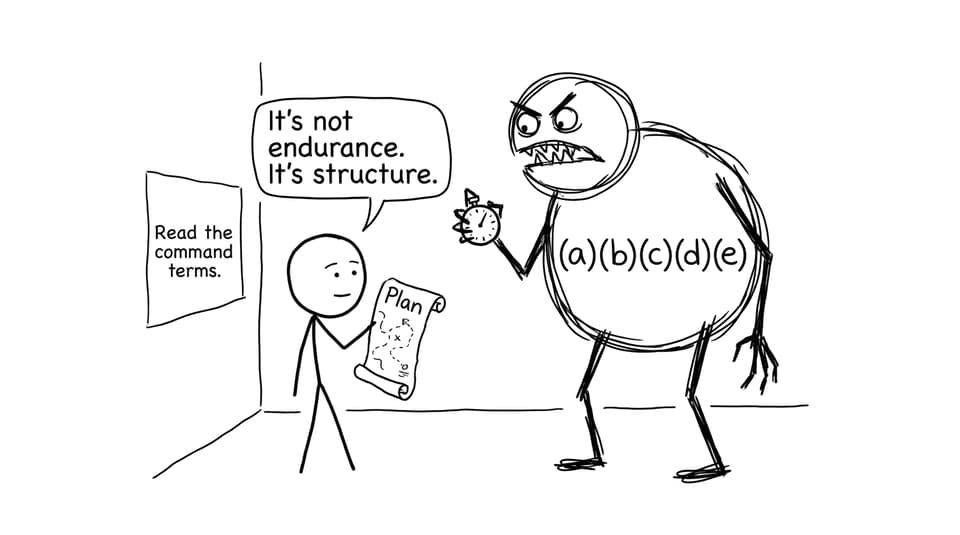
Why IB Math multi-part questions exist
In real problem solving, you rarely jump from “read the question” to “final answer.” You set something up, compute something, interpret it, then decide what it means. Multi-part questions mirror that reality.
In IB Math, examiners want to see if you can:
-
establish a correct method early
-
keep your reasoning consistent across steps
-
adapt when the question shifts from calculation to interpretation
-
communicate clearly when the marks move from “do” to “explain”
If you treat the question like separate mini-problems, it feels longer than it is. If you treat it like a guided conversation, it becomes predictable.
A quick checklist for handling IB Math multi-part questions
Use this before you start writing anything:
-
Read all parts quickly and circle the highest-mark prompts.
-
Highlight command terms (show that, hence, interpret, comment).
-
Slow down on (a) if it clearly feeds later parts.
-
Reuse results on purpose (quote them cleanly).
-
Reset mentally between parts: new line, new goal.
For command term traps, it helps to keep a short reference like How to Read Math Questions Carefully (and Avoid Traps).
The hidden structure: marks often climb as parts progress
A common IB Math mistake is spending forever polishing an early, low-mark calculation. It feels “safe” because it’s mechanical. But later parts often carry more marks because they ask for interpretation, evaluation, or justification.
That’s why rushing early parts to “save time” also backfires. If your foundation is shaky, later answers wobble. Errors cascade. Confidence follows.
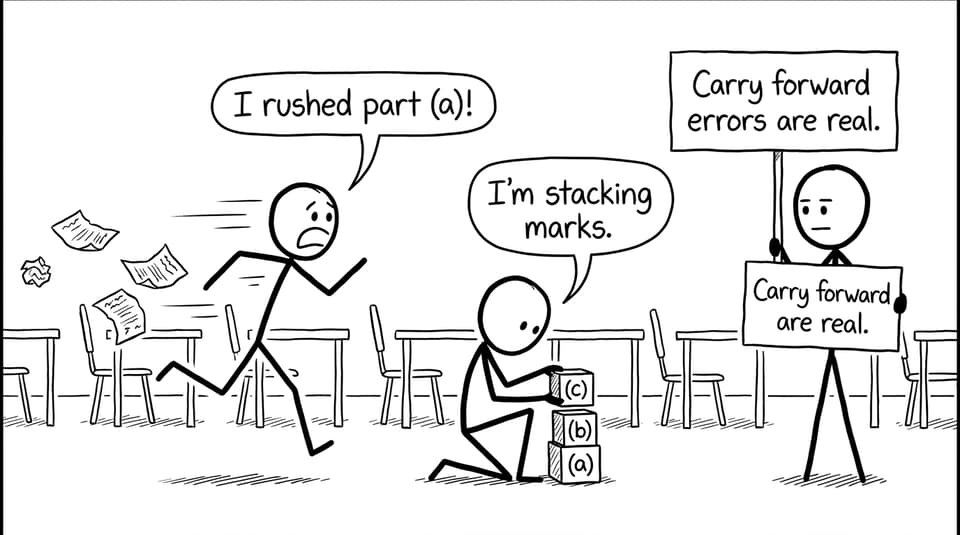
The skill is not speed. It’s sequencing: doing the right amount of work at the right time.
Multi-part questions test adaptability (and that’s the point)
Multi-part design forces you to switch modes. In IB Math, you may go from algebra to a graph interpretation, or from probability calculation to a critique of a model’s limitations.
That switching isn’t cruelty. It’s assessment.
The exam is asking: can you move between skills without clinging to one method like a life raft?
A practical way to train this is mixed practice. RevisionDojo makes that easy by letting you drill by topic when you need clarity, then switch to integrated sets when you need flexibility. Start with targeted practice in the IB Math AA resources or the Math AI Number and Algebra Questionbank, then rotate into other strands.
Reusing earlier results is not “cheating”; it’s examiner-friendly
Many students believe each part must be answered independently. In IB Math, that’s usually the opposite of what examiners intend.
If (b) says “hence,” or (d) says “using your answer to (c),” the paper is giving you a shortcut. Quote your earlier result clearly, then build from it.
This is where RevisionDojo’s tools compound:
-
Study Notes help you see the method pattern behind recurring multi-step setups.
-
Flashcards lock in the “trigger phrases” (hence, show that, comment on) so you respond automatically.
-
AI Chat can clarify why a later part expects reuse instead of re-derivation.
To tighten your workflow, pair practice sets with a revision system like How to Revise IB Math AA and AI Effectively.
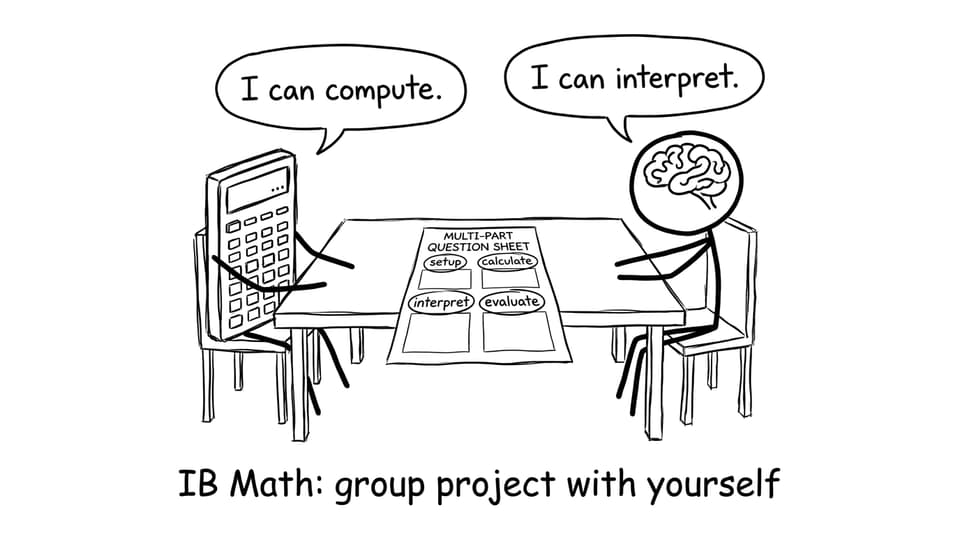
Using RevisionDojo to train multi-part performance
Multi-part questions stop feeling endless when your practice is structured.
On RevisionDojo, you can:
-
use the Questionbank to drill exam-style multi-step questions (with feedback and solutions) in places like the IB Math AA Calculus Questionbank or the IB Math AI Calculus Questionbank
-
run Mock Exams and Predicted Papers to rehearse timing and pacing under pressure via IB Predicted Papers and the deeper explainer on IB Predicted vs Specimen Papers: What They Mean
-
use Grading tools to see where marks were lost (setup, method, interpretation)
-
build memory with Flashcards and confidence with Tutors when a topic keeps recurring
If you want a broader strategy for consistency, The Ultimate IB Math Study Routine for Busy Students pairs well with multi-part training.
Conclusion: in IB Math, long questions are often the most generous
Multi-part questions can feel like endurance tests, but in IB Math they are often the most supportive questions on the paper. They guide you through the logic, feed you stepping stones, and give you multiple chances to earn marks.
If you want to make these questions predictable, train the structure: practise in RevisionDojo’s Questionbank, reinforce methods with Study Notes and Flashcards, get unstuck with AI Chat, then rehearse timing with Mock Exams and Predicted Papers. Multi-part questions stop being scary when you stop trying to survive them and start trying to understand the conversation they’re having with you.