
Photosynthesis is one of those IB Biology topics that feels simple until you try to explain it under exam pressure. Light goes in, sugar comes out… and then the markscheme asks why the two stages must cooperate. Suddenly, it’s not a neat story but a two-person relay race where the baton is ATP, NADPH, ADP, Pi, and NADP+.
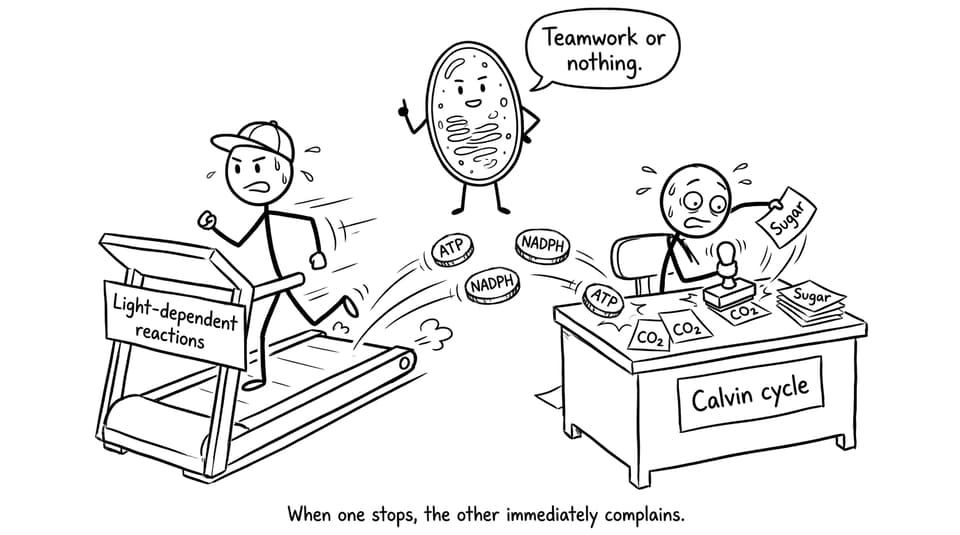
In IB Biology, the key idea is interdependence: the light-dependent reactions power the Calvin cycle, and the Calvin cycle keeps the light-dependent reactions running. If either stage slows, the other stage quickly hits a biochemical wall.
The IB Biology checklist: what each stage makes and needs
Keep this mental “trade deal” ready for IB Biology short-answer questions:
-
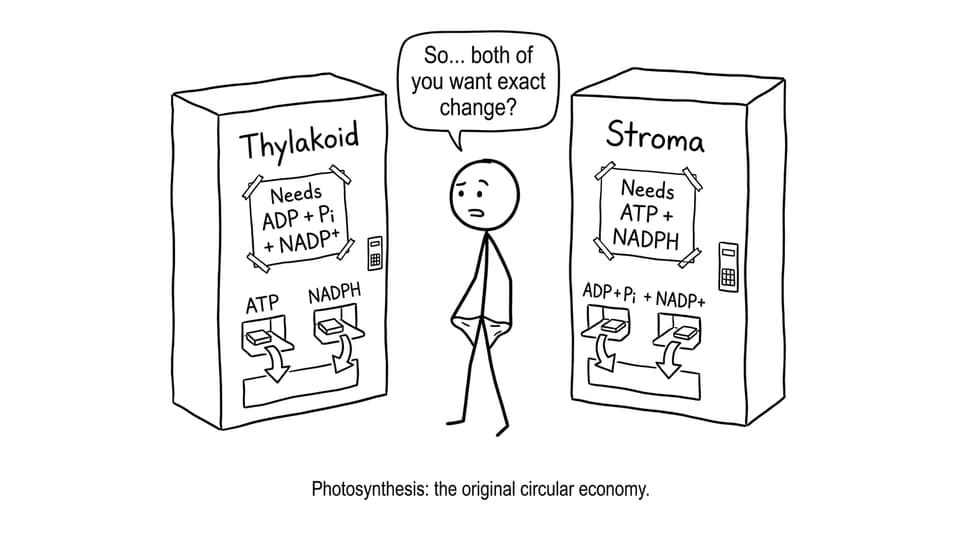
Light-dependent reactions (thylakoid membranes) produce ATP and NADPH.
-
Calvin cycle (stroma) uses ATP and NADPH to fix CO2 and build carbohydrate.
-
The Calvin cycle returns ADP + Pi and NADP+ back to the thylakoids.
If you want the syllabus-aligned version, use the IB Biology Topic C1.3: Photosynthesis hub and the matching photosynthesis notes.
How the light-dependent reactions set the Calvin cycle in motion
In IB Biology terms, the light-dependent reactions convert light energy into chemical energy. They occur in the thylakoid membranes, where excited electrons move through an electron transport chain, building a proton gradient used for ATP synthesis.
Two products matter for interdependence:
-
ATP (energy currency) made via chemiosmosis/photophosphorylation.
-
NADPH (reducing power) made when NADP+ accepts electrons (and H+).
Those outputs are not “extra”. They are the Calvin cycle’s budget. No ATP, no regeneration steps. No NADPH, no reduction of carbon compounds.
For targeted revision, see photolysis of water in PSII and reduction of NADP by PSI.
How the Calvin cycle “pays back” the light-dependent reactions
The Calvin cycle is called “light-independent” because it doesn’t use photons directly, not because it can run forever in darkness. In IB Biology, it relies on ATP and NADPH to:
-
Fix CO2 (via Rubisco)
-
Reduce GP to TP (using ATP and NADPH)
-
Regenerate RuBP (using ATP)
But here’s the overlooked half of interdependence: as the Calvin cycle spends ATP and NADPH, it regenerates ADP + Pi and NADP+. Those molecules are essential inputs for the light-dependent reactions. Without them:
-
ATP synthase runs out of ADP (no substrate, no ATP production).
-
Electron transport backs up without NADP+ as the final electron acceptor.
That feedback loop is exactly what examiners mean by “interdependence” in IB Biology.
Use these deep-dive pages for the high-yield steps: carbon fixation by Rubisco, synthesis of triose phosphate, and regeneration of RuBP.
Interdependence under real conditions: limiting factors
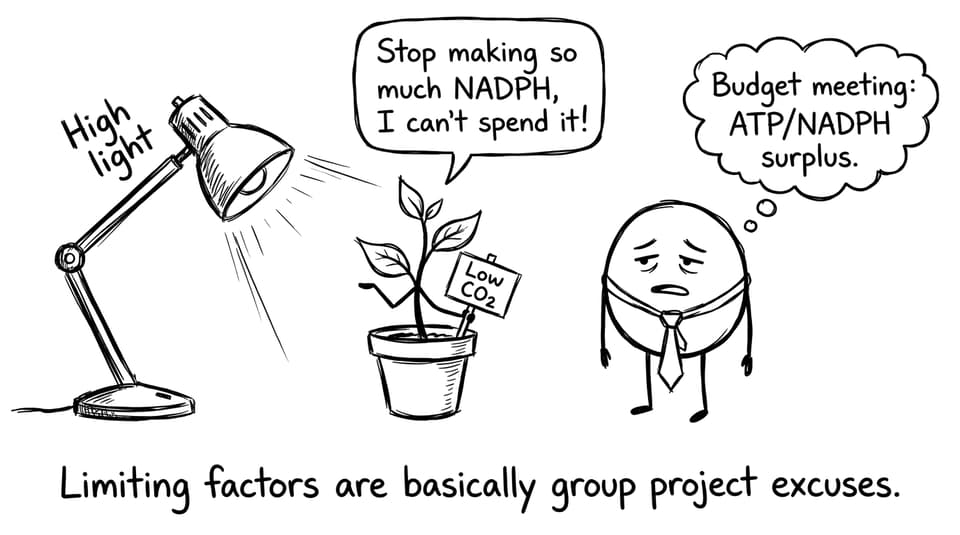
Interdependence becomes obvious when conditions change. Under high light, the thylakoids can produce ATP and NADPH rapidly. But if CO2 is limited, the Calvin cycle slows, meaning NADP+ regeneration slows too. Then the light-dependent reactions lose their electron acceptor supply, and the system must downshift.
This is why IB Biology photosynthesis questions often connect interdependence with limiting factors and rate control. For broader chloroplast context, see what is the function of chloroplasts? and for exam practice try the C1.3 Photosynthesis Questionbank.
Bring it home with RevisionDojo
IB Biology is full of topics where the marks sit in the connections, not the definitions. Interdependence in photosynthesis is exactly that kind of idea: two stages, two locations, one shared economy of ATP, NADPH, ADP, Pi, and NADP+.
When you revise this on RevisionDojo, you can move from Study Notes to Flashcards, test it in the Questionbank, and use AI Chat to refine your explanations into markscheme language. Add Predicted Papers, Mock Exams, and Tutors when you want pressure-tested confidence. Learn the loop, practise the wording, and IB Biology questions on photosynthesis start feeling predictable rather than personal.