
If you’ve ever looked at a differentiation question in IB Math and felt weirdly confident… only to lose marks anyway, you’re not alone.
The chain rule is a perfect trap because it feels like a button you can press whenever an expression looks complicated. Under exam pressure, “complicated” becomes a synonym for “chain rule.” And that’s exactly why it’s so easy to apply incorrectly in IB Math: the rule isn’t about difficulty, it’s about structure.
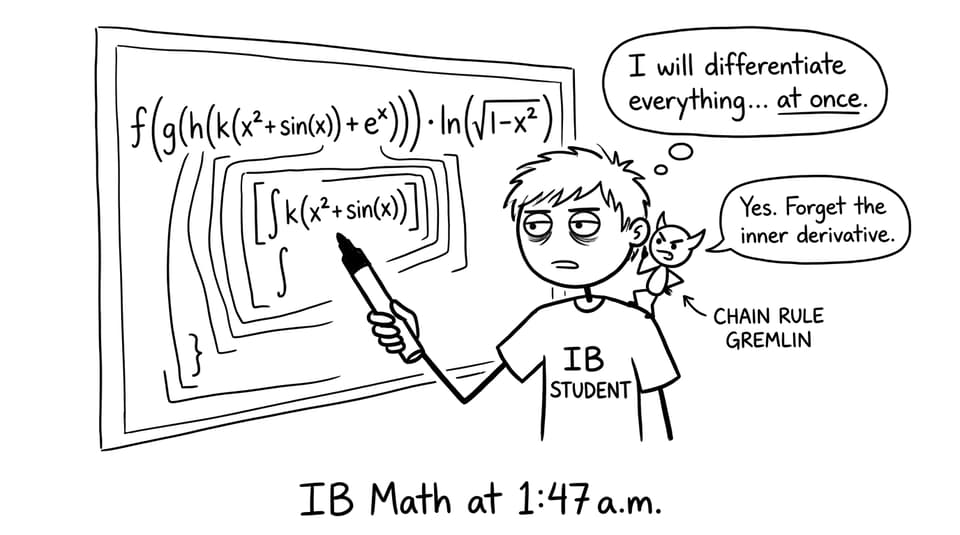
The real job of the chain rule in IB Math
In IB Math, the chain rule exists for one situation only: a composite function.
That means something like:
-
(y = \sin(x^2)) (a function inside a function)
-
(y = e^{(3x-1)})
-
(y = (5x+2)^{7})
The key idea is layers of input. The outer function isn’t receiving (x) directly. It’s receiving something else (like (x^2) or (3x-1)).
If you want a clear syllabus-aligned reference, RevisionDojo’s calculus hub is a good anchor point for the bigger picture: IB Math AA Calculus.
Why IB Math students overuse the chain rule
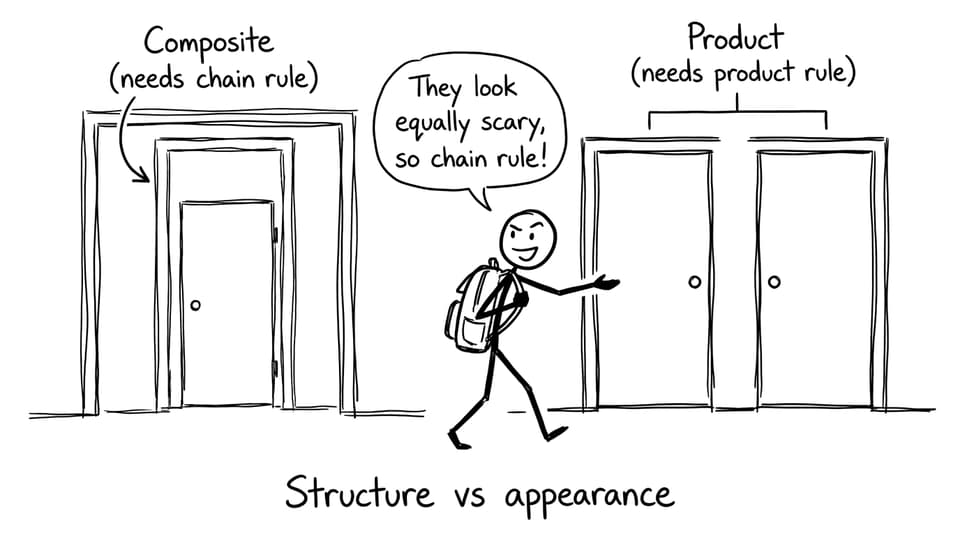
The most common chain-rule mistake isn’t “forgetting calculus.” It’s panic pattern-matching.
A function like (x^2\sin x) looks messy, but it’s not a composite function. It’s a product. The structure is “thing times thing,” not “function of a function.”
What IB Math examiners reward is not speed, but recognition. If you can pause for two seconds and say, “What is the outer function? What is being fed into it?” you avoid the most expensive errors.
To drill that recognition with exam-style questions, use targeted sets like Chain, Product and Quotient Rules Questionbank.
Why IB Math students forget the inner derivative
The second classic mistake is using the chain rule but dropping the inner derivative.
It usually happens when you memorize a surface template:
- “Differentiate the outside, keep the inside”
That’s only half the sentence. In IB Math, the other half is the mark-saving part:
- “…then multiply by the derivative of the inside.”
Example: (y = \sin(x^2))
-
Outer derivative: (\cos(x^2))
-
Inner derivative: (2x)
-
Final: (y' = 2x\cos(x^2))
If you want a clean explanation that matches how exam solutions are written, RevisionDojo’s notes for this skill are solid: Differentiating polynomials n E Q. Chain, product and quotient rules Notes.
A quick chain rule checklist for IB Math exams
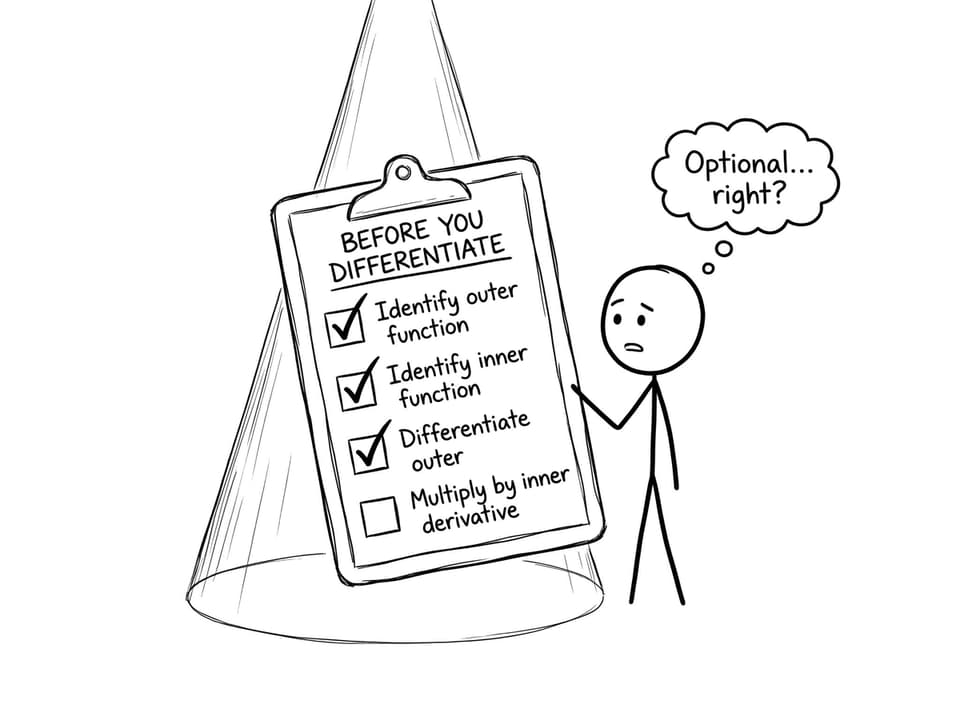
Before differentiating anything in IB Math, run this short mental checklist:
-
Can I name an outer function (like (\sin(\cdot)), (e^{(\cdot)}), ((\cdot)^n))?
-
Can I point to the inner function being substituted into it?
-
If yes, write (u=) inner function.
-
Differentiate in two steps: (\frac{dy}{du}) then (\frac{du}{dx}).
-
Multiply them.
This is also where RevisionDojo tools become more than “extra practice.” In the Questionbank feature, you can repeatedly train the same recognition step until it becomes automatic. Pair that with Study Notes, Flashcards, and AI Chat when you don’t just want the answer, but want to know why your method lost marks.
How IB Math hides the chain rule inside bigger questions
IB Math rarely asks the chain rule in isolation for long. More often, it’s embedded inside:
-
trig or exponential expressions
-
optimization setups
-
related rates
-
multi-step differentiation where product/quotient rules appear too
That’s why practicing mixed questions matters. A good place to broaden beyond one subskill is the topic hub itself: IB Mathematics Analysis and Approaches Resources.
The calm way to stop losing chain rule marks in IB Math
The chain rule isn’t hard because it’s advanced. It’s hard because it asks you to slow down for a beat and read structure when your brain wants to sprint.
If you want that calm to show up on exam day, build it now: use IB Math AA Calculus Questionbank for targeted sets, reinforce with Study Notes and Flashcards, ask AI Chat to diagnose where your setup went off-track, and then pressure-test with Mock Exams and Predicted Papers. That combination is what turns chain rule from a recurring mistake into a reliable source of marks in IB Math.
