

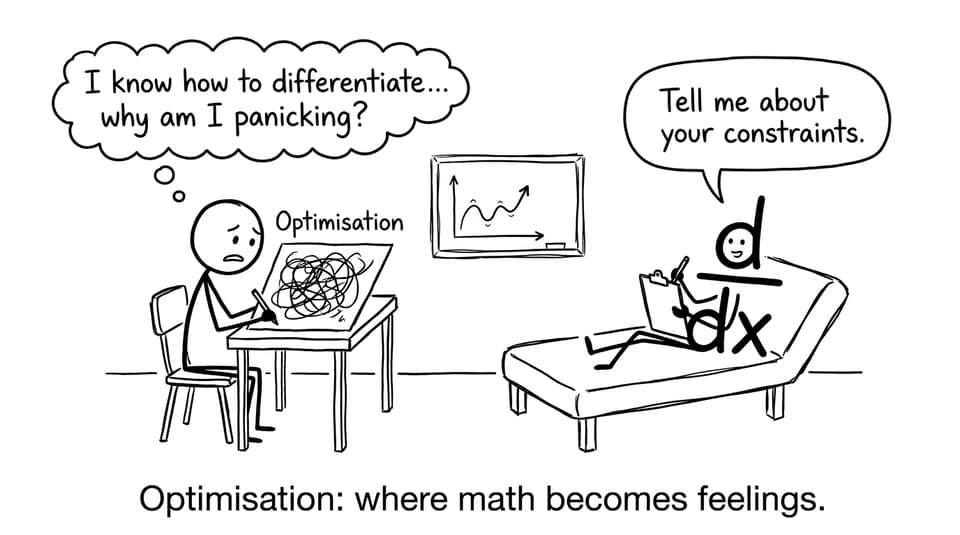
Optimisation questions in IB Math have a special way of making confident students go quiet.
You can know your differentiation rules cold, fly through routine derivatives, and still freeze the moment a question says “maximum,” “minimum,” or “greatest possible.” Not because you suddenly forgot calculus, but because optimisation isn’t really a calculus topic. It’s a thinking-under-pressure topic.
In IB Math, optimisation is where modelling, differentiation, and interpretation collide. And most marks are lost before you even pick up your pen to differentiate.
What optimisation means in IB Math (in plain terms)
Optimisation problems ask you to find the best value of something under constraints: maximum area, minimum cost, greatest volume, shortest distance, and so on.
But the “something” you optimise is rarely handed to you as a neat function.
Instead, IB Math expects you to:
-
translate words into variables,
-
connect those variables using constraints,
-
rewrite everything in one variable,
-
then use calculus to locate and justify the optimum.
If you want a structured walkthrough approach, RevisionDojo’s guide on how to use derivatives for optimization problems is a strong companion read.
The 5-step optimisation checklist (save this)
When optimisation feels messy, use this sequence:
-
Define variables clearly (what changes? what stays fixed?).
-
Write the quantity to optimise (area/volume/cost/etc.).
-
Use the constraint to eliminate variables until you have one.
-
Differentiate and solve for critical points.
-
Justify and interpret (maximum/minimum, endpoints, units, meaning).
For extra support, RevisionDojo’s Study Notes on the topic break this into a clean method: Optimisation notes.
Why modelling is the part that breaks people
The hardest moment in IB Math optimisation is deciding what the function even is.
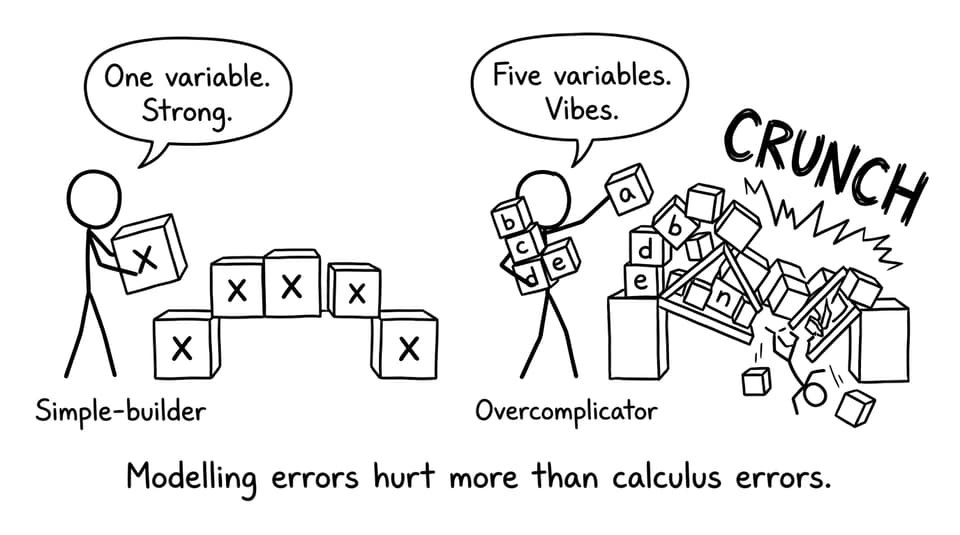
Students often rush because they feel safe once they’re “doing calculus.” But IB examiners reward the setup heavily. Differentiate the wrong function and your derivative can be perfect while your score collapses.
A common trap is keeping too many variables alive for too long. Optimisation wants one variable because one variable gives you one curve to optimise.
If you want targeted practice where setup marks are trained (not guessed), the Optimisation Questionbank on RevisionDojo is designed exactly for that, with examiner-style solutions.
Why differentiation alone doesn’t finish the job
In IB Math, finding a stationary point is not the finish line. It’s the midpoint.
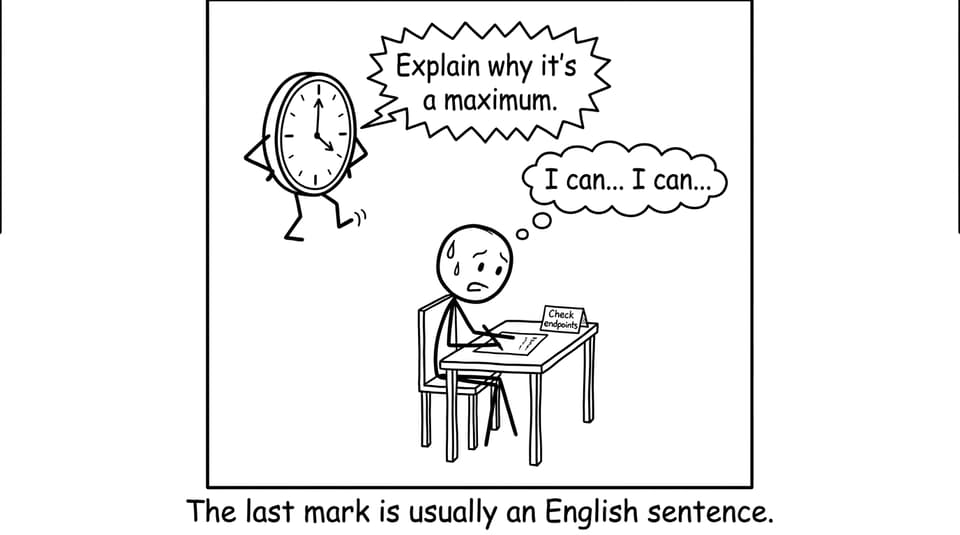
Optimisation requires you to explain what your answer means and prove it’s a maximum or minimum. That might involve:
-
sign analysis of the derivative,
-
the second derivative test,
-
checking endpoints of a restricted domain,
-
or simply reasoning from context.
This is why students lose “communication” marks even when the calculus is fine: the last marks are often earned by a sentence.
A useful nearby skill is understanding how derivatives behave conceptually, not just mechanically. This piece helps: Why does differentiation feel so mechanical at first in IB Maths?
How IB Math tends to assess optimisation
Optimisation usually shows up as high-mark, multi-step questions. Common formats include:
-
geometry (areas/volumes with constraints)
-
real-world modelling (profit/cost/time)
-
“justify” prompts (max vs min)
-
domain restrictions (physical or logical limits)
To train stamina, it helps to revise optimisation inside full-paper conditions. RevisionDojo supports this with Mock Exams and Predicted Papers for realistic rehearsal: IB Predicted Papers and Math AA Predicted Papers.
A calmer way to master optimisation in IB Math
Optimisation is hard in IB Math because it asks you to be both translator and mathematician: translate reality into a function, then use calculus, then translate back into meaning.
If you want a system instead of guesswork, build a short weekly loop with RevisionDojo: learn the method via Study Notes, drill set-ups in the Questionbank, lock memory with Flashcards, and use AI Chat plus Grading tools to check whether your final justification would earn the communication marks. When you’re ready, use Predicted Papers and Mock Exams to practise under time pressure, and lean on the Tutors and Coursework Library when the modelling step feels stuck.
Optimisation stops being scary when your process becomes predictable. And that’s exactly the kind of predictability IB Math rewards.