


The moment implicit differentiation stops feeling “safe”
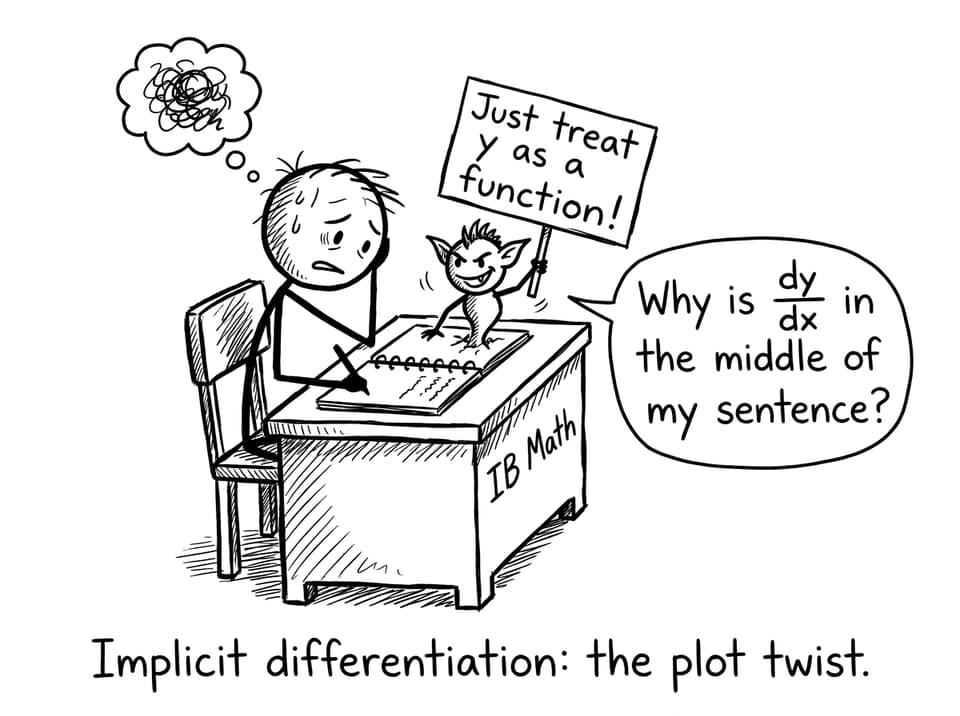
There’s a specific kind of panic that shows up in IB Math: you’re calmly differentiating, then suddenly dy/dx appears in the middle of your working like an uninvited guest. Your brain pauses. Your pen hovers. And the question you were sure you could do starts to feel like it belongs to someone else.
Implicit differentiation is often the first time IB students realize calculus isn’t only a set of button-press rules. It’s a way of describing how two quantities change together, even when the relationship is tangled. That tangle is exactly why it feels confusing, and also why the IB keeps coming back to it.
Quick checklist: what implicit differentiation is really testing
In IB Math, implicit differentiation questions usually test whether you can:
-
Remember that y depends on x even when it isn’t written as y = f(x)
-
Apply the chain rule whenever you differentiate something containing y
-
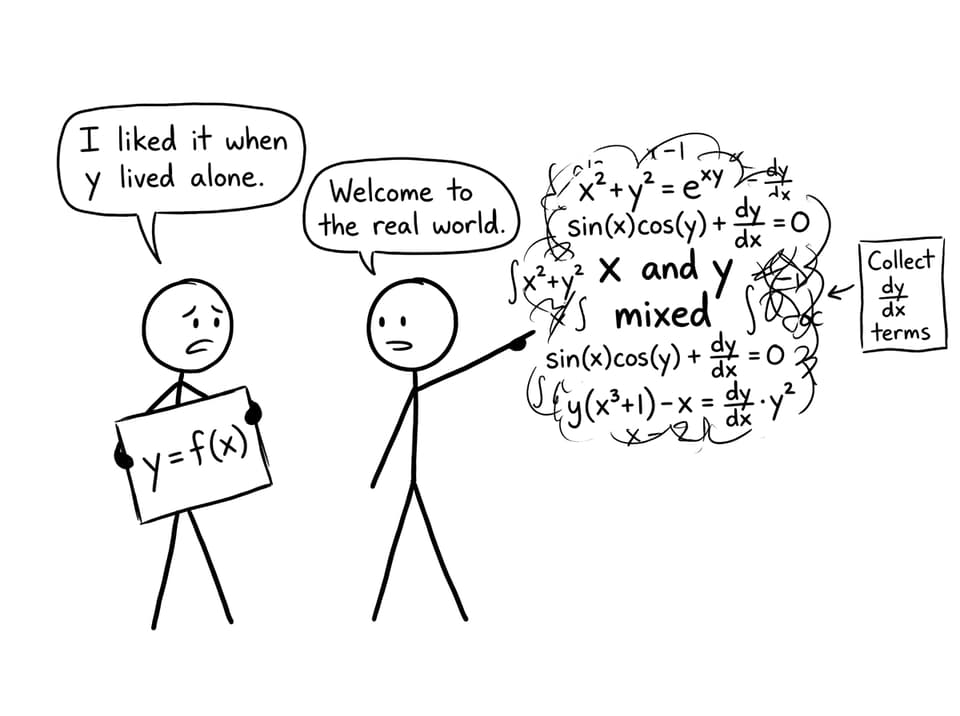
Keep dy/dx terms organized, then collect and solve for dy/dx
-
Use the derivative for tangents, normals, and rates of change
If you want a clear home base for the topic, start with Question Type 1: Implicit differentiation.
Why implicit differentiation feels different in IB Math
Most earlier IB Math differentiation practice trains you to expect a neat ending: differentiate, simplify, done. But implicit differentiation refuses to cooperate because x and y share the same space.
Instead of “find the derivative of a function,” the task becomes: “differentiate a relationship.” That’s a mindset shift. You’re no longer treating y like a standalone output. You’re treating y like a moving part.
A good support page to pair with this idea is the broader IB Math AA Calculus topic hub, because it helps you see implicit differentiation as one tool inside a bigger calculus toolkit.
The dy/dx “jump scare” (and why it’s actually logical)
The most common reason students struggle in IB Math is simple: they differentiate y as if it were a constant.
But when an equation contains y, you must read it as y(x), even if the question never says so. So when you differentiate something like y², you’re differentiating a function of a function:
-
Differentiate the outside (2y)
-
Multiply by the derivative of the inside (dy/dx)
That multiplication step is the whole point. It’s the chain rule revealing the dependency you’re not allowed to ignore.
For extra context on how the IB thinks about derivatives as meaning (not just rules), see Why does differentiation feel so mechanical at first in IB Maths?.
Where mistakes actually happen: the algebra at the end
Another reason implicit differentiation feels brutal in IB Math is that you often do the calculus part correctly… then lose marks during the “tidy-up.”
After differentiating, dy/dx appears on multiple terms. Now you must:
-
Move all dy/dx terms to one side
-
Factor out dy/dx
-
Solve like it’s an algebra question
That last step is unfamiliar because it’s not “calculus-only.” It’s calculus plus rearranging under pressure.
If your algebra slips when you’re rushed, use targeted practice rather than random sets. RevisionDojo’s Calculus Questionbank for IB Math AA is built for exactly that kind of focused drilling with feedback.
Why IB Math keeps testing implicit differentiation
The IB didn’t include implicit differentiation just to be annoying. Many curves and relationships aren’t easy (or even possible) to rewrite into y = f(x). Implicit form is often the natural form.
So in IB Math, implicit differentiation becomes a gateway skill for:
-
Related rates and changing quantities
-
Finding gradients at points on a curve
-
Tangents and normals written from first principles
-
Interpreting a curve geometrically
A classic extension is tangents and normals, where your dy/dx becomes a slope you actually use. RevisionDojo covers that connection in SL 5.4 Tangents and normal (notes).
Exam-proof structure for implicit differentiation in IB Math
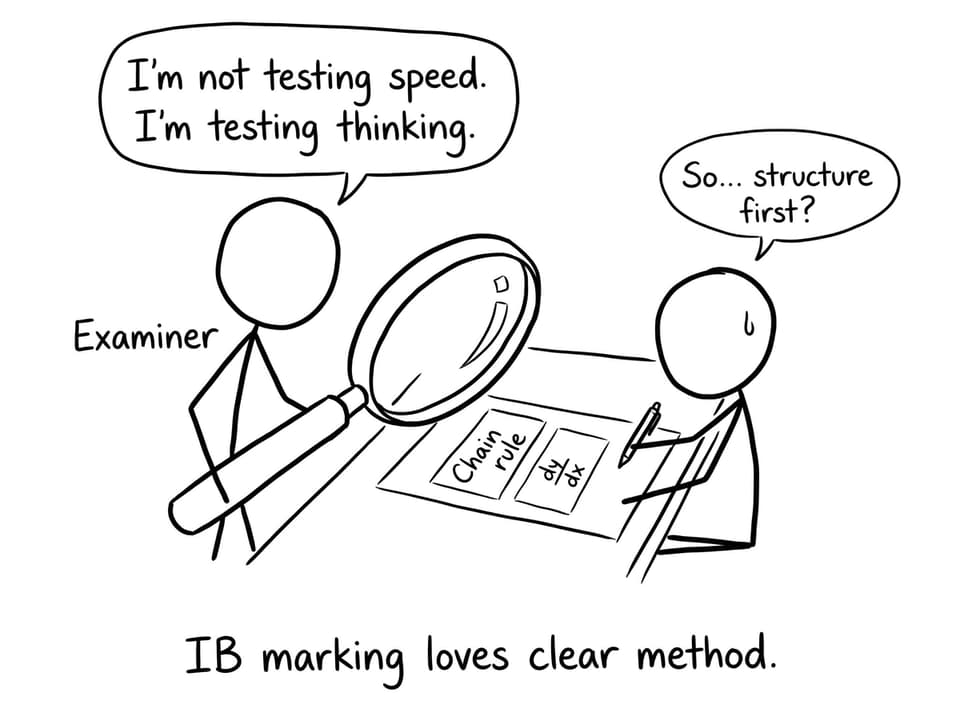
When you practice IB Math implicit differentiation, don’t aim for speed first. Aim for a repeatable layout:
-
Rewrite the equation neatly.
-
Differentiate term-by-term.
-
Every time you differentiate something in y, write “(dy/dx)” immediately.
-
Circle dy/dx terms, then collect them.
-
Factor and solve for dy/dx.
If you want the topic inside its syllabus context (and to avoid revising the wrong level), anchor your plan from IB Mathematics Analysis and Approaches Resources.
Bring it home with RevisionDojo
If implicit differentiation is confusing in IB Math, it’s rarely because you “don’t get calculus.” It’s because the question forces you to think relationally, stay organized, and finish with algebra under time pressure.
RevisionDojo is built for that exact reality: use the Questionbank to isolate implicit differentiation, lean on Study Notes and Flashcards to lock the chain rule triggers, and use AI Chat to ask “where did dy/dx come from?” without embarrassment. Then tighten your method with Grading tools, run timed sets in Mock Exams, and top up confidence with Predicted Papers (without guessing what matters). If you need human help, the Tutors and Coursework Library keep the bigger picture steady while you master the details.
When implicit differentiation finally clicks, it doesn’t feel like magic. It feels like you learned to stay calm inside messy equations, which is exactly what IB Math is trying to teach.