


If you have ever lost marks in IB Math because you wrote “all real numbers” too quickly, you are not alone. Domain questions look calm on the surface, then quietly punish rushing. The function seems friendly. The algebra works. And yet the exam says: Not so fast.
The tricky part is that domain is not really an algebra skill. It is a meaning skill. It asks: “Where does this function actually make sense?” In IB Math, that question shows up everywhere: graphs, inverses, modelling, even calculus. And because exam pressure makes us chase speed, domain becomes one of the easiest places to drop silent, avoidable marks.
What “domain” actually means in IB Math
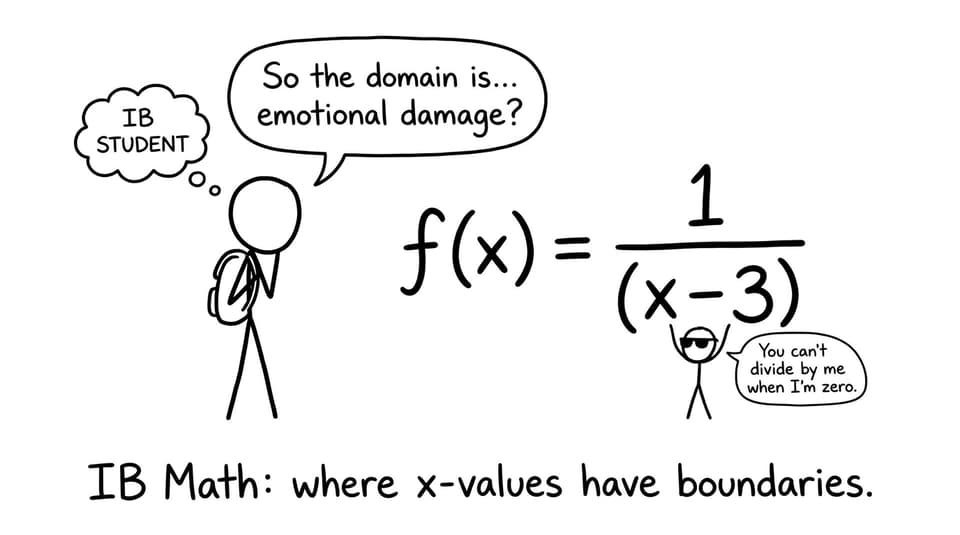
Domain is the set of allowed inputs, usually the x-values you are permitted to substitute into a function. In IB Math, you are expected to infer the domain from structure, not wait for it to be stated.
A useful way to think about it: the domain is the function’s “terms and conditions.” If you break them, the function stops being defined (or stops being real-valued, depending on the question).
If you want a clean, syllabus-aligned refresher, the topic notes here are a good anchor: AA SL 2.2 Functions: notation, domain, range, inverse.
The 20-second domain checklist (exam-friendly)
When a domain question appears in IB Math, run this quick scan before you do anything else:
-
Fractions: denominator (\neq 0)
-
Square roots (real domain): inside (\ge 0)
-
Logs: argument (> 0)
-
Even roots / rational powers: watch hidden “must be non-negative” rules
-
Composites / inverses: apply restrictions from each layer
-
Context (modelling): time, length, money, population, capacity limits
Then state the domain clearly using inequalities or interval notation.
You can drill exactly this kind of thinking with exam-style prompts from RevisionDojo’s AA SL 2.2 Questionbank so the checklist becomes automatic.
Why domain feels tricky: multiple “hidden gates” at once
Domain questions in IB Math get difficult when restrictions stack.
A single function can contain:
-
a denominator that bans one value,
-
a square root that bans an interval,
-
and a log that bans everything (\le 0).
Students often spot the loudest restriction and miss the quiet one. Examiners do not.
One way to build intuition is to learn functions as behaviour, not just rules on a page. This walkthrough helps connect the “machine” idea of functions to the domains they permit: Understanding Functions in IB Math AA: A Beginner’s Walkthrough.
The three domain traps IB Math loves
Division by zero (the classic)
If (f(x)=\frac{1}{x-3}), the function is undefined at (x=3). That is not a “small issue.” It changes the graph, breaks continuity, and affects solutions if you later solve an equation involving (f(x)).
Roots and powers (what domain are we in?)
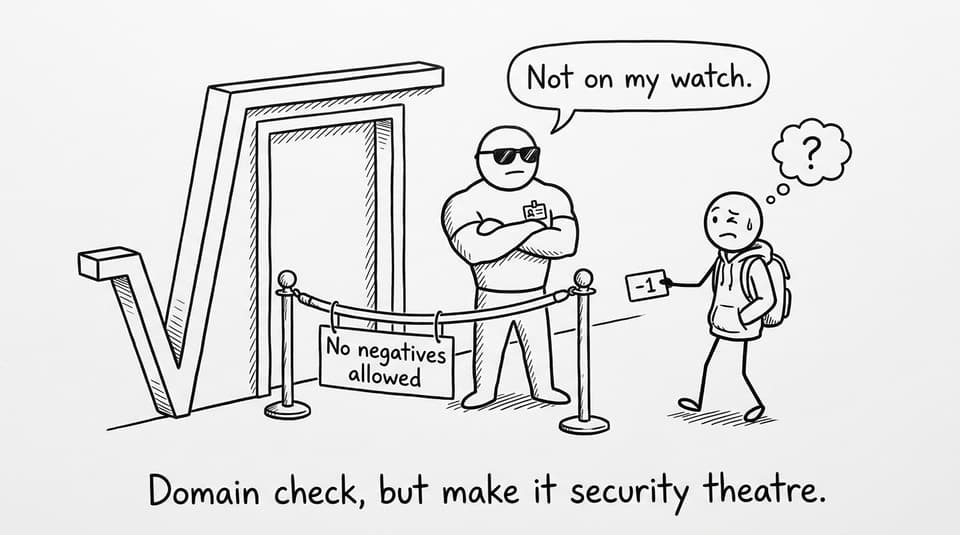
Many IB Math questions assume a real domain unless stated otherwise. So (\sqrt{x-5}) forces (x\ge 5). If the paper wants complex numbers, it will usually say so.
Logs (the strictest gatekeeper)
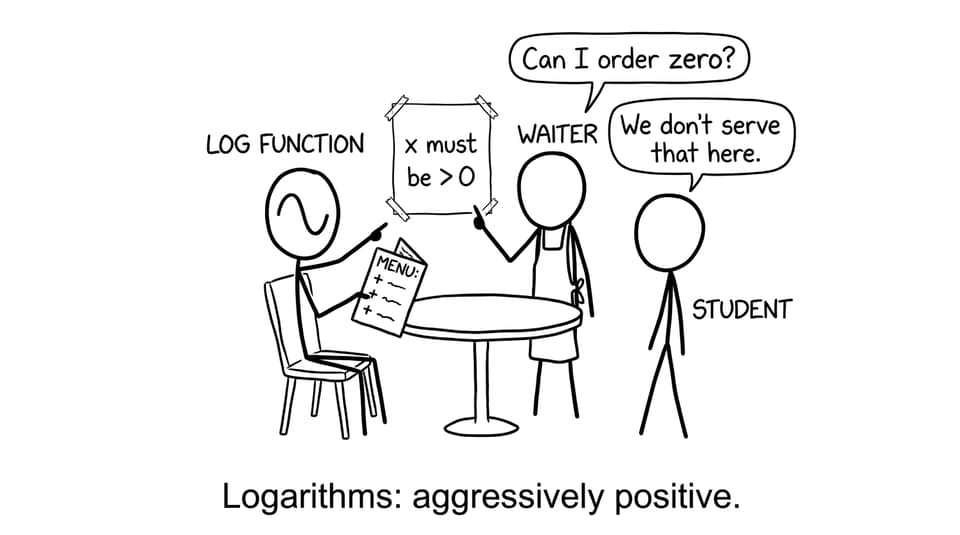
For (\ln(2x+1)), you need (2x+1>0\Rightarrow x> -\tfrac12). The “greater than” is not negotiable. Zero does not count.
Why domain matters later (and why IB Math punishes forgetting it)
Domain is not a one-off definition you memorise in week one. In IB Math, it is a foundation under:
-
Graph sketching: asymptotes, holes, endpoints
-
Inverse functions: you often must restrict domain to make an inverse valid
-
Solving equations: extraneous solutions appear when you ignore domain
-
Modelling: “mathematically allowed” is not always “realistically possible”
For the modelling side of domain (where context creates restrictions), this is a useful companion: Why does domain matter more in real-world functions in IB Maths?.
How to practise domain the smart way (with RevisionDojo)
The fastest way to improve domain accuracy in IB Math is to stop treating it as an afterthought.
Use RevisionDojo like a short loop:
-
Learn the core idea in IB Mathematics Analysis and Approaches Resources.
-
Practise domain-heavy questions in the SL 2.2 Questionbank.
-
Use AI Chat to ask “What restriction did I miss?” and get feedback in mark-scheme language.
-
Lock in definitions with Flashcards.
-
Check understanding with Study Notes and worked examples.
When you want to go beyond practice sets, RevisionDojo’s Mock Exams and Predicted Papers help you pressure-test domain under timing, and its Grading tools help you see whether your notation is examiner-ready. If you are still stuck, Tutors can spot the exact pattern behind your mistakes.
The quiet skill that lifts your whole IB Math grade
Domain feels tricky in IB Math because it is where the course stops being symbol-pushing and starts being truth-checking. The best students are not the fastest calculators. They are the ones who pause for half a breath and ask, “What values are actually allowed?”
If you want that habit to become automatic, build it with RevisionDojo: practise domain questions in the Questionbank, reinforce rules with Flashcards and Study Notes, stress-test with Mock Exams and Predicted Papers, and use AI Chat plus Grading tools to make your explanations examiner-ready. Domain stops being tricky when it becomes your first step, not your last thought.


