



Finding the area between curves in IB Math has a weird reputation. Not because the integration is always hard, but because the question makes you do something students rarely practise under pressure: pause, look, and decide.
You can be fluent with definite integrals and still freeze the moment two functions show up like rival characters in the same scene. And in IB exams, that freeze is expensive, because most mistakes happen before you integrate anything.
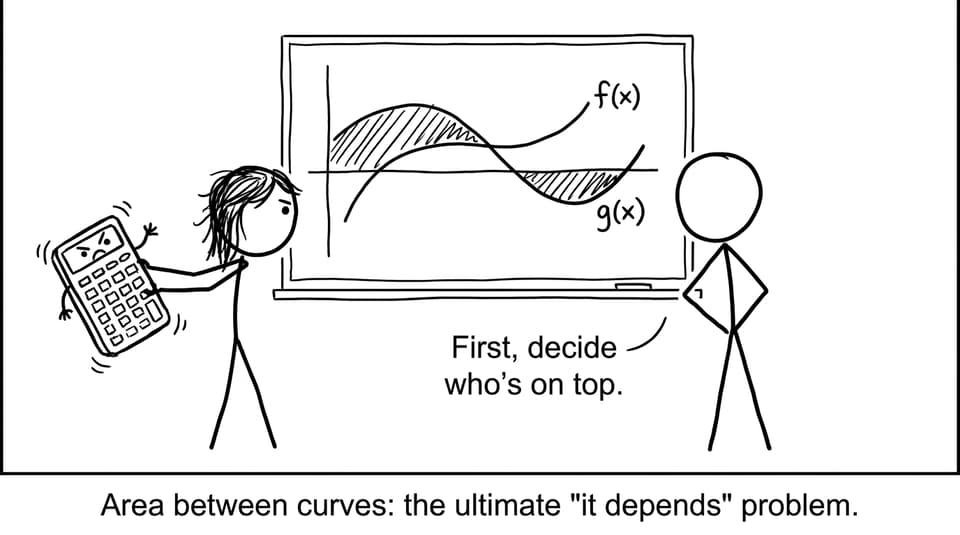
A quick IB Math checklist for area between curves
Before you touch the integral sign, run this mental checklist:
-
Sketch both curves (even a rough sketch).
-
Find intersection points (solve (f(x)=g(x))).
-
Decide which curve is on top on each interval.
-
Write the setup: (\int (\text{top} - \text{bottom}),dx).
-
If the curves cross, split into multiple integrals.
If you want targeted practice, start with the SL 5.11 topic hub on definite integrals and areas between curves and then move straight into exam-style drills.
What “area between curves” really asks you to do in IB Math
In early calculus, area means “between the curve and the x-axis.” In IB Math, area between curves quietly changes the reference point: you’re no longer measuring from zero, you’re measuring from another moving target.
The vertical distance between two graphs is (f(x)-g(x)) (or the other way around), and that distance can stretch, shrink, and even flip as (x) changes. Integration is just the tool for adding up all those changing slices.
If your definite integrals still feel shaky, the explanation in Why Do Definite Integrals Confuse So Many IB Maths Students is a good reset because it focuses on meaning, not memorising.
Why the “top minus bottom” decision is where most IB Math marks disappear
Students often think subtracting the functions is an algebra step. But in IB Math, it’s a graph-reading step.
Here’s the trap: you can correctly integrate (g(x)-f(x)) with perfect calculus and still lose marks because you chose the wrong order. The integral gives signed area, so the “wrong” order produces a negative value, even though the region has a positive size.
A quick habit that helps: write “top - bottom” in words before you write anything in symbols. Then glance at your sketch and label which one is top.
For more guided practice by style of question, use Area between two curves with changing dominance. It trains exactly the decision IB examiners are testing.
Why intersection points matter more than the integration
In IB Math, limits of integration are often the real question.
Most “area between curves” problems are built around where the curves meet, because those intersection points define the enclosed region. That means you must solve (f(x)=g(x)) cleanly, and you must know which solutions actually bound the region you’re asked about.
If you want exam-style repetition of that exact skill, practise with Finding the area between two curves (intersection points).
When one integral isn’t enough (the crossing-curves plot twist)
Sometimes your sketch reveals something uncomfortable: the curves cross inside the interval, so the “top” function changes.
That’s when a single integral becomes a half-truth. You need to split the region into pieces and integrate each piece with the correct “top - bottom” order.
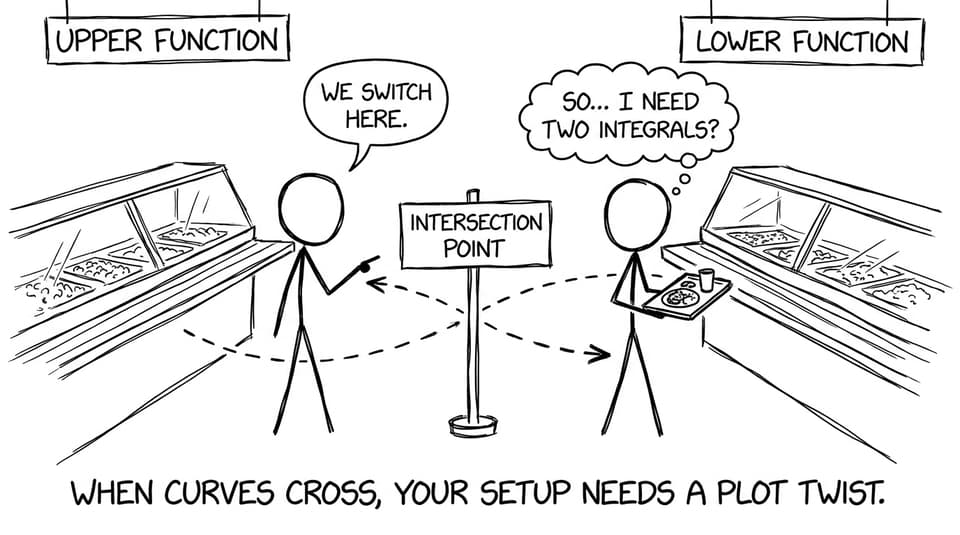
This is why students feel the topic is tricky: the calculus is steady, but the logic changes mid-question.
How RevisionDojo makes this easier to master
The fastest way to get comfortable in IB Math is to practise setups until they feel automatic.
RevisionDojo helps in a very practical way:
-
The IB Mathematics Analysis and Approaches resources keep topics organised so you revise what IB actually tests.
-
The Calculus Questionbank gives exam-style questions with solutions, so you can diagnose whether the issue is sketching, limits, or integration.
-
The SL 5.5 integration notes and SL 5.11 notes are quick references when you forget a definition or interpretation.
-
When you’re close to exams, IB Math AA Predicted Papers plus Mock Exams and grading tools help you rehearse timing and method marks.
And when you get stuck at 11:47 p.m., AI Chat can walk through your setup choices step by step, while Flashcards and Study Notes help lock in the pattern.
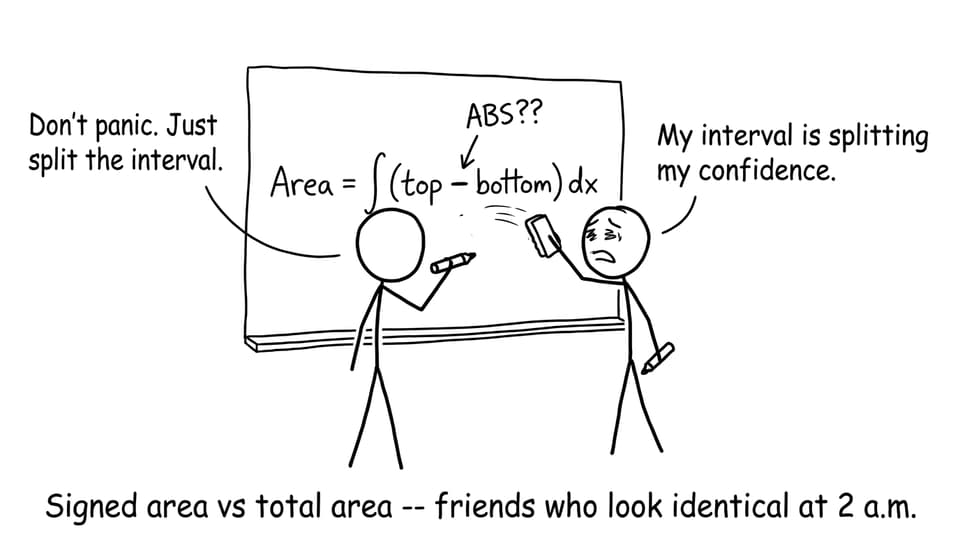
Conclusion: why IB Math makes it feel hard (and how to make it easy)
Area between curves in IB Math is tricky because it’s a setup problem disguised as a calculus problem. The skill is deciding limits, choosing “top - bottom,” and splitting when the story changes.
If you want this to stop being a mark-loser, practise the setup more than the integration. Use RevisionDojo’s Questionbank, Study Notes, Flashcards, AI Chat, Predicted Papers, Mock Exams, and grading tools to make those decisions automatic well before exam day.