



Exponential growth is the kind of idea that feels obvious for about 30 seconds.
You see a formula, you plug in numbers, the calculator produces an answer, and your brain nods along. Then an IB Math exam question asks what the parameters mean, or whether the model is reasonable in context, and suddenly your confident arithmetic turns into a fog of half-remembered words like “rate” and “factor.”
The twist is that exponential growth and decay aren’t tricky because they’re hard to compute. They’re tricky because they’re easy to misinterpret. And IB Math is built to reward interpretation.
A quick IB Math checklist for reading exponentials
Before you solve anything, pause and check:
-
Is the change a constant percentage (exponential) or a constant amount (linear)?
-
What does the initial value represent in the context?
-
Is the “rate” given as a percentage, a factor, or a continuous rate (using (e^{kt}))?
-
What are the units of time (years, months, hours), and does the model match them?
-
What does the graph do in the long run (approach an asymptote, explode upward, flatten out)?
If you want a clean refresher on forms like (ka^x) and (ke^{rx}), use RevisionDojo’s Exponential and logarithmic functions notes (AA SL 2.9).
Why IB Math students confuse “constant percent” with “constant amount”
Most misreads begin with a very human shortcut: your brain prefers straight lines.
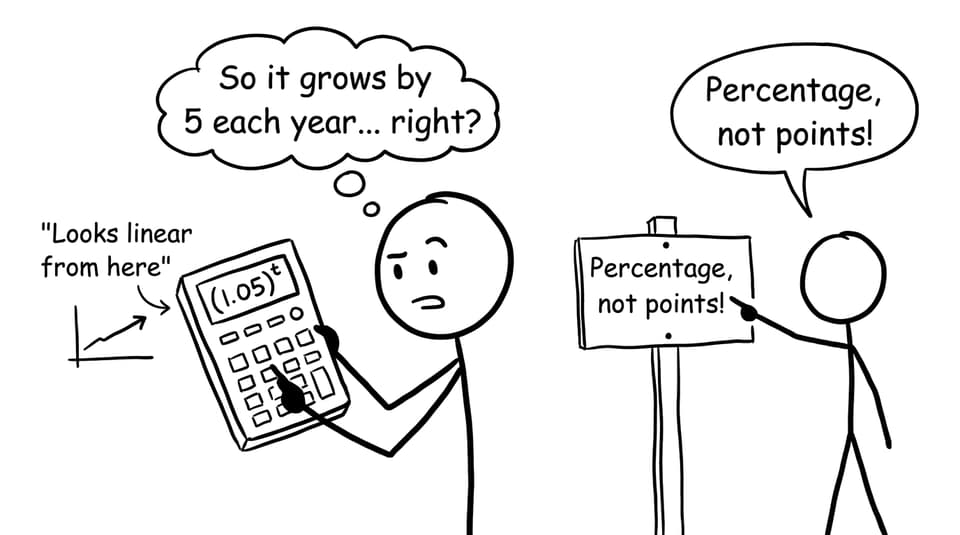
If a population goes from 100 to 105, it’s tempting to say “it increases by 5 each year.” That’s linear thinking. Exponential thinking is quieter: “it increases by 5% of whatever it currently is.” Those sound similar early on, which is exactly why they’re dangerous.
In IB Math, the early stages of an exponential curve can look almost linear, especially on standard axes. So students carry linear language into exponential questions and lose method marks for interpretation, even if the substitution work is fine.
For targeted practice on exactly these interpretation traps, RevisionDojo’s Functions Questionbank (AA) is a reliable place to drill exam-style prompts.
Why “rate,” “growth factor,” and “base” get mixed up in IB Math
A lot of IB Math exponential confusion is vocabulary wearing a disguise.
-
In (A=P(1+r)^t), the rate is (r), but the growth factor is (1+r).
-
In (A=Pa^t), the factor is (a), and the rate is often implied by (a-1) (if you’re thinking per time step).
-
In (A=Pe^{kt}), the constant (k) is a continuous growth/decay rate, and interpreting it as a simple percent per time step can mislead you.
IB exam questions love asking what happens when you change one parameter. If you confuse (r) with (1+r), your written conclusion will be off, even though your calculator line looks “correct.”
To strengthen the algebra-to-meaning connection, pair the AA notes above with RevisionDojo’s Exponents and logarithms notes (AI SL 1.5) for the language and transformations that show up in modelling.
Why exponential graphs are so easy to narrate incorrectly
Students often describe exponential graphs with one word: “increasing” or “decreasing.” In IB Math, that’s like describing a movie by saying it has “characters.” True, but not enough.
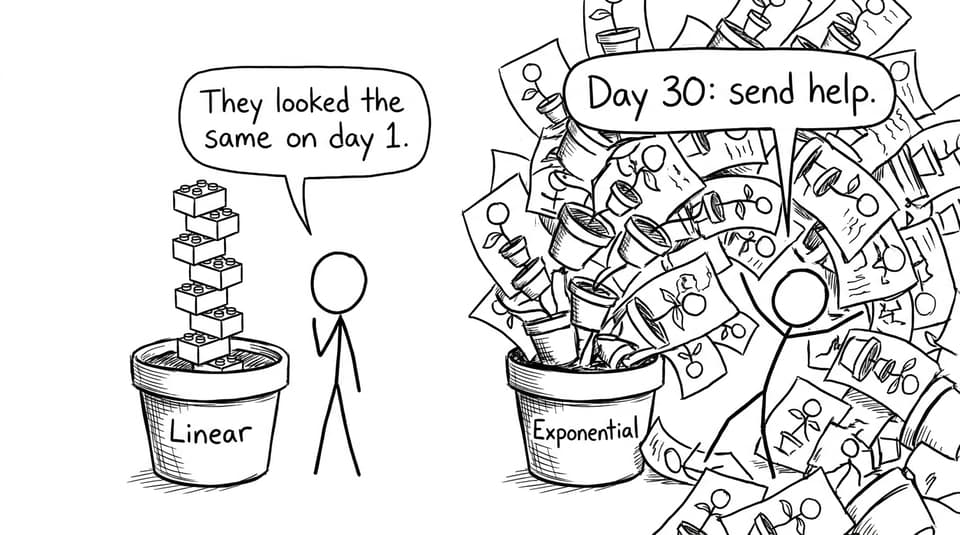
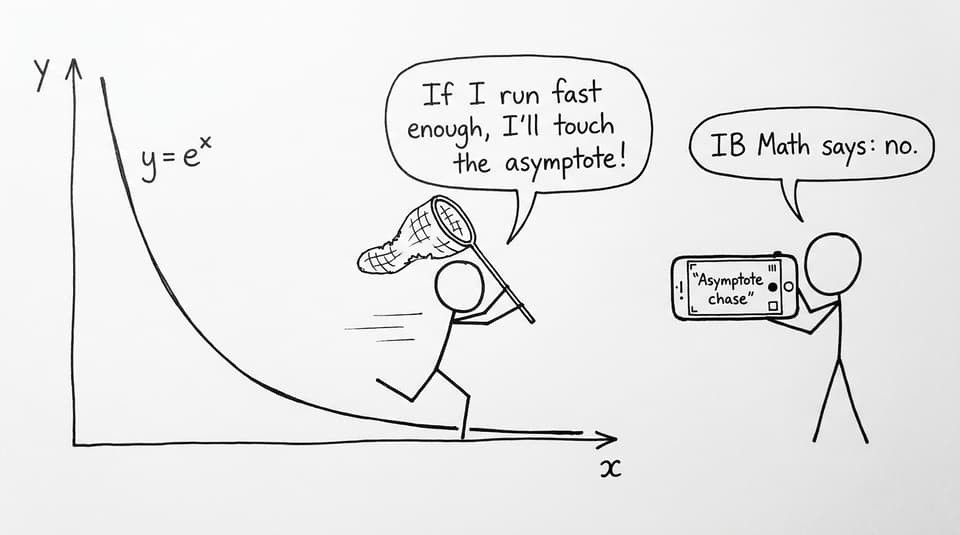
Exponential growth is about the growth of the growth (the rate accelerates). Exponential decay is about shrinking by a constant proportion, which creates a long tail and an asymptote. When the question asks for long-term behaviour, you need to say what the function approaches and why.
RevisionDojo’s Exponential and logarithmic functions hub (AA SL 2.9) is useful here because it keeps the focus on interpretation, not just curve-sketching.
How IB Math tends to test exponential growth and decay
In IB Math, exponentials usually appear as:
-
Real-world modelling (population, depreciation, cooling/heating, finance)
-
Parameter interpretation in context
-
“Compare linear vs exponential” decisions
-
Solving for time using logs
-
Commenting on reasonableness and limitations
If you’re specifically hitting finance-style exponentials, RevisionDojo’s Financial apps Questionbank (AA SL 1.4) gives exam-style sets where interpretation is the difference between a 4 and a 7.
Exam moves that stop misinterpretation (fast)
-
Write one sentence in words before symbols: “It changes by x% each unit of time.”
-
If the question gives a percent, build the factor explicitly: (1.08), (0.93), etc.
-
If it’s decay, sanity-check: after one time unit, should the number be smaller?
-
Always end with a context sentence: units, time, what it means.
To build stamina around these multi-step prompts, mix topic practice with timed strategy from Best time management tips for IB Math exams.
Bringing it home (and making it stick)
Exponential growth and decay are easy to misinterpret because your brain wants straight lines, simple words, and quick substitutions. IB Math wants something deeper: percentage thinking, parameter meaning, and graph behaviour over time.
If you want this topic to feel calm under exam pressure, build a tight loop: learn the concept, do exam-style questions, check interpretation, repeat. RevisionDojo makes that loop simple with its Study Notes, Flashcards, Questionbank, AI Chat, Mock Exams, Predicted Papers, and Tutors when you need a human explanation at the exact moment the model stops making sense.
For your next session, start with the Exponential growth example (explained simply), then do one timed set from the Questionbank and write full-sentence conclusions. That’s how IB Math interpretation becomes automatic.