


IB Math: when a simple average turns into a fog
The first time expected value clicks, it feels almost comforting. Multiply outcomes by probabilities, add them up, and you get a long-run average. Clean. Countable. Finite.
Then IB Math quietly changes the floor under your feet. The outcomes stop being a list and become a line. Probability stops being something you can point at and becomes something you have to collect. And suddenly, expected value feels less like arithmetic and more like trying to measure mist.
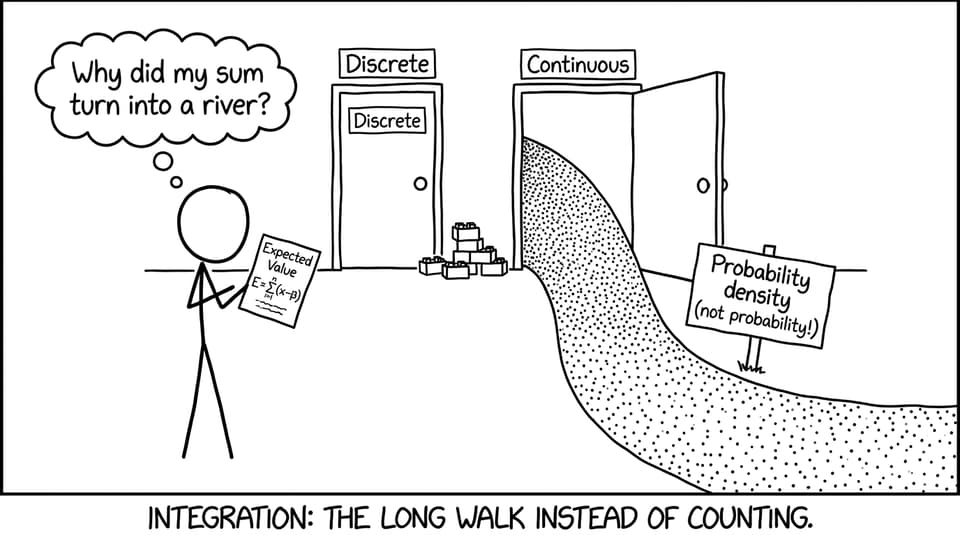
That difficulty is not because expected value is a new concept. It is because continuous variables force you to think about probability as accumulation, not counting. If you are revising this topic, it helps to treat it as a change in interpretation first, and a change in calculus second.
Quick checklist before you touch an integral (IB Math)
-
Can you explain expected value as a long-term average, not a “most likely” value?
-
Do you remember that for a continuous variable, (P(X=a)=0)?
-
Have you checked the PDF is valid (non-negative, total area 1)?
-
Are your limits of integration matched to the domain given in the question?
-
Will you write a one-sentence interpretation after calculating (E(X))?
For targeted practice, RevisionDojo’s AHL 4.14 Questionbank practice on random variables is a strong place to build confidence.
Why expected value feels easier when things are discrete
Discrete expected value suits the way most people naturally reason. You have separate outcomes, each with its own probability mass. In IB Math, this often looks like:
Every term has a clear meaning. “This outcome happens this often.” You can imagine a table. You can imagine tally marks. It feels like bookkeeping.
Continuous variables remove the table.
Once you move into PDFs, probability is no longer attached to single outcomes. The graph value (f(x)) is not “the probability of (x).” It is a density, meaning probability is created by combining density with width (area).
If you want to strengthen that mental shift, RevisionDojo’s Statistics and Probability notes for IB Math AA are useful because they put the language (mass vs density, area under the curve) in one place.
Continuous variables: probability becomes area, not a point
The most unsettling fact in IB Math continuous probability is also the most important:
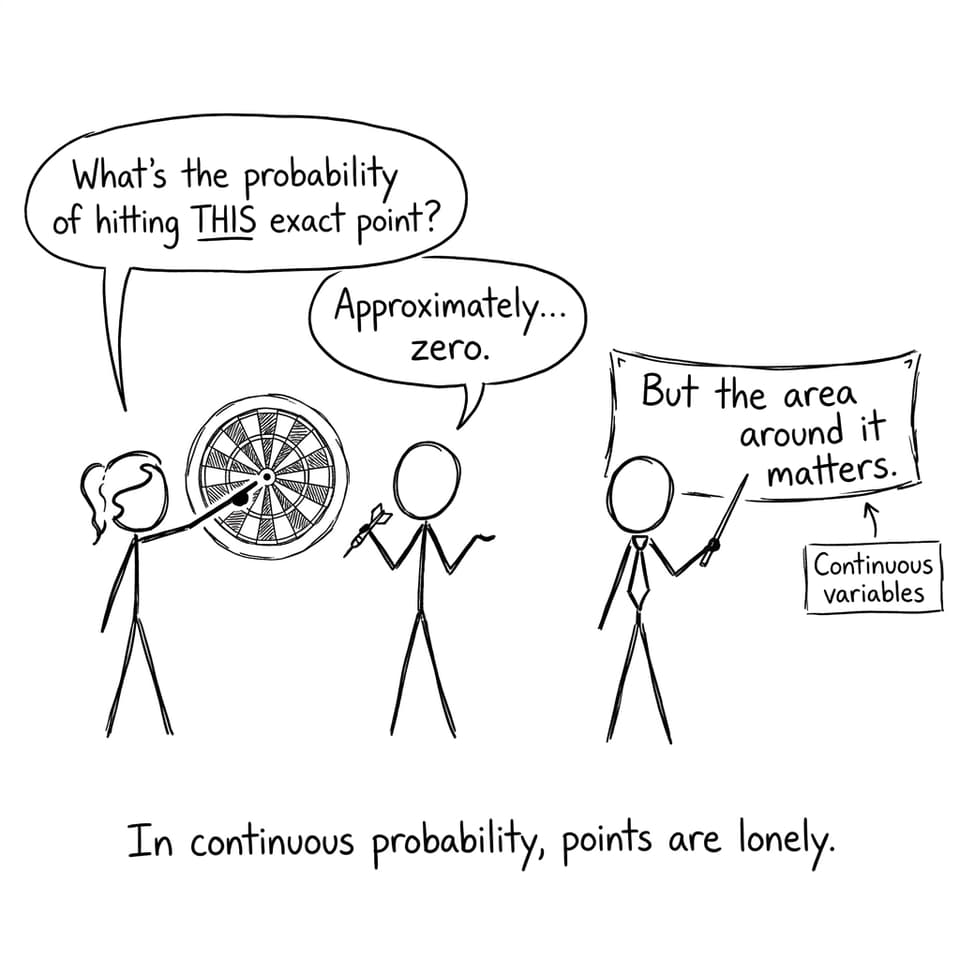
- (P(X=a)=0) for any exact value (a).
That does not mean “it cannot happen.” It means the probability at a single point has no width, so it has no area, so it contributes nothing measurable. You only get probability over an interval:
This is why expected value becomes an integral. You are no longer adding up probability chunks; you are accumulating infinitely many tiny contributions.
For a clearer feel of how IB sets up probability questions (before expectation even appears), see How to Solve IB Math Probability Problems Step-by-Step.
Why integration makes expected value harder (even when calculus is fine)
In continuous form, IB Math expected value is typically:
The calculus itself may be manageable. The hard part is what the symbols represent.
In discrete problems, you can tell yourself: “I’m averaging outcomes.” In continuous problems, the honest version is: “I’m taking a weighted average where the weights live in a density function and only become probabilities after I integrate.”
That sentence is longer. Your brain feels the extra load.
This is also why students who memorize the formula but do not internalize density often get stuck. If PDFs still feel intangible, the reflective explanation in Why Do Probability Density Functions Feel So Abstract in IB Maths? is worth reading alongside your practice.
Limits: where IB Math hides the easiest marks to lose
A huge portion of “expected value went wrong” comes down to boundaries.
-
Sometimes the domain is explicit (for example, (0\le x\le 5)).
-
Sometimes it is embedded in a piecewise definition.
-
Sometimes the question expects you to find a constant (a) by using (\int f(x)dx=1) before computing (E(X)).
IB marks often reward the choice of limits because it shows you understand what values are possible.
If you want exam-style repetition with worked solutions, try RevisionDojo’s Bootcamp on finding expected value for a continuous random variable.

How IB Math exam questions usually test this
In IB Math, expected value with continuous variables tends to appear as one of these patterns:
-
Verify a PDF is valid, then compute (E(X))
-
Find an unknown constant using total area 1, then compute (E(X))
-
Compare (E(X)) to a “typical” value (often hinting at mean vs mode confusion)
-
Interpret the result in context (where the method marks alone are not enough)
To broaden the probability-statistics connection (which helps with interpretation marks), How to Master Probability and Statistics in IB Math pairs well with your expected value revision.
The calm way to get better at IB Math expected value
Expected value is not harder in continuous variables because IB Math wants to torture you with integration. It is harder because the meaning of probability becomes subtler: not a point, but an area; not counting, but accumulation.
If you want that subtlety to feel natural under exam pressure, RevisionDojo helps you build it from multiple angles: Study Notes for the concepts, Flashcards for the definitions and triggers, the Questionbank for exam-style repetition, AI Chat for instant clarification, and Grading tools to see where method marks are leaking. When you are ready to simulate the real thing, Mock Exams and Predicted Papers help you practise timing and interpretation, and the Tutors and Coursework Library support the bigger picture of your IB journey.
The goal in IB Math is not just to integrate. It is to understand what you are integrating and why that integral is the only honest way to describe an average in a continuous world.