


Human rights are often described like gravity: always there, universal, non-negotiable. Then you look at the news and realise gravity seems to work fine, but rights don’t.
That tension sits at the heart of IB Global Politics. You study treaties, declarations, courts, and institutions built to protect people. And yet violations remain normal, persistent, and sometimes openly defended. The hard truth (and the high-mark insight) is that global human rights enforcement isn’t mainly a legal puzzle. It’s a political one.
A quick IB Global Politics checklist: why enforcement is weak
Before you write any essay on this in IB Global Politics, keep this short list in your head:
-
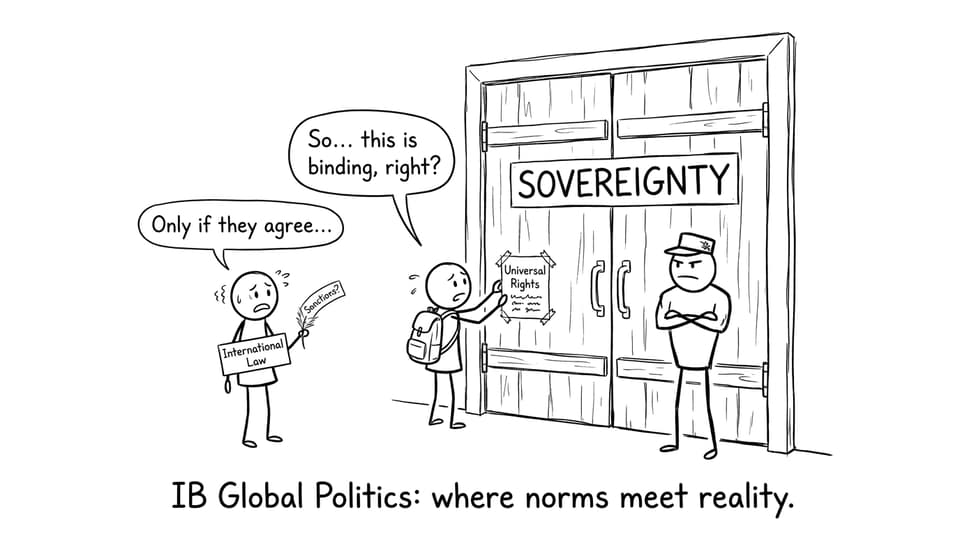
Sovereignty limits outside interference.
-
Enforcement mechanisms often lack binding punishments.
-
Power politics creates double standards.
-
Competing priorities (security, trade, alliances) crowd out rights.
-
Cultural and ideological disputes reduce agreement.
-
State capacity can be too weak to protect rights even with good intentions.
If you want a clean definition base first, use RevisionDojo’s explainer on What human rights are in global politics.
Sovereignty: the locked door in IB Global Politics
In IB Global Politics, sovereignty is the idea that states are the highest legal authority inside their own borders. That sounds abstract until you see how it functions as a shield.
International human rights law relies heavily on state consent: states sign, ratify, interpret, and (sometimes) ignore obligations. There is no world government with a global police force that can routinely override domestic authority. When outside actors push too hard, governments can frame it as “non-interference” and rally domestic support.
To revise this tension quickly, anchor your concepts with the Power topic notes and then connect sovereignty to legitimacy in your evaluation.
Weak enforcement mechanisms: norms without teeth
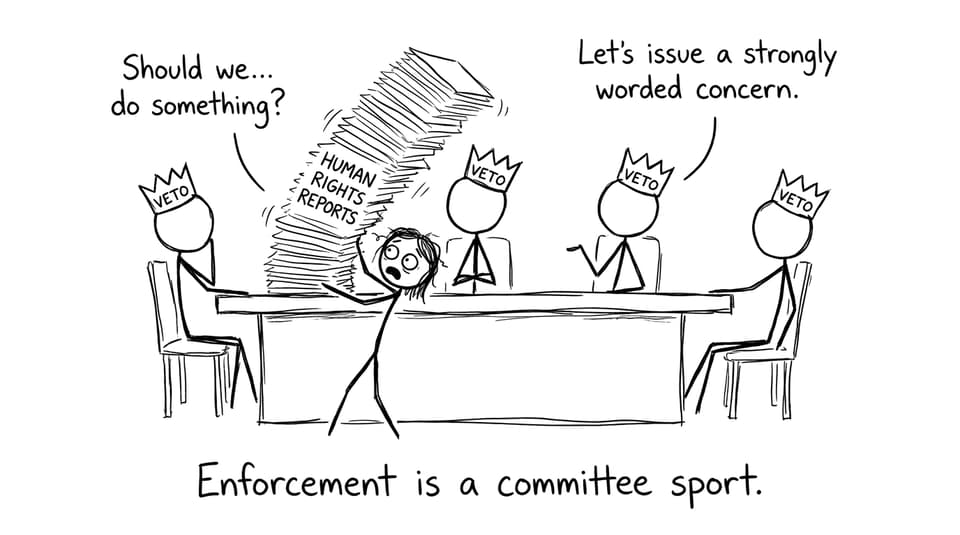
Human rights bodies can investigate, report, name-and-shame, and recommend reforms. But many cannot impose penalties that force compliance.
Even courts face a basic obstacle: they need cooperation. Arrests, extradition, evidence collection, and enforcement of rulings often depend on the same states being accused. This is why IB Global Politics answers that only list institutions tend to plateau, while answers that explain institutional limits score higher.
Use RevisionDojo’s targeted resources to build examples fast:
Power politics: when enforcement becomes selective
The most uncomfortable part of IB Global Politics is noticing that principles are applied unevenly.
Powerful states may avoid consequences because they have military strength, economic leverage, strategic resources, or key alliances. Meanwhile, weaker states can face stronger pressure, harsher scrutiny, or more intrusive “solutions.” This selective enforcement fuels accusations of hypocrisy, which then undermines the legitimacy of the entire human rights system.
If you need institutional context for essays, RevisionDojo’s United Nations notes are a strong refresher.
Competing priorities: security, stability, and money
Human rights enforcement usually demands costs: sanctions risk trade, prosecutions risk peace talks, criticism risks alliances. During war, terrorism scares, or economic crises, governments often argue that rights must be limited “temporarily.” In practice, temporary can become permanent.
This is where IB Global Politics evaluation matters: don’t claim human rights are ignored everywhere. Instead, show trade-offs and why leaders make them, then judge the consequences.
For exam practice on this theme, drill with the Rights and Justice Questionbank and the Debates on Rights and Justice page.
Capacity and institutions: sometimes states can’t protect rights
Some governments lack independent courts, professional police, or reliable administration. Even with political commitment, weak institutions can’t consistently deliver protection.
For IB Global Politics, this is a great counterbalance: enforcement isn’t always blocked by bad faith. Sometimes it’s blocked by weak governance, corruption, or limited resources.
How to turn this into marks (without overwriting)
A simple exam-ready structure:
-
Define enforcement and the main human rights framework.
-
Explain sovereignty and why consent matters.
-
Evaluate enforcement mechanisms and their limits.
-
Use power politics to explain double standards.
-
Add competing priorities and capacity as layered constraints.
-
Conclude with a balanced judgement on why progress is slow.
For writing technique, RevisionDojo’s guide to top-scoring Global Politics essays helps you connect concepts to evaluation.
Conclusion: the IB Global Politics takeaway
Global human rights enforcement is difficult because it asks a world of sovereign states to behave like a single legal community without having a single enforcing authority. That gap is where power, interests, weak mechanisms, and uneven capacity all rush in.
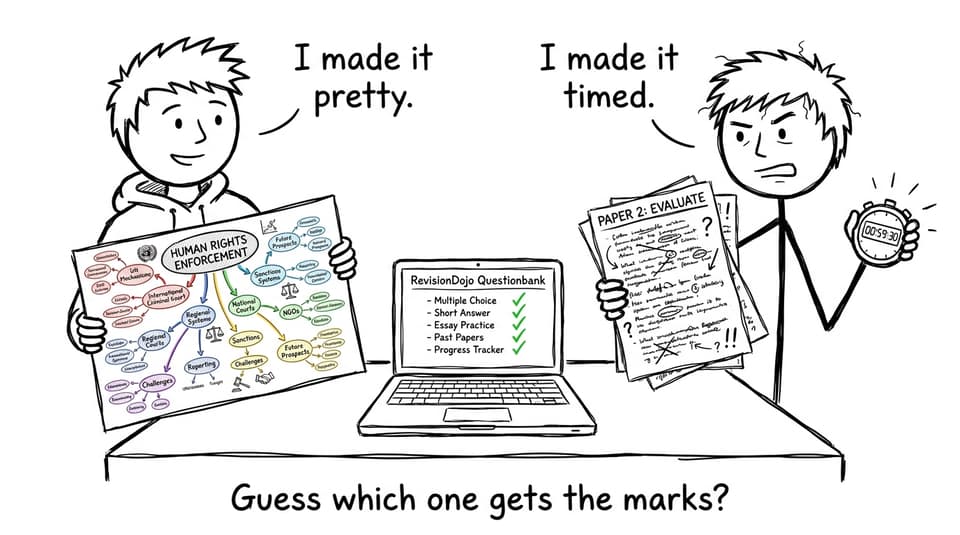
If you’re revising IB Global Politics, build your answer around that gap: norms vs reality. Then practise turning it into evaluation using RevisionDojo’s Study Notes, Flashcards, and Questionbank, and pressure-test your timing with Mock Exams and Predicted Papers via the IB Global Politics hub and IB Global Politics predicted papers.