

The moment IB Math stops feeling like algebra
In IB Math, there’s a particular kind of frustration that hits right after you finally make peace with limits. You learn to “approach” a value without necessarily touching it. You practice tables, graphs, and a few tricky algebraic rearrangements. Then calculus arrives and someone says: Great. Now use limits to define differentiation.
It can feel like the course is being dramatic. After all, the derivative rules look clean and fast. Why not just start there?
Because IB Math is trying to give you something sturdier than speed: an explanation that survives unfamiliar questions. Limits are the logic underneath differentiation. Without that logic, derivative rules can feel like tricks you borrow instead of tools you own.

Quick checklist: what IB wants you to understand
Before you chase techniques, keep this short IB Math checklist in mind:
-
A derivative measures instantaneous rate of change (at a point).
-
“Instantaneous” is reached by shrinking an interval, not by guessing.
-
Limits formalise what happens as the change in input gets closer and closer to zero.
-
Derivative rules are compressed limit reasoning, not separate facts.
-
Exams often reward interpretation (meaning, units, context) as much as algebra.
If you need a fast refresher on limits foundations, these notes help: AI SL 5.1 Introduction to Limits.
What differentiation is really measuring in IB Math
At its core, IB Math treats differentiation as a question of behaviour: How does output change when input changes? That sounds simple until you ask for the rate of change at a single point.
Average rate of change is comfortable:
-
Pick two x-values.
-
Compute the slope of the secant line.
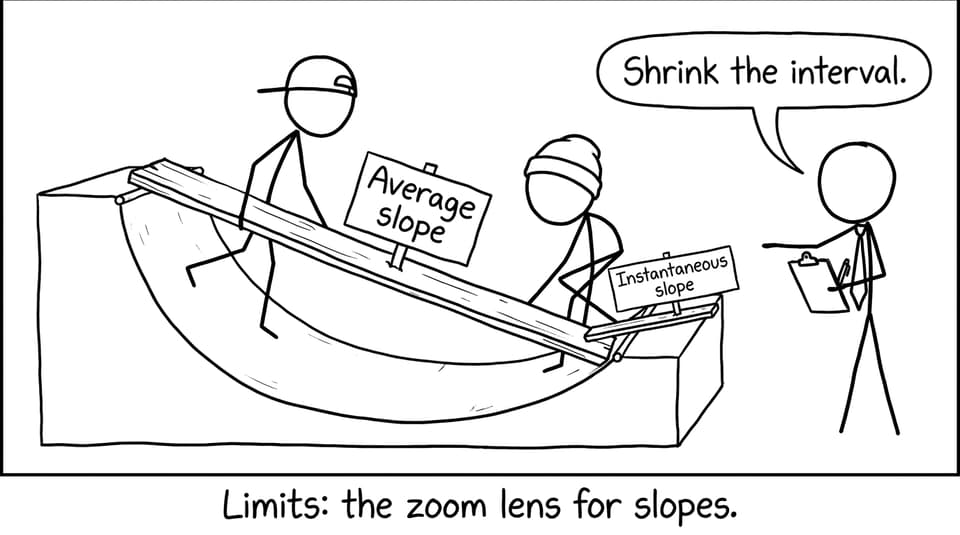
But “at one point” sounds impossible because you don’t have two points anymore. Limits solve that problem by keeping two points temporarily, then shrinking the gap until it becomes as small as you like.
That shrinking process is the idea behind the first-principles definition:
[
f'(a) = \lim_{h \to 0} \frac{f(a+h)-f(a)}{h}
]
In IB Math, that limit is not there to torture you. It’s there to justify why the derivative is the slope of the tangent and the instantaneous rate of change.
To practise this exactly in exam style, the most targeted set is AA SL 5.1 Introduction of differential calculus Questionbank.
Why IB Math doesn’t stop at average rate of change
If calculus only asked, “What’s the average change from x=2 to x=5?”, limits would be optional. But IB Math uses change to model motion, growth, optimisation, tangents, and interpretation. Those are all point-based questions.
Think about a speedometer. It doesn’t report your average speed over the last kilometre. It reports what’s happening now. That “now” is what the limit captures: the slope your secant line approaches as your interval becomes tiny.
This is also why limits quietly prepare you for deeper calculus ideas like continuity and differentiability. When you later meet “not differentiable at a point,” you’re really being told the limit process breaks: the function doesn’t settle into one consistent tangent.
For a clean explanation of this first-principles mindset, use AA AHL 5.12 First principles and higher derivatives Notes.
Why derivative rules feel like magic (and how limits remove the magic)
Many students experience IB Math as two different subjects:
-
Limits: slow, careful, conceptual.
-
Differentiation rules: fast, mechanical, “just do it.”
But the rules are simply patterns discovered from the limit definition. If you understand that, rules stop being spells and become shortcuts you can trust.
A helpful companion read is Why Do Derivative Rules Feel Like Magic in IB Maths?. Pair that with structured topic coverage in IB Mathematics AA Calculus and you’ll start seeing one continuous story instead of disconnected chapters.
Common IB Math mistakes when limits and differentiation meet
A few patterns show up again and again in IB Math exam scripts:
-
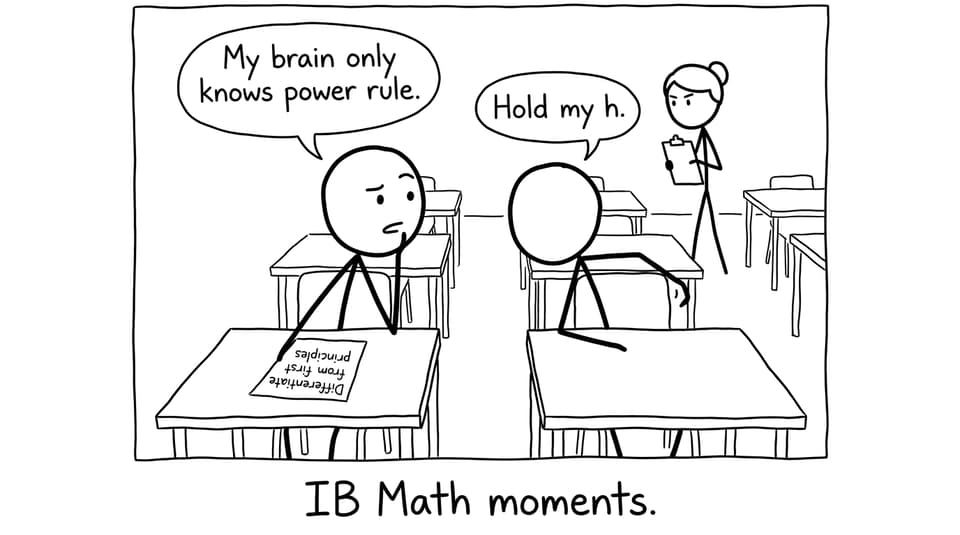
Treating (h\to 0) as “just substitute 0 immediately” (it isn’t).
-
Doing algebra without stating what the expression represents.
-
Memorising rules, then panicking when the question asks for first principles.
-
Forgetting that limits describe behaviour near a point, not necessarily at the point.
If limits still feel hard to picture, this perspective helps: Why Are Limits So Hard to Visualise in IB Maths?.
Exam strategy: how to write limit-based differentiation like an examiner wants
When IB Math asks for differentiation from first principles, marks usually come from structure and clarity:
-
Write the definition correctly.
-
Substitute into (\frac{f(a+h)-f(a)}{h}).
-
Simplify fully so (h) cancels.
-
Only then apply the limit as (h\to 0).
-
Interpret: slope of tangent, rate of change, units if in context.
To drill this efficiently, RevisionDojo’s Questionbank is ideal, and the calculus videos are useful when you need to see the steps unfold calmly.
Bring it home with RevisionDojo
Differentiation is introduced using limits in IB Math because the course is teaching ownership, not imitation. Once you see the derivative as a limit of shrinking slopes, rules become efficient summaries instead of mysteries.
If you want that understanding to translate into exam marks, RevisionDojo ties the concepts to practice: Study Notes and Flashcards for memory, videos for clarity, the Questionbank for repetition, AI Chat for stuck moments, and Grading tools with Mock Exams and Predicted Papers to test readiness. When limits and differentiation finally click, IB Math stops being a sequence of hurdles and starts feeling like one coherent language.