



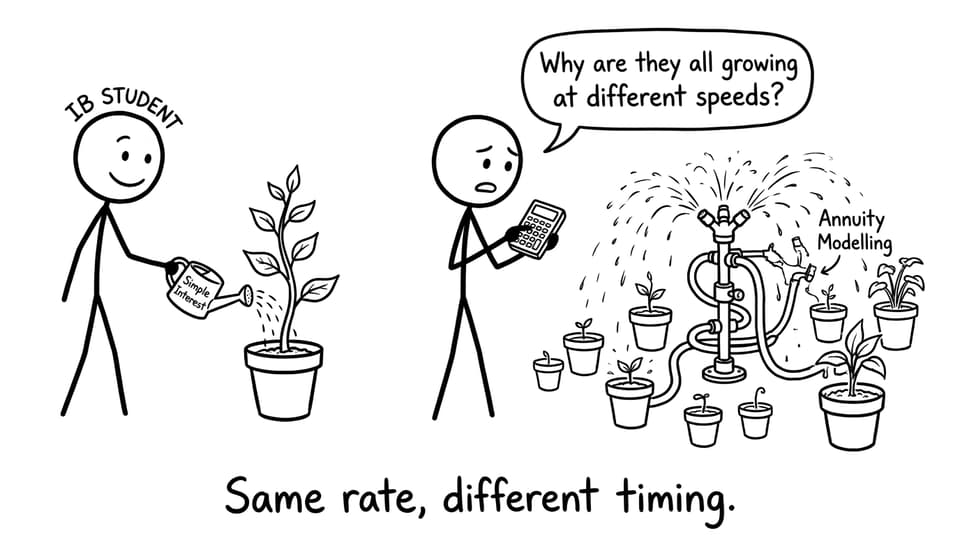
Annuity modelling is the moment many IB Math students stop feeling like they are “doing calculations” and start feeling like they are “doing judgement.” Simple interest is calm: one starting value, one rate, one time. Annuities are noisy: lots of payments, lots of tiny growth journeys, and a calculator that will happily give you a number even when your model is slightly wrong.
That is the real reason annuity modelling feels harder than simple interest in IB Math. It is not that the algebra suddenly gets wild. It is that the story gets longer, and every detail matters.
A quick checklist before you touch your calculator (IB Math)
Use this mini checklist in IB Math Paper 2-style finance questions:
-
What is the payment (PMT)?
-
What is the interest rate per period (not just “per year”)?
-
How many periods are there (n)?
-
Are payments at the end (ordinary annuity) or beginning (annuity due)?
-
Are you finding future value (accumulation) or present value (today’s worth)?
-
Can you write a one-sentence interpretation in context?
If you can answer those calmly, annuities become much less intimidating.
Simple interest is one block; annuities are a stack of blocks
In simple interest, you grow one original amount at a constant rate over time. The model is almost always linear in time, which is why it feels predictable.
In annuities, the “original amount” is not one deposit. It is a stream of deposits. In IB Math, each payment experiences compounding for a different length of time:
-
The first payment compounds for the longest.
-
The last payment compounds for the shortest.
-
The final balance is the sum of many different growth paths.
So the difficulty is conceptual layering: repeated payments + exponential growth + careful bookkeeping.
For targeted practice on these exact finance setups, the Loan repayments and amortization topic hub is a strong place to drill the modelling patterns.
Timing direction is where most IB Math marks leak
A lot of students lose marks not because they cannot compute, but because they silently assume the wrong payment timing.
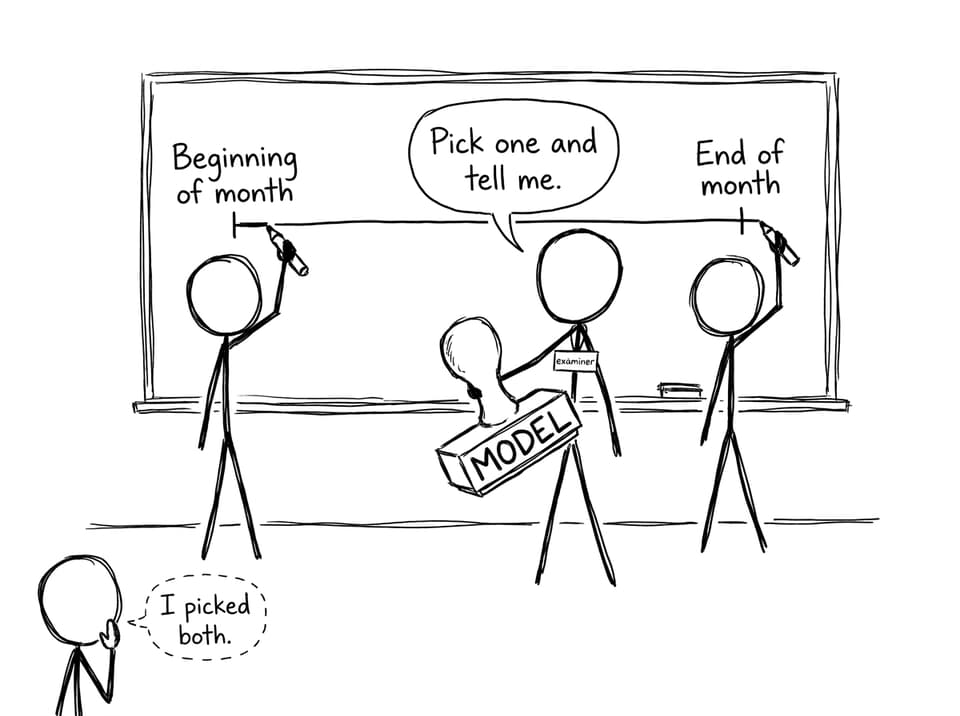
End of period payments (ordinary annuity) is the default in many exam contexts. Beginning of period payments (annuity due) changes the model and shifts the result.
The tricky part in IB Math is that both models can look “reasonable,” especially if you are rushing. Examiners can award method marks for structure, then still penalise the wrong assumption.
If you want a bigger-picture explanation of why IB often forces you to decide the model yourself, see Why do IB Maths questions avoid giving financial formulas directly.
Technology is required, but “calculator worship” is punished
Annuities in IB Math are designed to reward students who use technology and can explain what the output means.
Your GDC can compute an annuity quickly. But the exam still wants modelling communication:
-
What does the value represent (balance, present value, repayment)?
-
What assumptions did you make (timing, compounding frequency)?
-
Does it make sense (units, magnitude, direction of change)?
That is why annuities feel harder than simple interest: the calculator does not remove the thinking, it just removes the arithmetic.

If you are sharpening calculator-allowed performance overall, How to prepare for IB Math Paper 2 (Calculator Allowed) pairs well with annuity practice.
Small input errors explode over long time horizons
With annuities, time is long and growth is exponential. That combination is sensitive:
-
A small rate mistake (monthly vs annual) compounds into a big difference.
-
One missing payment changes the whole stream.
-
A timing shift can add or remove an extra compounding period.
In IB Math, this is exactly why “reasonableness” comments matter. It is also why students who keep a mistake log improve quickly.
For extra support on the finance foundations behind annuities, explore SL 1.4 Financial apps: compound interest, annual depreciation and the matching Flashcards for SL 1.4.
Bring it home with RevisionDojo
Annuities are harder than simple interest in IB Math because they pile up timing, compounding, and interpretation into one question. The best fix is targeted repetition: set up the timeline, match the rate to the period, use technology deliberately, and explain what your result means.
RevisionDojo makes that repetition efficient. Use the Questionbank to drill finance modelling, Study Notes to re-learn the structure in minutes, Flashcards to lock in definitions, and AI Chat to sanity-check your setup. Then level up with Grading tools, Mock Exams, and Predicted Papers for exam-condition practice, plus the Coursework Library and Tutors when you want human feedback.
If annuity questions keep stealing marks, make IB Math finance your easiest topic by practising the exact model patterns on RevisionDojo: start with AI SL 1.7 Loan repayments and amortization and build momentum from there.