

The quiet mistake that ruins good probability answers
In IB Math, probability questions often feel fair right up until they don’t. You read a scenario, spot two events, and your hand almost automatically reaches for multiplication. It’s neat. It’s fast. It’s also the most common way strong students lose marks.
Independence isn’t a technical footnote in IB Math probability. It’s the hidden switch that decides which method is valid. When you assume independence too early, you can build a perfectly tidy solution on a false foundation. Examiners don’t just check your final number. They check whether your logic matches the situation.
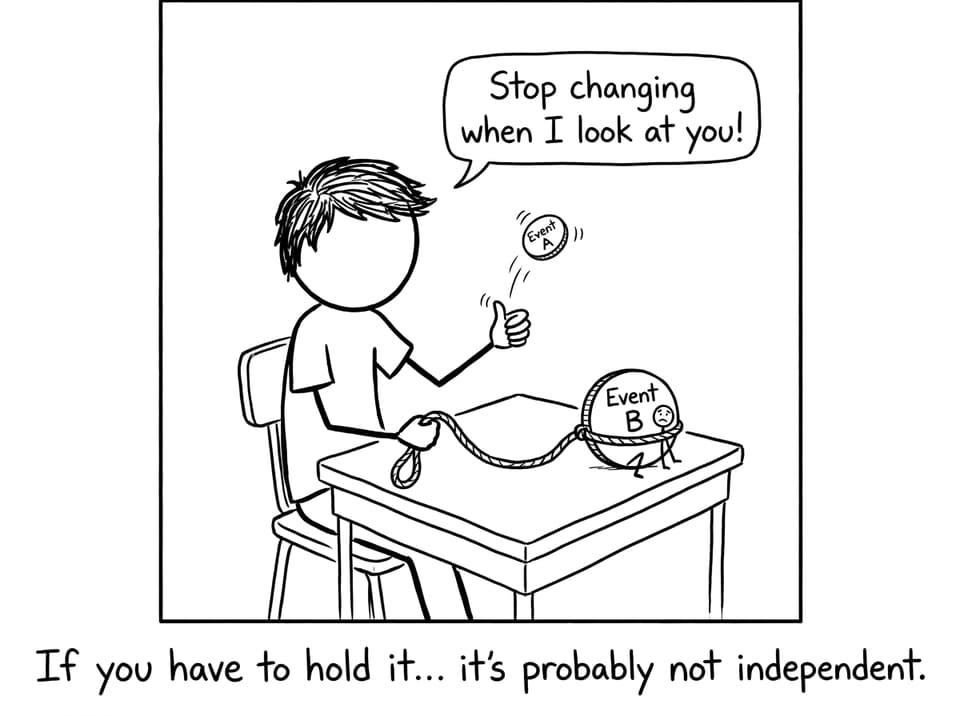
Quick checklist: how to treat independence in IB Math
Before you multiply anything in IB Math, pause and run this quick scan:
-
Define the events clearly (what exactly is A? what exactly is B?).
-
Ask: does knowing B happened change the probability of A?
-
Test with conditional probability: is (P(A\mid B) = P(A))?
-
If it’s sequential, sketch a tree and see whether branch probabilities stay the same.
-
State your assumption in words, especially for modelling and interpretation marks.
For extra practice on conditional probability and testing independence, use the targeted topic page on RevisionDojo: Conditional and Independent Probabilities (AA SL 4.11).
Why independence changes the entire method
The core idea in IB Math is simple: events are independent only if information doesn’t move the odds. If learning that B occurred forces you to update your belief about A, the events are dependent.
That one sentence controls the method:
-
If events are independent, (P(A\cap B)=P(A)\times P(B)).
-
If they’re dependent, you need (P(A\cap B)=P(B)\times P(A\mid B)) (or the other way around).
The trap is that many exam questions are written to look independent at first glance. RevisionDojo’s step-by-step approach in How to Solve IB Math Probability Problems Step-by-Step is useful here, because it forces you to label events and justify the relationship before calculating.
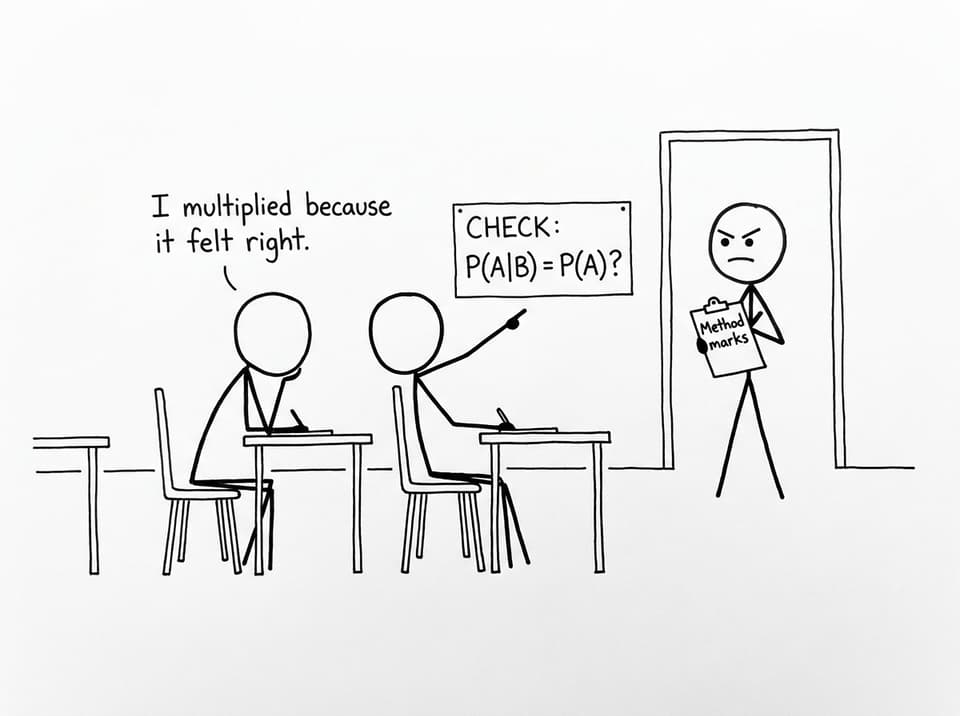
Conditional probability: the fastest independence detector
If you remember one independence test for IB Math, make it this:
[P(A\mid B)=P(A) \quad\text{(independent)}]
In words: if B happening doesn’t change the chance of A, then independence is plausible. If the number changes, dependence is confirmed. This is exactly why IB loves conditional probability: it exposes whether you’re reasoning or guessing.
To build fluency quickly, drill exam-style items from RevisionDojo’s Statistics and Probability Questionbank (Math AI) and compare your setup against markscheme-aligned solutions.
Tree diagrams make dependence visible
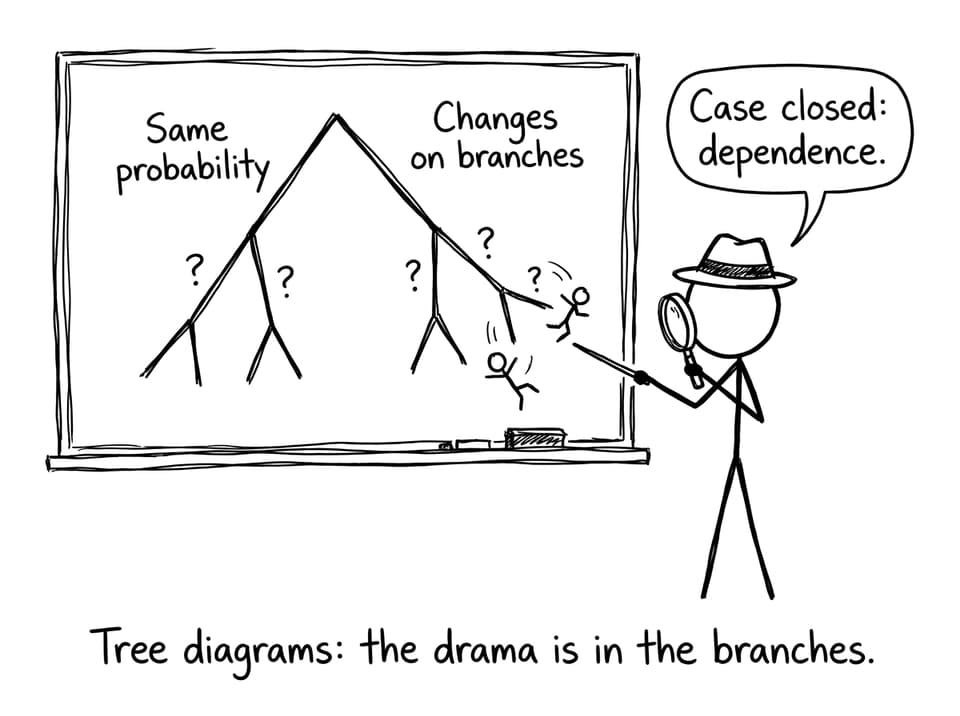
Formulas are compact, but trees are honest. In IB Math, tree diagrams are like a lie detector for independence:
-
If branch probabilities stay the same after the first event, you’re leaning independent.
-
If branch probabilities change, the second event depends on the first.
If trees confuse you under time pressure, keep a dedicated reference open while revising, like How to Use Probability Trees in IB Math AI and the notes on Combined and Conditional Probability Diagrams (AA SL 4.6).
Bring it home: independence is a thinking skill
In IB Math, independence is less about memorising a rule and more about refusing to let convenience decide your method. Once you stop assuming and start checking, probability becomes calmer and more predictable.
If you want to turn that habit into exam performance, build a simple loop on RevisionDojo: review the relevant Study Notes, drill with the Questionbank, then pressure-test your reasoning with Mock Exams and Predicted Papers. Independence errors don’t come from weak calculation skills. They come from unchecked assumptions. Fix the assumption, and the rest of IB Math probability starts to behave.
Further useful hubs: